
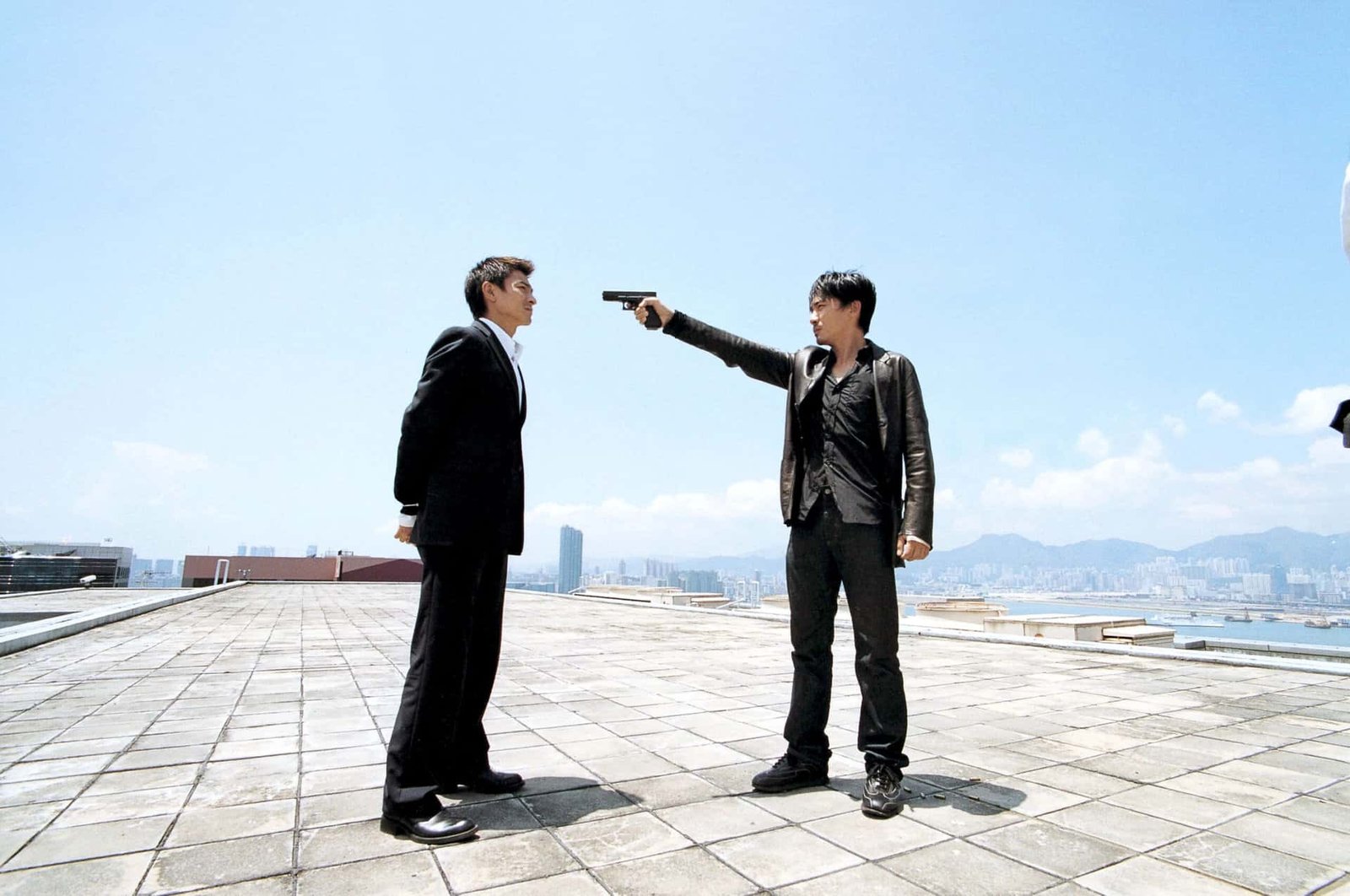
Undercover cop stories have long been a cornerstone of Asian cinema, with Hong Kong setting the pace and Korea following, through a narrative device that allows filmmakers to explore crime, identity, and morality through a particularly tense and often psychologically taxing prism. From the chaotic comedy and the intricate thrillers of Hong Kong classics to the brooding existentialism of South Korean thrillers, the trope has evolved significantly across decades and regions, reflecting not only changes in genre conventions but also shifting social anxieties.
At the heart of these stories lies a fundamental question: how long can one inhabit a false identity before it begins to consume them? Whether through humor, stylized violence, or bleak realism, the films in this list approach this dilemma from vastly different angles. Some lean toward entertainment, emphasizing action and spectacle, while others delve into the psychological toll of living between two worlds, where loyalty becomes fluid and morality increasingly ambiguous.
Here are 13 of the best samples, in chronological order.
1. Fight Back to School (Gordon Chan, 1991, Hong Kong)
When the gun of senior officer Wong Sir at the Special Duties Unit goes missing, he deploys problem officer Chow Sing-sing, who is about to be disqualified, to go undercover into a school to find it. Chow gets paired with Tat, an ageing officer, for the task and the two bicker and fumble their way into the Edinburgh High School in Hong Kong to look for the missing gun.
Clearly a riff on the very popular “21 Jump Street” tv series, “Fight Back to School” is Stephen Chow firing on all cylinders, for a feature that is filled with as many laughs and hilarious action scenes as one would expect from a Stephen Chow work. His chemistry with Ng Man-tat is once again a highlight as the two clearly overage undercover cops struggle to find their footing in the high school with the kids and the adult teachers. The very popular feature went to spawn two sequels in similar settings. (Rhythm Zaveri)

Among the notable crime movies in Hong Kong cinema, “Infernal Affairs” stands as one of the most influential, even inspiring Martin Scorsese’s Oscar-winning remake “The Departed.” Yet, while the remake has its merits, the original remains a masterpiece in its own right. As an ongoing rivalry lingers between law enforcement and the criminal underworld, two men with opposing professions take on secret roles, with Lau Kin-ming posing as a police officer to spy on the Hong Kong Police Force as a mole for Triad boss Hon Sam, while undercover cop Chan Wing-yan infiltrates the Triad as a gangster to monitor Sam’s activity and report to Superintendent Wong Chi-shing. Eventually, the two moles become locked in a tense cat-and-mouse game, each determined to unmask the other while wrestling with their double lives.
Most prevalent, the structure allows for deeper immersion into the dual narratives of Inspector Lau Kin-ming and Officer Chan Wing-yan as they attempt to infiltrate the operations of their opposing organizations. However, this commitment to these undercover roles takes a noticeable psychological toll on both men, as they experience overwhelming stress, further amplified by their efforts to unmask one another. The core theme of “Infernal Affairs” is identity crisis, with Lau coming to embrace his new identity while Chan despises it and yearns to reclaim his true self. Engaging from start to finish, it offers a powerful character drama through its exploration of identity and a thematically rich dive into the grim realities of organized crime. (Sean Barry)
3. Protégé (Derek Yee, 2007, Hong Kong)

With “Protégé,” Derek Yee approached the undercover cop premise through a more intimate and morally corrosive prism, focusing less on action spectacle and more on the erosion of identity that comes from prolonged immersion in the drug world. The story follows Nick, an undercover officer who has spent years infiltrating the operation of a major drug lord, Kwan, to the point of becoming his trusted right-hand man. As the moment to bring the syndicate down approaches, Nick finds himself increasingly entangled not only in the mechanics of the trade, but also in the human wreckage it leaves behind, particularly through his connection with a drug-addicted woman and her daughter.
What makes “Protégé” stand out is precisely the way the undercover role becomes less a police mission and more an existential trap. Nick’s proximity to Kwan gradually blurs the line between duty and identification, while Derek Yee frames the entire underworld with a realism that turns every transaction, relapse, and revelation into something quietly devastating. Rather than presenting the protagonist as a swaggering infiltrator, “Protégé” emphasizes his discomfort, his growing moral ambiguity, and the impossibility of walking away untouched. In that regard, it remains one of the sharpest and bleakest undercover cop movies in Hong Kong cinema.

Dante Lam wowed audiences in 2008 with the crime thriller “Beast Stalker,” which earned multiple award nominations with star Nick Cheung scoring Best Actor prizes from the Hong Kong Film Critics Society, the Hong Kong Film Awards, and the Golden Horse Awards. Unfortunately, Lam’s highly anticipated follow-up “Fire of Conscience” was a letdown in comparison, and “The Stool Pigeon,” released the same year, attempts to recapture the glory by reuniting Nick Cheung and Nicholas Tse, while also adding Gwei Lun-Mei to the mix. Despite these accolades, the result is a depressing, melodrama-heavy crime thriller that feels more like a lateral move rather than a return to form.
In the early goings of “The Stool Pigeon,” we meet the cold-as-ice Inspector Don Li, who risks the life of a criminal informant in order to bring down a notorious gangster. When the raid goes sour and the informant suffers brutal consequences, Li becomes guilt-ridden but continues his questionable tactics. To replace his former snitch, he recruits a soon-to-be-released prisoner, Ghost Jr., promising him money to infiltrate a team planning a major jewelry heist. Once undercover, Ghost Jr. insinuates himself among gang leaders, while forming connections that complicate both his mission and his personal life. (Calvin McMillin)

Winner of the Chinese Film Media Awards for Best Picture and Best Director, among a number of other local and international accolades, “Drug War” is the first Johnnie To action movie to be shot entirely in Mainland China. The story revolves around Captain Zhang Lei, a police officer, and Timmy Choi, a mid-level criminal caught after a car accident and subsequent investigation into a drug trafficking network. In order to avoid the death penalty, Choi agrees to cooperate with Zhang, leading him through a web of connections that includes various figures within the syndicate. As Zhang and his partner pose as criminals to infiltrate the organization, Choi remains an unpredictable presence, seemingly compliant but always hinting at hidden intentions.
Johnnie To directs an agonizing thriller where cops act as criminals in order to dismantle the syndicate from within, with much of the tension stemming from Zhang’s undercover maneuvers and Choi’s constant search for an escape route. This dynamic is elevated by Louis Koo’s performance, which emits a persistent sense of unease, portraying a man who appears submissive yet clearly harbors his own plans. At the same time, the movie does not shy away from presenting the police in bleak terms, as their methods often mirror the brutality of their opponents, while minor comments on the death penalty remain in the background. (Panos Kotzathanasis)

Ja-sung is an undercover police officer, who has ascended the ranks of the crime syndicate to which he was assigned, to the point of becoming the right hand of the number two in the hierarchy, named Jung Chung. However, when the number one is killed, the syndicate is engulfed in a power struggle for the top position, between Jung Chung and Joong-gu, which eventually escalates into war. Ja-sung, who was to retire soon, must now keep acting in his role, since his operator Kang Hyung-chul is set on influencing the leader’s selection, putting a puppet of his at the top of the syndicate. The fact brings tension between the two.
Park Hoon-jung directs an agonizing crime thriller, which contains the usual violence, anti-heroes, impressive action sequences, and stylish gangsters in their suits, along with the much-loved plot twists. However, the movie’s main point of excellence is its characters, with the thin balance that dominates their relationships constantly shifting, in a game of death where nothing is improbable, as it is most eloquently stressed in the finale. Another point of excellence is the acting, with Lee Jung-jae playing the perpetually anxious Ja-sung, Hwang Jung-min excelling as Jung Chung, and Choi Min-sik being great as a cop not so different from the people he is after. “New World” is another Korean masterpiece in a genre where the country does not seem to stop producing works of extreme quality. (Panos Kotzathanasis)

Three lifelong friends, now narcotics officers, are hot on the trail of a wanted criminal. Unfortunately for the heroic trio, one of them is starting to get a bit power-drunk as the man in charge, one is at his absolute breaking point as an undercover narc, and the last is the glue holding them all together. Tin is the superior officer in charge of his childhood buddies, while on the way to taking down Hak Tsai, he is putting one of his best friends, Chow, under tremendous pressure as an undercover operative. That leaves Wai to pick up the pieces as best he can, before the trail leads them toward the fearsome Eight-Faced Buddha and a Thailand operation that changes everything.
Obviously, carnage ensues, while fight sequences reminiscent of John Woo’s earlier work and Johnnie To’s current body of work set off what ultimately becomes the culminating point of the movie, a scene where one of the three Musketeers must decide the fate of his remaining comrades. From that moment on, the brotherhood forged by Wai, Chow and Tin collapses, with the emotionally drained surviving officers going their separate ways until news of the elusive Eight-Faced Buddha resurfaces. The real kicker here is the acting and star power swirling inside “The White Storm,” with Louis Koo, Sean Lau and Nick Cheung essentially saving the day and ensuring that fans of the genre will definitely find something to like. (from supplied review text)

Reiji is possibly the most helpless member of the Japanese police force, and the full-on opening of “The Mole Song: Undercover Agent Reiji,” with a naked Reiji covered only with a fig-leaf-sized piece of newspaper and strapped to the hood of a car driven at top speed, leaves no doubts about the protagonist’s ineptitude and the silly tone of the movie. But, thinking again, who better than an incompetent loser can infiltrate the yakuza without arousing suspicions and carry on a potentially suicidal mission without even realizing? Following this train of thought, Reiji’s superiors recycle him as a mole in the heinous Sukiya-kai yakuza clan, suspected of plotting with the Russian mafia to smuggle a big shipment of MDMA into Japan.
Following the typical manga aesthetics, “The Mole Song” is garish, flamboyant and over the top camp, with relentless and adrenaline-fueled action, one set piece after another, while the slapstick gags and jokes are genuinely silly and hilarious. The movie does not try to be clever, but remains one of those unashamedly entertaining comedies to be taken for what it is. A rather melodramatic spotlight is placed on the brotherhood of blood between Reiji and Crazy Papillon, their bromance becoming pivotal, while Ikuta Toma’s histrionic performance carries the whole thing on his shoulders. In the end, it is still an engaging and well-directed action comedy, a treat for the eyes and a proud addition to Takashi Miike’s light entertainment section. (Adriana Rosati)

Essentially a mixture of Johnnie To’s cinematic style and the story of “Infernal Affairs” with a touch of John Woo’s heroic bloodshed, “Line Walker” aims mostly at entertainment. A Hong Kong police chief who has the identities of all undercover agents in his files manages to protect them by deleting the files before he is murdered. However, this also means that a number of them continue to work unbeknownst to the body of the force. Agent Ding Siu-ka and her handler Inspector Q are working out their names with great success, with the exception of Blackjack, an undercover agent working inside the most notorious drug syndicate of Hong Kong. When they finally trace him to a man named Shiu, the situation grows more and more dire as everyone starts playing everyone else.
The whole twist about who Blackjack is becomes a point of agony for everyone involved, while the humoristic interactions between Q and Siu-ka, who are obviously more than colleagues, add a very pleasant note of comedy to the whole thing. At the same time, the agony about the discovery of the moles and the non-moles, and who among the bad guys will get killed in the madness dominating Tung Pak-ho’s triad, adds a very appealing sense of tension that carries “Line Walker” from beginning to end. The combination of crisp editing, Chin Kar-lok’s stunt coordination and well-placed slow motion results in a series of action scenes that are quite impressive to watch, while Francis Ng, Charmaine Sheh, Nick Cheung and Louis Koo cement the excellent casting. It may not be a masterpiece of the category, but it is definitely a fun movie. (Panos Kotzathanasis)

“The Merciless” plays with the form and function of the South Korean gangster genre, centering on veteran actor Sol Kyung-gu as Han Jae-ho and Im Si-wan as Jo Hyun-soo, his closest confidant in what proved to be a breakout role. The two men meet while they are both in prison, when Jo prevents a hit from being carried out on the older man. Their relationship is formed through and by violence, both inside and outside prison, and the key narrative enigma is embodied by Jo, whose frighteningly violent veneer appears to be masking a vulnerability that can only be negated through acts of increasing brutality. The result is an immoral anti-hero for whom even the homosocial bonds of the gang are not sufficient to command loyalty and obedience.
From the opening scene, with its imagistic grammar of excess and disorientation, the cinematography is exquisite, using a tonality of difference to mirror the theme of surfaces and the hidden depths that lie beyond them. The color palette oscillates between saturation and desaturation, helping to differentiate the overlapping time frames through which the story is told. The action is always motivated, the camera remains mobile without becoming intrusive, and Im Si-wan manages to combine the vulnerable and violent aspects of Jo seamlessly in what is the outstanding performance in the movie. “The Merciless” is one of the best examples of just how good South Korean cinema can be at its very peak. (Colette Balmain)

Erik Matti is one of the most recognizable and crucial figures of the Filipino film industry, with works like “On the Job,” “Honor Thy Father,” and “The Aswang Chronicles” highlighting his range, and “BuyBust” coming to further establish his prowess in genre filmmaking through a massive production that included hundreds of stuntmen and extras. The story centers on Nina Manigan, a member of an elite anti-narcotics squad who survives a previous disastrous mission and is now tasked with another operation in the slums of Manila. Alongside a specialized team and a captured asset, Teban, the group attempts a buy-bust against a powerful drug syndicate, only for the mission to spiral out of control as they find themselves surrounded by enemies and betrayed from within.
The narrative initially builds tension, but once the action shifts to the slums, the movie transforms into a relentless barrage of violence, with hand-to-hand combat, firearms, and improvised weapons dominating the screen. Erik Matti also incorporates commentary on the War on Drugs and police corruption, although this aspect remains somewhat buried beneath the sheer intensity of the action. Neil Derrick Bion’s cinematography creates a claustrophobic atmosphere, enhanced by dynamic color schemes, while Jay Halili’s editing ensures a rapid pace that aligns perfectly with the film’s aesthetics, particularly during standout sequences such as the extended single-take fight in the rain.

Saving grace comes from South Korea, in the form of Lee Byeong-heon’s action comedy “Extreme Job,” which works superbly on both levels, being properly tense and funny-to-die, while also adding satire and social insight in its subtext. The plot revolves around the team of incompetent narcotics detectives led by the jaded Captain Ko and consisting of an equally jaded surveillance expert, an apparently crazy detective, a rookie too fired up to prove himself, and the only female member of the team. Their target is a notorious gangster rebuilding his old crew, while the gang’s inner circle is located in a building across the street from a fried chicken joint that is about to close. The team then comes up with the brilliant idea to buy the place and make it the center of their stakeout mission.
What does not seem like a bad plan soon spirals in hilarious fashion, since the business reaches sudden and unexpected success thanks to Detective Ma’s cooking abilities, and what seems to be a cure for their ailing finances might prove counterproductive for the case they are supposedly working on. As the plot progresses, starting with quite physical comedy and then developing a smart context, it ends in an orgy of unbelievable laugh-out-loud moments and choreographed violence. “Extreme Job” works on so many levels, with the pace not functioning as a trick to cover plot holes but as part of a rhythm that is simply amazing. In that and every other sense, it is an enormous success and probably one of the best and most hilarious comedies in years. (Marko Stojiljković)
13. The Prison (Na Hyun, 2019, South Korea)

The incarcerated Jung Ik-ho rules the prison he’s in while running a nationwide crime syndicate from the inside where he sends his fellow prisoners out at night to commit crimes across the country. When former cop Song Yoo-gun, who had a 100% arrest rate, is sent to prison on hit-and-run, he eventually ends up joining them and slowly rises through the ranks within the syndicate.
To add this film to this list is a spoiler in itself, as “The Prison” spends a majority of its time as a crime film about Yoo-gun’s rise within the syndicate before revealing him to be a mole, but it is nonetheless a very strong film that does a lot of things well, including its very well executed set pieces with strong performances and production values. Performances are strong across the board, with Han Suk-kyu and Kim Rae-won both impressing as expected, while the twist, though not entirely unpredictable, is deftly handled. (Rhythm Zaveri)



