
Updated March 27, 2026 04:12PM
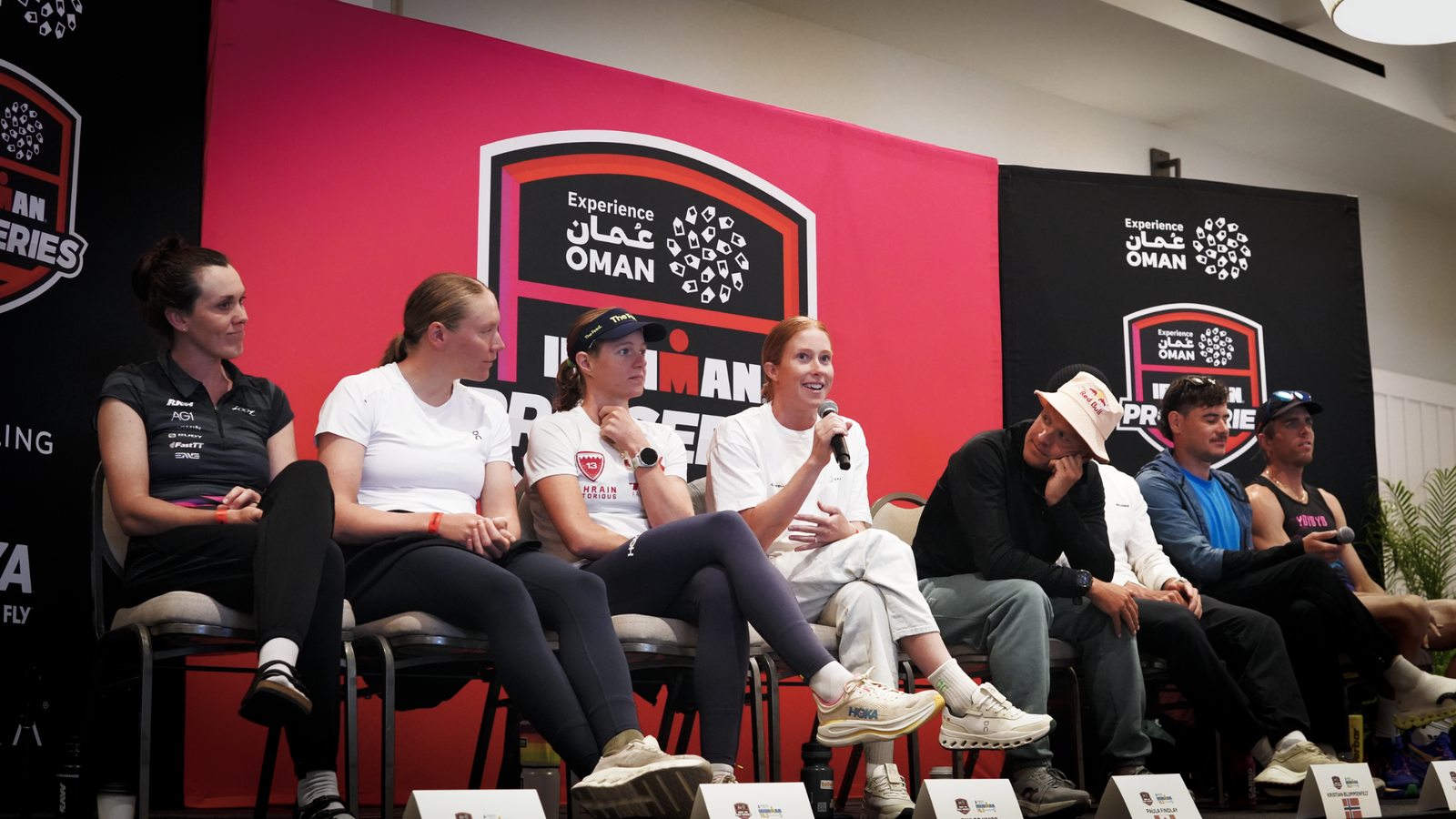
Pre-race favorite Kristian Blummenfelt (NOR) shares his drive to win and his pre-race prep for Oceanside six days after winning a run battle at Ironman 70.3 Geelong, Taylor Knibb (USA) shares a redefined “why” as she kicks off her season, Paula Findlay (CAN) speaks to defending her Oceanside title, Jackie Hering (USA) and Sam Long (USA) share how being a parent makes them better athletes, reigning Ironman World Champ Solveig Lovseth (NOR) teases the Norwegian trio (Blummenfelt, Gustav Iden, and 2025 Kona champ Casper Stornes) about their tolerance for cold water, and Iden shares his mentality when faced with setbacks.
There was a lot packed into 40 minutes at the Ironman 70.3 Oceanside pre-race pro press conference, held in the Seabird Hotel’s Grand Coastal Ballroom across from the pier in downtown Oceanside. Many pros found out during the press conference that there will be no speed zone on Basilone Road in Camp Pendleton (the bike course change had been announced, but not all the pros had heard). The road was repaved, and there is still a no-pass zone, but without a speed cap, some athletes’ strategies will change on the bike.
With a stacked field, including more than 100 pro triathletes lining up for the third race (and first North American race) in the 2026 Ironman Pro Series, the conference was a lighthearted glimpse into the training, racing, and mindsets of some of the best athletes in the sport early in their season.
Here are the bits worth knowing.
Kristian Blummenfelt (NOR)
On his approach to racing: “Well, I always like to target every race and try to dig as deep as I can, and I race to win, even if it’s a world championship race or a small race. I feel I have to give my best out there. And yeah, I don’t really know why it’s like that, but I guess I’m just built like that.”
On racing back-to-back weekends: “One of the days, [I was] traveling all night and just pressing getting back into training again. And it’s almost like a perfect time between two races. You know, it’s enough time to rest, and since it’s only six days in between, I can’t do too much hard training. So it’s more like just keeping the body going and then sort of resting into tomorrow.”
On how to approach Oceanside: “What’s special here is the bike course, and the fact that it’s quite bumpy. So I think I learned last year that I do have to be placed better on the road, and tightening the bottles quite well as well, adding on some elastic bands to make sure that I’m not losing any nutrition because that can be costly on the run.”
Paula Findlay (CAN)
On returning to Oceanside: “It is early in the season, but it’s really hard to not come to this race. I love it. It’s my favorite one of the year. I always in the middle of the race think, ‘Why am I doing this? This is so hard.’ A shock to the system, but the vibes here, the course, the support when you’re on the course, especially the run, is always immaculate. … I’m not in my best shape all time, but I think in March, that’s OK. I’m excited to kind of see where I’m at and race this super awesome field.”
On defending her title and how the sport has changed: “I think the sport changes every year. It gets faster and faster. … Having Solveig and Taylor here and some other women that are up and coming makes the field more competitive. And the addition of the Pro Series has made kind of every race competitive. You can’t really go to a weak race anymore, and I don’t know I’ve been here so many times. I look back at pictures of when I was here, like in 2018, 2019, and looking at my bike position and coming into these races injured at some points. And I’ve been through it all, and I think we’re all continuing to get faster and faster. It doesn’t really change how I approach it. I just try to be as prepared as I can be, but it’s definitely a little more intimidating every year with the fields getting so strong.”
Taylor Knibb (USA)
On reassessing her “why”: “I had to go through a little bit of a process of recognizing that my why had shifted because I think I had achieved my why. And then there was, like, a bit of incongruity last year, because I was fighting it. And so then at the end of the season, I really sat down. It’s like, ‘OK, I need to reassess. Why am I doing this work still? What do I want to do?’ and then, I feel like I’m a bit more aligned and at peace this year, so we’ll see how that goes. But yeah, it’s a really fun process to get to try to be your best, and at some points of your career, your life, you might have the balance. But also, like, this is my focus, this is what I do. This is what I build my life around. And I think that’s what that’s an incredible privilege. And being able to do that and go all in and, like, see what you can do, it’s really fun. And you know what? Like, sometimes you do well, sometimes you’ll end up sitting on the side of the road and, like, anywhere in between, and that’s part of it, because without the ability to fail, the achievements don’t really mean much.”
Gustav Iden (NOR)
On dealing with injury and not racing in Geelong or New Zealand: “I don’t think it’s a good thing to be used to being injured, but I feel like over the last three years, I’m getting quite used to it. So, yeah, I never really twisted my ankle before. And I think my tendons are made of steel or something, because when it first snapped there, it was really, really painful, and then it took a long time to get back, and I’m still not 100% there. I’m not running as much as I want to but, yeah, it is challenging to have these constant setbacks. But to be honest, after what I’ve been through earlier, this is quite minor, I would say to cancel a trip to Australia and New Zealand is, yeah, not that difficult. It would be nice to race there, but to have a little bit more time to build up and change plans, it’s not that bad.”
Casper Stornes (NOR)
On how he’s feeling about Oceanside: “I don’t see myself winning here maybe not this time. I’m not in the best shape, but if I get a podium here, I’m quite happy. I’m struggling a little bit with my Achilles. But yeah, it’s gonna take a very good performance.”
Solveig Lovseth (NOR)
On being in Oceanside: “It’s really good to be here. First of all, I’ve heard that the water is really, really cold. The boys were complaining so much last year. … But the water is fine, so I don’t know why they’re complaining.”
On kicking off her season: “I just really look forward to getting the season started now. It’s been many months, so just training back home, and the training has been really consistent, so it’s good to just see where I’m at at the moment. I’m just excited to race again.”
Jackie Hering (USA)
On being a pro triathlete and mom: “I have two kids, an 8- and a 10-year-old, and so I’m here representing the moms. I encourage all my younger pro triathlete ladies, that it is great to have a family, and it really does help you be better. … It’s tricky, because balance kind of comes and goes depending what part of the season you’re in. Obviously, right now it’s kind of race season, so I’m gone a lot more than during the winter. But yeah, it’s about having the support of your family, having a lot of people on board who are helping you out, especially like my husband, who holds down the fort so I can come race. And yeah, it’s just about getting everyone on board and really not wasting time and focusing when you need to do your workouts, and then when you’re done with your workouts, just you got to switch on to mama.”
On the Pro Series: “I love the Pro Series. It truly like reinvigorated me as far as racing full Ironmans. I was on a break, and the Pro Series is what got me back into it. And I just love the challenge of putting together three full Ironmans and the two best half Ironmans you can. So my mindset going into the races is just do the very best I can and lose as little amount of time as I can to the people who’s ever in front of me, and it’s. Really nice, because it kind of dilutes the pressure of each individual race, and you can just focus on your own best effort on that day.”
Sam Long (USA)
On being a pro triathlete and dad: “Everything’s had to change, especially now as a father of two, we’ve got a 4-month-old back there. So this winter has been kind of crazy in a lot of ways, and in the best of ways as well, because I think with one [kid], my wife was able to really do the vast majority, and she still does the vast majority. … We’ve been doing potty training and sleep regressions, million things and yeah, and then daycare sickness, and so it’s like training and racing all seems quite simple in comparison to that, to be honest. … But it’s made me, like Jackie said, incredibly, incredibly time efficient, having to cut out anything that’s excess, that’s extra, and weirdly enough, you would think it would make you a worse triathlete, because it’s like, you don’t have as much time, you don’t have as much energy. You’re never sitting on the couch watching Netflix. But for some reason, it gives you this drive deep inside … and that’s what you rely on to then be a better athlete.”
On the competition in Oceanside: “When you’ve got to race the best guys in the world, and you’ve got to see where you really stand, that’s the process of why I’m here. So, like, I’m gonna put out my best effort no matter what. I hope to put out the best race in my life, and I hope to put out the best effort I’ve ever put in Oceanside. Do I know if that will win? No, in a way, do I even care? Like, if I put out my best race effort, then, you know, maybe it wins. And at the end, I want to see how close I am and how much more work I have to do this year.”



