
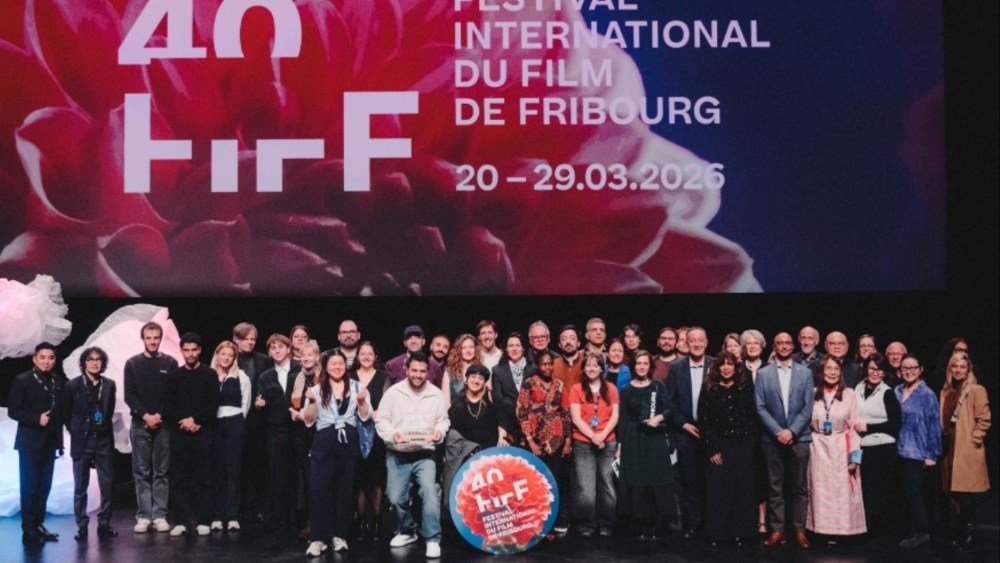
As it marked its landmark 40th edition, Switzerland’s Fribourg Intl. Film Festival leaned into the qualities that have long made up its DNA: a strong public audience, politically engaged programming, and a deep commitment to cinema often underrepresented on European screens, all while quietly expanding its scope.
Running March 20–29 in the Swiss city, this year’s edition drew more than 51,000 admissions to screenings in person and online in a city with a population of just 40,000, reinforcing the festival’s established relationship with its local audience. Rather than functioning as a marketplace or industry hub, FIFF continues to operate as a curator-driven, audience-facing festival where films are seen, shared and debated in theaters and around the city.
Across its juries, new initiatives, and award winners, the anniversary edition offered a clear snapshot of a festival refining, rather than reinventing, its identity.
“Divine Comedy”
At 40, FIFF Sticks to Its Core Mission
If this anniversary edition suggested renewal, it did so without moving away from the principles that have shaped the festival for decades. The expansive lineup once again centered films from parts of the world that remain underrepresented on European screens, particularly across Africa, Asia and Latin America, including a spotlight on Colombian cinema, while also making room for work emerging from conflict zones and politically fragile contexts.
For artistic director Thierry Jobin, that remains the foundation of the event. “The festival was born as a window on the world, a window on the global South,” he told Variety, noting that FIFF still seeks out films “that had to be made.”
The impact of FIFF on participants over the years was apparent in the videos sent by past filmmaker attendees played during the closing ceremony from Iran, Morocco, India and China.
Looking to the future, the festival’s evolution is less about reinvention for the sake of reinvention and more about continuing to build on a model based on sharing cinema with its loyal, and expanding, audience.
A New Award Signals Institutional Ambition
The introduction of the Fribourg Cinema Award marked one of the clearest signs of evolution in this edition of FIFF. Launched in collaboration with the University of Fribourg, the lifetime achievement award, together with an honorary degree, aims to recognize filmmakers whose work engages with contemporary social and political issues. Its inaugural recipient, chosen unanimously by the jury, Tunisian director Kaouther Ben Hania (“The Voice of Hind Rajab”), reflects that positioning by recognizing her work bridging documentary and fiction while addressing some of the most pressing questions of our time.
More than a ceremonial honor, the award signals FIFF’s growing ambition to assert itself within a broader conversation both locally and internationally, treating cinema not just as an art form, but as a way of studying and examining contemporary issues.
Accepting the award, Ben Hania, who described herself as “an eternal student,” said she makes films “to learn … each film is like doing a PhD.”
Fewer Films, More Visibility
FIFF’s relatively compact lineup is also part of what sets it apart. In recent years, the festival has reduced the number of films it screens, a shift that has made each title more visible within the program. Rather than competing with dozens of overlapping premieres, films tend to circulate more widely among audiences, creating a shared point of reference across the festival. “By putting on fewer films, we had more audience,” said Jobin. “People more often see the same films, giving each film a more precious place.” That dynamic was visible with the audience award winner, Georgi M. Unkovski’s “DJ Ahmet,” which built strong word of mouth across the festival and is set to open in Swiss theaters next week. The result is a program where individual titles can break through, building momentum and generating discussion across the festival.
A Different Kind of Jury System
One of the more distinctive aspects of FIFF is the way it structures its juries. Alongside the international jury of industry vets, the festival brings in a youth jury, a seniors’ jury, an ecumenical jury composed of members from different faith traditions, as well as juries composed of students and artists from other disciplines, many of whom are not industry professionals. This mix of perspectives shapes a prize list that goes beyond insider opinion. The result is a range of winners that don’t always line up, showing how differently films land depending on who’s watching. At a festival built around its audience, that feels intentional. Instead of separating public reaction from official awards, FIFF builds it directly into the process.
Awards Reflect a Politically Engaged Lineup
The awards largely mirrored the tone of this year’s program, with several of the top prizes going to films shaped by political pressures. The Grand Prix went to Ali Asgari’s “Divine Comedy,” a satirical look at censorship and bureaucracy in Iran, while the Special Jury Award honored “My Father’s Shadow” by British-Nigerian filmmaker Akinola Davies Jr. Ukrainian cinema also featured prominently, with Zhanna Ozirna’s “Honeymoon” picking up both the critics’ choice and youth jury awards. In the short film competition, “Prehistoric” by Iranian filmmaker Armin Etemadi took the top prize, continuing a run of wins for Iranian shorts at the festival.
In accepting their awards, several of the filmmakers spoke directly about the situations in their home countries, whether in Iran or Ukraine. Asgari, for example, who was unable to attend the festival, sent a video message asking for a minute of silence for victims of political violence in Iran in lieu of applause. Together, the awards underscored a festival where films don’t just screen, but continue to resonate beyond the screen.



