
Fifty-eight candidates who want to represent New Jersey in Congress met Monday’s deadline and filing requirements to run in June’s primaries, with political observers predicting a rough road for Republican incumbents and challengers alike as President Donald Trump’s popularity sags.
While eight incumbents face no primary challengers, four do — and all of New Jersey’s 12 House races have contested primaries for one major party or the other, except South Jersey’s 1st Congressional District, where incumbent Rep. Donald Norcross (D) and Damon Galdo (R), a conservative podcaster, have no challengers.
Some races brim with competition, with the most crowded contest in Central Jersey’s 12th Congressional District, which covers parts of Mercer, Middlesex, Somerset, and Union counties. There, 13 Democrats are vying for their party’s nomination in the race to replace Rep. Bonnie Watson Coleman, a six-term Democrat who is retiring.
Nationally, hopes are growing among Democrats that they might flip enough seats to gain control of both the House and the Senate after November’s mid-term elections.
Predictions of a Democratic wave, spurred by Trump’s approval rating dipping to record lows, even drove many New Jersey Republicans to sit this one out, said Dan Cassino, a professor of government and law at Fairleigh Dickinson University, and the executive director of the FDU Poll.
“Republicans are expecting a wave election in the fall. Because they’re expecting a wave election, the highest quality challengers don’t bother to run, which creates the wave election whether it was already going to happen or not. It becomes a self-fulfilling prophecy,” Cassino said. “At the same time, Democrats come out of the woodwork to run.”
Of the 53 House candidates who met New Jersey’s filing requirements this week, just 15 — less than a third — are Republicans.
Cassino also pointed to the 8th Congressional District in North Jersey, a seat now held by Rep. Rob Menendez. The two-term Democrat will face one Democratic challenger, Mussab Ali, in the primary — but no Republicans filed to run, making this the only race with no GOP candidate.
“I don’t know the last time we had a congressional race in Jersey where a major party just didn’t bother to nominate anyone,” Cassino said. “Sure, oftentimes they’ll put up a sacrificial lamb. But just not even bothering to put anyone up? That’s a bad sign.”
In New Jersey, observers consider Republican Rep. Thomas Kean Jr. the most vulnerable of New Jersey’s three House Republicans as he runs for a third term in the 7th Congressional District, one of the state’s swingiest districts. Four Democrats are looking to take him on, with Rebecca Bennett, Michael Roth, Tina Shah, and Brian Varela meeting the filing requirements to get on June’s Democratic primary ballot.
In the Senate, incumbent Sen. Cory Booker, a Democrat now running for a third six-year term, is running unopposed in his party’s primary. He has four GOP challengers, but pollsters predict Booker will easily win.
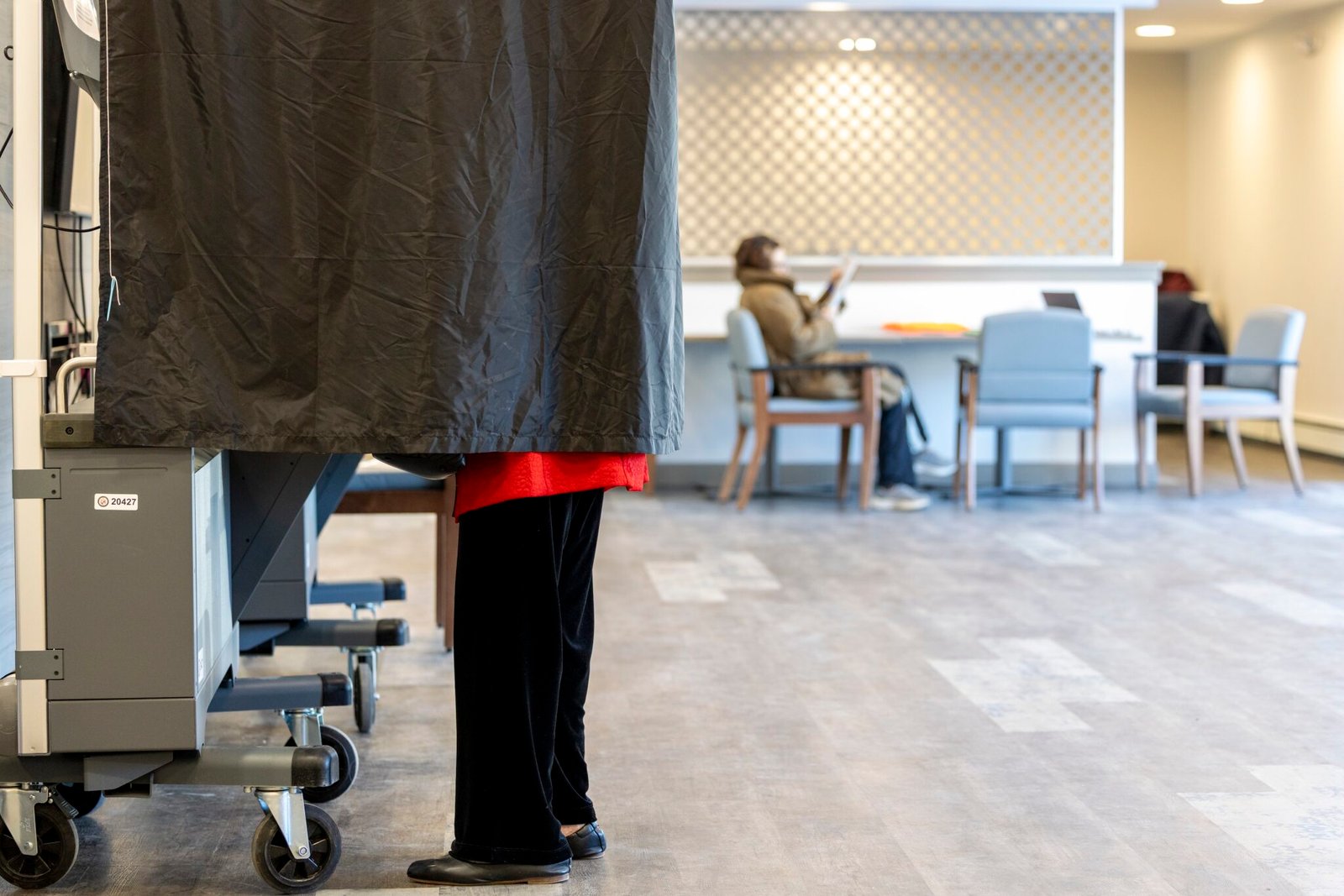
June 2 is primary day, with a six-day early voting period starting May 26.
The big picture
The coming primaries are the first for New Jersey’s congressional delegation since state legislators last year hiked the number of signatures candidates need to get on the ballot. The change was controversial, with supporters saying it will weed out frivolous candidacies and critics complaining it protects incumbents and makes it harder for people to run for office.
Some candidates who filed this week barely met the new signature threshold, and that’s likely to prompt petition challenges that could winnow the field further, said Micah Rasmussen, director of the Rebovich Institute for New Jersey Politics at Rider University. Under the new law, major-party House candidates need 500 signatures, up from 200, to get on the ballot, while those seeking statewide office, including U.S. senators, need 2,500 signatures, up from 1,000.
“I definitely see a number of candidates who are right at that 500 line and may be susceptible to a challenge. So the way we’re looking at things right now may not be all the candidates who wind up being on the ballot by the time we get through that traditional next step of signature challenges,” Rasmussen said. “It was definitely something that presented a new challenge for candidates.”
Candidates have until Thursday afternoon to fix defective petitions and Friday afternoon to challenge petitions. Such challenges will be decided by April 1.
Those eying office have campaigned on an exhaustive list of issues, but Rasmussen sees common themes — especially in Democrats’ campaign slogans — that center largely on affordability and resisting Trump.
“A lot of the Democrats who are running this year are talking about fighting Trump or fighting MAGA or opposing the war. There are a couple of doctors, physicians, who are running, and they talk about ‘health care, not bombs,’” Rasmussen said. “And you’re still seeing a lot on affordability.”
Cassino agreed that anti-Trump sentiment has dominated campaign messaging, even as the chasm between establishment and progressive Democrats continues to widen in New Jersey.
“Oftentimes, we will see in primaries: ‘I am more electable than this other candidate.’ We’re not really seeing that. It is about candidates who are trying to channel the anger and channel the disappointment with Donald Trump more than anything else,” Cassino said.

The races
Two races — in Kean’s and Watson-Coleman’s districts — are likely to hog the most attention, pundits agree.
Who will win the Democratic primary in Watson-Coleman’s district remains wholly unpredictable, because establishment support has split so much that outsiders have a real chance of winning — much like what happened in last month’s special Democratic primary for Gov. Mikie Sherrill’s old House seat, Rasmussen said. In that race, progressive activist Analilia Mejia beat former Rep. Tom Malinowski, an establishment Democrat widely favored to win.
“It’s a Democratic district, a Democratic year, and you also have an open seat. When you don’t have to take on incumbency, which gives a significant advantage, that is when we typically see a lot of people want to take on those open-seat opportunities, which don’t happen very often,” Rasmussen said. “When more candidates run, they have to share their lane, and when they share their lane, it really creates an opportunity for an outsider that wouldn’t otherwise maybe exist if there was just one organizational favorite. I think it leaves this primary race without a favorite.”
The Democrats running there are: Assemblywoman Verlina Reynolds-Jackson; East Brunswick Mayor Brad Cohen; Squire Servance, a patent and life sciences attorney; Samuel Wang, a neuroscientist and Princeton University professor; Sue Altman, former head of the New Jersey Working Families Alliance who was Sen. Andy Kim’s state director until January; technology consultant Sujit Singh; Plainfield Mayor Adrian O. Mapp; plastic surgeon Adam Hamawy; Trenton entrepreneur Elijah Dixon; Kyle Little, who owns a fitness business; Jay Vaingankar, an energy adviser in the Biden White House; Matt Adams, a former Middlesex councilman and retired U.S. Army Reserves lieutenant colonel; and Shanel Robinson, a Somerset County commissioner.
Republican Gregg Mele, an attorney, is running unopposed in his party’s primary for that seat.
In Kean’s district, he has faced recent criticism for his failure to stop federal authorities from buying a massive warehouse in Roxbury where they plan to open an immigrant processing and detention facility. State and local officials are suing the Trump administration to stop the facility from opening.
“I think Kean is the only one who has a serious vulnerability, and I think Tom Kean knows that too,” Cassino said. “He’s doing his best to stay out of the limelight and not give voters a reason to turn against him. I mean, he just doesn’t talk to people. And that’s a strategy that’s worked out for him so far.”
Kean has no challengers in the GOP primary. Four Democrats are seeking their party’s nomination in the primary to challenge Kean in November’s general election: Bennett, a military veteran and health care administrator; Roth, who briefly headed the Small Business Administration under former President Joe Biden; Shah, a pulmonary and critical care physician; and Varela, an entrepreneur.
The other contested primaries in New Jersey’s House races are:
- Four Democrats want to challenge Republican Rep. Jeff Van Drew, the Republican incumbent looking to land a fifth term representing South Jersey’s 2nd District. They are: Tim Alexander, a civil rights attorney and former detective in the Atlantic County Prosecutor’s Office; Cape May Mayor Zack Mullock; Terri Reese, a former retail manager; and Bayly Winder, who has worked in foreign affairs, national security, and crisis management. The GOP primary is uncontested.
- Three Republicans will run in the GOP primary in hopes of challenging Rep. Herb Conaway Jr., the Democratic incumbent in South Jersey’s 3rd District. They are: Burlington County contractor Justin Barbera; Jason Cullen, a packaged-goods manager; and Michael McGuire, a divorce lawyer and former New York Police Department cop. Conaway has no Democratic challengers.
- Two Democrats will square off in the primary to take on GOP incumbent Rep. Chris Smith in the Jersey Shore’s 4th District. They are: electrician John Blake and Rachel Peace, a single mom and environmental advocate. Smith has no GOP challengers.
- Two Republicans are making bids for their party’s nomination in North Jersey’s 5th District, where Democrat Rep. Josh Gottheimer is seeking a sixth term. They are: John Aslanian and Sean Kirrane, both entrepreneurs. Gottheimer has no Democratic challengers.
- Two Democrats hope to topple Rep. Frank Pallone Jr., the Democratic incumbent who’s seeking a 19th full term in the 6th District, which covers parts of Middlesex and Monmouth counties. They are: Katie Bansil, who works in finance, and John Hsu, a progressive activist and former software engineer. Hillary Herzig is running uncontested in the GOP primary.
- Two Republicans are vying for their party’s nomination to challenge Democratic incumbent Rep. Nellie Pou in the 9th District, which covers parts of Bergen, Hudson, and Passaic counties. They are: Tiffany Burress, a personal injury attorney, and Clifton City Councilwoman Rosemary Pino. Pou has no Democratic challengers.
- LaMonica McIver, the embattled Democratic incumbent in North Jersey’s 10th District, will face one Democratic challenger in the June primary, Lawrence D. Poster, a political newcomer campaigning as a “Democrat for the Middle Class.” The GOP primary is uncontested. Carmen Bucco is running uncontested in the GOP primary.
- Three Democrats will challenge Mejia in June’s Democratic primary in the 11th District, which includes towns in Essex, Morris, and Passaic counties. Mejia’s Democratic challengers in June’s primary are: software engineer Joseph Lewis; Chatham Councilman Justin Strickland; and former Morristown mayor Donald Cresitello. Joe Hathaway is running uncontested in the GOP primary. Mejia and Hathaway are competing in an April 16 special election to fill the vacancy in this district until Jan. 3, 2027.
In the Senate, four Republicans are seeking their party’s nomination to challenge Booker in the fall. They are: former TV news reporter Alex Zdan, New Jersey state trooper Richard Tabor, otolaryngologist Robert Lebovics, and former Tabernacle Deputy Mayor Justin Murphy.
GET THE MORNING HEADLINES.



