
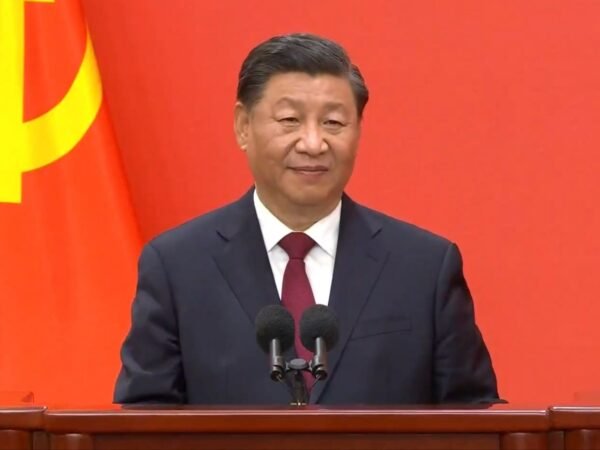
The dawn of 2026 arrived in the Taiwan Strait with a thunderous dissonance. On the water, the People’s Liberation Army (PLA) was concluding Justice Mission 2025, a massive exercise involving 89 warplanes, drone swarms, and blockade simulations that Taipei rightly characterized as an unprecedented escalation. Yet, on the airwaves, President Xi Jinping’s New Year’s address offered a different frequency. While he reiterated that reunification is “unstoppable,” the context was not one of imminent fiery conquest, but of cool, historical inevitability.
For defense planners in Washington and Taipei, the impulse is to merge the drills and the speech into a single signal of accelerating aggression – a countdown to a D-Day scenario. Such a reading is superficially correct but strategically flawed. By misinterpreting Beijing’s confidence as urgency, the West risks preparing for the wrong war.
From the vantage point of Beijing, the “unstoppable” rhetoric is not a prelude to a sprint, but the settling in for a marathon. By framing reunification as a “trend of the times” (shishi) – a classical Chinese concept blended with Marxist historical determinism – Xi is subtly decoupling the Taiwan issue from immediate military timelines. In the Chinese government’s lexicon, “historical inevitability” acts like gravity. If the outcome is guaranteed by the laws of history, one does not need to force it violently today; one simply needs to grow massive enough to let gravity do its work.
This perspective reveals the true function of Justice Mission 2025. To the Western observer, these drills look like invasion rehearsals. But viewed through the lens of strategic patience, they serve primarily as an “access denial” shield. Their strategic goal is to freeze the status quo and lock out external interference – specifically from the United States and Japan. By establishing a credible ceiling on Taipei’s international space through military pressure, Beijing secures the perimeter.
Behind this shield, the real work begins. The bulk of Xi’s New Year address was not fixated on the Taiwan Strait, but on the “engine” of national rejuvenation: the launch of the 15th Five-Year Plan (2026-2030). His focus on “New Quality Productive Forces” – the Communist Party’s terminology for dominance in artificial intelligence, quantum computing, and green energy – is the tell. The leadership in Beijing understands a truth that Western hawkishness often obscures: China cannot successfully absorb Taiwan if it loses the broader war for economic and technological stability.
Therefore, Xi’s “unstoppable” narrative is a calculated maneuver. It buys him the political space to prioritize these complex domestic challenges without being accused of weakness on sovereignty. It signals a shift from the reactive urgency of the 2022–2024 period to a strategy of confidence. This effectively rebuts the Western “Peak China” theory; Xi is asserting that China has not peaked, and that its leverage will only grow with time.
Furthermore, the newfound emphasis on “Taiwan Recovery Day” (October 25) – linking the island’s status to the anti-fascist victory of 1945 – is a move to fortify the moral legitimacy of Beijing’s claim. By shifting the narrative from a prolonged civil war dispute to a matter of post-WWII international order, Beijing is engaged in a “memory war.” This reframing portrays American intervention not as the defense of democracy, but as the disruption of the anti-fascist peace. This “ritualization” of the conflict allows the Communist Party to demonstrate resolve through high-profile historical gestures rather than high-risk military gambles.
The danger for the West lies in mistaking this patience for passivity. A patient China, focused on correcting its internal economic vulnerabilities and dominating critical technologies, is a far more formidable competitor than a rash China seeking a premature military showdown. The 15th Five-Year Plan is designed to make China sanction-proof. An invasion today would be catastrophic, but an “integration” in 2035, backed by overwhelming economic gravity, is the scenario Beijing is building toward.
If Washington continues to view every PLA movement solely as a precursor to an amphibious landing, it plays directly into Xi’s hand – expending resources on a kinetic conflict that Beijing hopes to avoid, while missing the deeper, structural contest for comprehensive national power. Xi has bet his legacy not on a roll of the dice in the Taiwan Strait, but on the “inevitable” current of history. He intends to win without fighting. The question is whether the West has a strategy to counter a rival that is willing to wait.



