
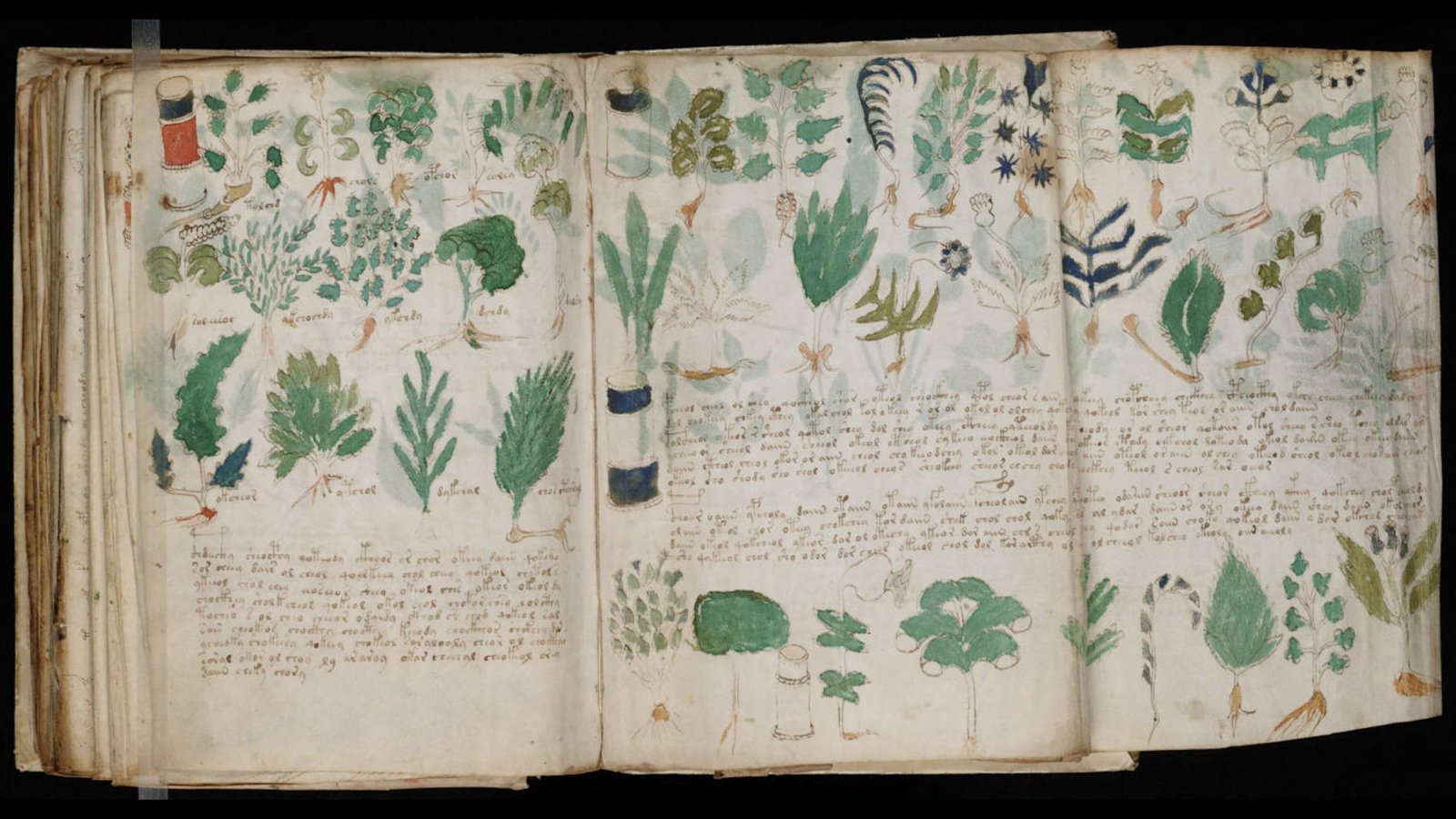
Mysterious Voynich Manuscript May Be a Cipher, New Study Suggests
For more than a century, the Voynich manuscript has fascinated scholars, cryptographers, and conspiracy theorists alike. Filled with strange illustrations and written in an unknown script, the medieval book has endured as one of history’s great linguistic puzzles.
Now, a new study has revived one of the most persistent ideas about the manuscript: that it may, in fact, be a sophisticated cipher.
🌿 What Exactly Is the Voynich Manuscript?
The manuscript is a 240-page vellum book, carbon-dated to the early 15th century. It contains:
strange botanical drawings of plants that don’t exist
charts resembling astronomy or astrology
bathing women in elaborate tubes
pharmaceutical-style diagrams
The writing — in what is now known as “Voynichese” — has never been conclusively decoded.
The manuscript gets its modern name from Wilfrid Voynich, a rare-book dealer who purchased it in 1912.
🔍 The New Study: Cipher, Not Language?
Many earlier theories suggested the manuscript might be:
a forgotten natural language
a hoax with meaningless text
glossolalia (automatic writing)
encoded Latin or Italian
or something symbolic, not linguistic
The new study takes a different approach. Using modern computational analysis, the researchers investigated whether the text shows structural patterns typical of a cipher system.
Their conclusion:
The manuscript behaves less like natural language
and more like deliberately transformed text.
Key findings include:
✔ repeating patterns that resemble substitution cipher behavior
✔ structural consistency — suggesting intentional encoding
✔ absence of grammatical markers typical of real languages
✔ repetition that appears controlled rather than random
In other words, it may not be nonsense — but rather meaningful text that has been systematically obscured.
🧠 What Kind of Cipher Could It Be?
Researchers suspect something akin to:
a homophonic substitution cipher (where one letter can map to several symbols), or
a multi-stage cipher combining substitution and transposition
Both were known — and used — in Europe during the Renaissance, often for diplomacy and medicine.
This possibility aligns with one long-standing theory that the text could encode medical or herbal knowledge meant to stay secret.
⚠️ But Not Everyone Agrees
Other scholars warn against jumping to conclusions.
Critics argue:
pattern-spotting software can force structure onto almost anything
earlier “decodings” have repeatedly collapsed under scrutiny
the manuscript’s illustrations may reflect fantasy, not science
a well-crafted hoax would also produce statistical consistency
And perhaps most importantly:
No one has yet produced a translation that withstands peer review.
Until that happens, the field remains cautious.
🧬 Why the Voynich Still Captivates Us
The mystery endures because the manuscript sits at the crossroads of:
medieval science
cryptography
art
secrecy
imagination
Every serious new study keeps the debate alive — and reminds us how much knowledge from the past has been lost, protected, or hidden.
📌 So — Did We Finally Solve It?
Not yet.
The new research strengthens the argument that the Voynich manuscript may contain encoded meaning, rather than gibberish. But without a key — and without a validated translation — the puzzle remains unsolved.
For now, the manuscript continues to guard its secrets, inviting cryptographers, linguists, historians, and curious minds to keep trying.
And that may be part of why it continues to fascinate: the mystery is still open.



