
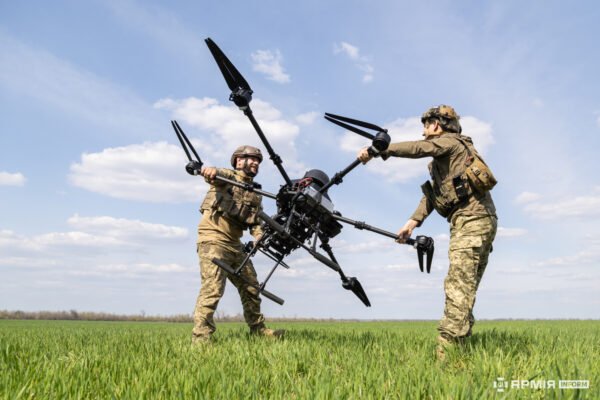
Today’s warfare is marked by rapid innovation in unmanned systems – and extremely high consequences for falling behind. Pioneering this shift, Ukraine’s expertise in strategic drone deployment, high-speed technological advancements, and mass scaling of UAV manufacturing redefine the logic of modern warfare.
Deriving battlefield truths from Ukraine’s circumstances, Taiwan – as another geopolitical flashpoint – strives to synthesize Ukraine’s drone-related tactics into its own asymmetric military operations. Alongside this, increasing geopolitical pressure has prompted Taiwan to accelerate efforts in building an autonomous drone supply chain. According to statistics from Taiwan’s Ministry of Finance, from January to October 2025, Taiwan’s drone exports totaled US$54.75 million, a significant increase of 11.4 times compared with US$4.41 million for the entire year of 2024.
Taiwan has also released a tender to procure 48,750 commercial-grade military drones for military use by 2027, and plans to purchase 635 units C-UAS systems by 2028. While significant progress, these numbers are diminutive in comparison to Ukraine, which produces an estimated 4 million drones annually. Further complicating these production disparities are Taiwan’s maritime landscape – which poses operational challenges for UAVs – and the absence of formal government-to-government ties with Kyiv, which limits the scope of technical cooperation.
Recently, initial cooperation between Taiwan and Ukraine has materialized through private-sector channels. A memorandum of understanding (MOU) between Taiwan’s drone industry alliance, TEDIBOA, and a Ukrainian defense tech hub, Iron Cluster, was signed in September 2025. The same month saw an MOU inked between Taiwan’s Defense Industry Development Association, DIDA, and Polish and Ukrainian counterparts. These developments place Taiwan-Ukraine cooperation at square one – a position with room to move forward and mature together. This does not negate, however, that political, industrial, and technological barriers remain.
For its security, Taiwan must both glean strategic insights from Ukraine and face its unique geographical and technical challenges head on in order to establish a resilient domestic UAV supply chain.
Applying Ukraine’s Battlefield Insights to Taipei
For Taiwan, Ukraine offers several lessons for drone production: adaptation through constant end-user feedback, establishing de-centralized procurement methods, and instituting a balance between localization and co-production with battlefield-tested foreign companies.
To the first point, technologies and tactics that used to endure 6 months on the battlefield now only sustain advantages for a short 4 to 6 weeks before Russian counter-advancements overtake them. End user feedback, particularly from Ukrainian military units, plays a major role in streamlining changes and improvements. With firsthand experiences, these units have striking clarity on what technology works and what does not. In a recent Ukrainian analytical report of 80 UAV related companies, 75 percent said they gather feedback “daily” or “regularly.” This empowers an evidence-based, bottom-up decision making founded on a direct feedback loop with military units themselves.
Meanwhile, Taiwan’s drone related military procurement tenders span over a period of 1-3 years with no official mechanism in place for rapid system modifications. Consequently, Taiwan’s evolution cycle is currently too slow to allow UAV technology to gain an edge against aggressors’ advancements. A huge part of Ukraine’s success lies in its ability to integrate battlefield feedback into production in near real time – a lesson Taiwan would do well to learn.
Besides insights of adaptability and innovation, Ukraine has two overarching frameworks to combat the susceptibility of its supply chain and meet its own UAV quantity demands: localization and co-production.
Localization includes the domestic production of components and large node assembly. For the latter, Ukraine has mostly reached sovereignty, with 95 percent of drones finalized domestically. For the former, starting from 2023, Ukraine has rapidly developed its base of manufacturers for key parts including frames, wire harnesses, flight controllers, motors, and regulators. The defense cluster Tech Force in UA and the Better Regulation Delivery Office (BRDO), an independent Ukrainian think tank found that 22 out of 80 (28 percent) interviewed Ukrainian UAV manufacturers utilize at least 50 percent Ukrainian components. This number was concurrent with another Ukrainian study of around 70 manufacturers, where 45.2 percent used around 30-70 percent of Ukrainian components. While still limited, this development greatly aids both operation tempo and the scaling of UAV production.
However, Ukraine’s experience also warns Taiwan about supply chain vulnerabilities: bottlenecks stemming from reliance on foreign components and risks associated with centralized manufacturing facilities. For Ukraine, current deficiencies include semiconductors, microelectronics – Surface-Mount Devices (SMD), Printed Circuit Boards (PCB), On-Screen Display (OSD) chips, etc. – optical components, batteries, and magnets. Batteries and magnets for motors are especially critical as they rely on lithium and neodymium – rare earth elements that China has a processing monopoly on.
While promising, Ukraine’s domestic manufacturing component capacity can not yet keep up with demand volumes, resulting in the continual purchase of cheap Chinese components. Not only is this a security risk, but also due to Chinese export restrictions starting from June 2023 on various drones and components, there have been increased costs, delays, and consequent shortages – forcing Ukraine to acknowledge the necessity of a self-reliant defense.
In a poll by the Snake Island Institute, a Ukrainian research organization, 23 out of 30 (76.7 percent) of manufacturers they engaged with indicated that they would stop buying Chinese components if there were other options available at the same price.
In Taiwan’s case, under the Five Trusted Industry Sectors initiative, it is launching a development program for the drone industry (2025-2030), aimed at researching key UAV technologies among other objectives. Taiwan’s localization plan, in particular, includes targeted, critical subsystems: flight control, navigation, and communications chips and operational software.
As for co-production, there are three main justifications for Ukraine to develop additional production channels abroad. First, Ukraine does not have the financial resources to utilize its own domestic production capacity. This leads to the second reason: Ukraine benefits from European joint ventures by receiving funds via European subsidiaries and supplementing the Ukrainian economy. Lastly, Ukraine needs to establish safer manufacturing lines, and foreign production lines can operate even if domestic facilities are targeted or disrupted.
These challenges and solutions are not unique to Ukraine. The message to Taiwan is clear: redundancy not only creates resilience through secure production lines, but also creates ties for longer term political alliances. At the same time, a foundational level of self-reliant manufacturing is absolutely necessary.
Taiwan’s current UAV co-production projects are limited to a few business-to-business (B2B) or business-to-government (B2G) agreements. One notable example is the United States’ AeroVironment and Taiwan’s NCSIST’s MOU, which expects future co-development on UAVs. Still, Taiwan acknowledges the advantages of an allied co-production ecosystem, especially in jump starting “non-red” production lines. While Taiwan’s drone co-production is currently in its nascent stages, significant opportunities for scaling exist.
Merging Taiwan’s Manufacturing Might With Ukraine’s Tested Technology
Ukraine and Taiwan have astounding potential for drone cooperation. Taiwan can contribute in lessening Ukrainian vulnerabilities, while at the same time strengthening its own budding drone infrastructure. Existing cooperation comprises Taiwanese exports to Ukraine and Ukrainian sourcing of Taiwanese components, but there are opportunities for expanding these B2B connections, tech sharing, joint research and development, and aligning certifications to increase exports.
For Taiwanese exports in particular, interviews with both Taiwanese and Ukrainian sources by the the Research Institute for Democracy, Society, and Emerging Technology (DSET) found that most, if not all, of Taiwan’s drone exports to Poland (31,711 drones by October 2025) and Czechia (24,318 drones by October 2025) – the top destinations for Taiwan’s drone exports – are being transferred to Ukraine.
Besides this, the majority of present-day cooperation with Ukraine consists of Taiwanese component sales. This partnership is built upon B2B rather than governmental relations.
According to a Ukrainian defense industrial entity interviewed by DSET, out of 61 UAV related companies, seven Ukrainian companies source from Taiwanese companies. These companies likely work with the same four Taiwanese companies, consistently sourcing airframes, battery cells, motors, flight control chips, and other microelectronics.
Other initial steps include the aforementioned MOUs signed between TEDIBOA and Ukraine’s Iron Cluster on September 2, 2025 and between DIDA and its Polish and Ukrainian counterparts on September 3. These MOUs work toward facilitating more B2B partnerships and providing platforms for industrial cooperation – including joint marketing, UAV business development, and participation in international ventures.
Operationalizing Taiwan-Ukraine UAV Cooperation
Looking forward, Taiwan should focus on leveraging its manufacturing and semiconductor dominance to anchor a global, non-Chinese drone supply chain, ensuring that both nations don’t need to rely on compromised components.
While Taiwan-Ukraine cooperation remains at an early stage, Ukraine continues to expand joint drone-production initiatives with its partners, adopting several distinct paths. Cooperation with Turkiye and Germany is focused on establishing domestic subsidiaries and building factories for proven systems like the TB2 and Vector drones within Ukraine. A second model with the United States and United Kingdom aims at advanced technology integration, especially developing AI-driven interceptor drones and plugging frontline data into production lines. Finally, Ukraine has partnerships with nations like Denmark and Czechia to manufacture Ukrainian-designed drones abroad to secure supply chains. None of these arrangements currently involves Taiwan.
By contrast, Taiwan’s collaboration with its own security partners has advanced more substantially. The recent U.S. National Defense Authorization Act includes provisions for co-production with Taiwan, while the Department of Defense’s DIU has, for the first time, incorporated Taiwanese firms into the Blue UAS program. Taiwan has also been included in the U.S. Partnership for Indo-Pacific Industrial Resilience (PIPIR) initiative to strengthen critical weapons supply chains. To date, however, none of these forms of cooperation has been formalized between Taiwan and Ukraine.
Admittedly, given the absence of official engagement between Taipei and Kyiv, Ukraine’s partnerships with other states cannot be directly replicated within the Taiwan-Ukraine context. Even so, existing industry-to-industry frameworks may offer a pragmatic starting point for advancing future collaboration.
Final Thoughts: Collaboration for Shared Security
In the future, a partnership that adds Taiwan to Ukraine’s UAV ecosystem is mutually beneficial. Taiwan already possesses valuable, transferable capabilities in high-tech electronics, manufacturing, and manpower.
At the same time, Ukraine is at an inflection point as it addresses the risks of supply chain dependencies by phasing out the usage of Chinese drone components. Starting with stronger component sourcing agreements, both partners can move toward a more integrated and resilient industrial base. For Ukraine, reliable access to Taiwan’s microelectronics ecosystem offers a solution to the volatility of current supply chains, ensuring that production constraints do not dictate operational capabilities. For Taiwan, this collaboration offers a unique opportunity to mature its defense sector, leveraging Ukraine’s experience and combat-tested innovations.
Ultimately, reducing reliance on monopolized supply chains is a shared necessity. Both sides can secure greater industrial autonomy required to navigate an increasingly uncertain world.
With the war in Ukraine transforming modern conflict, Taiwan’s bold bet on UAVs is the starting line for survival.



