
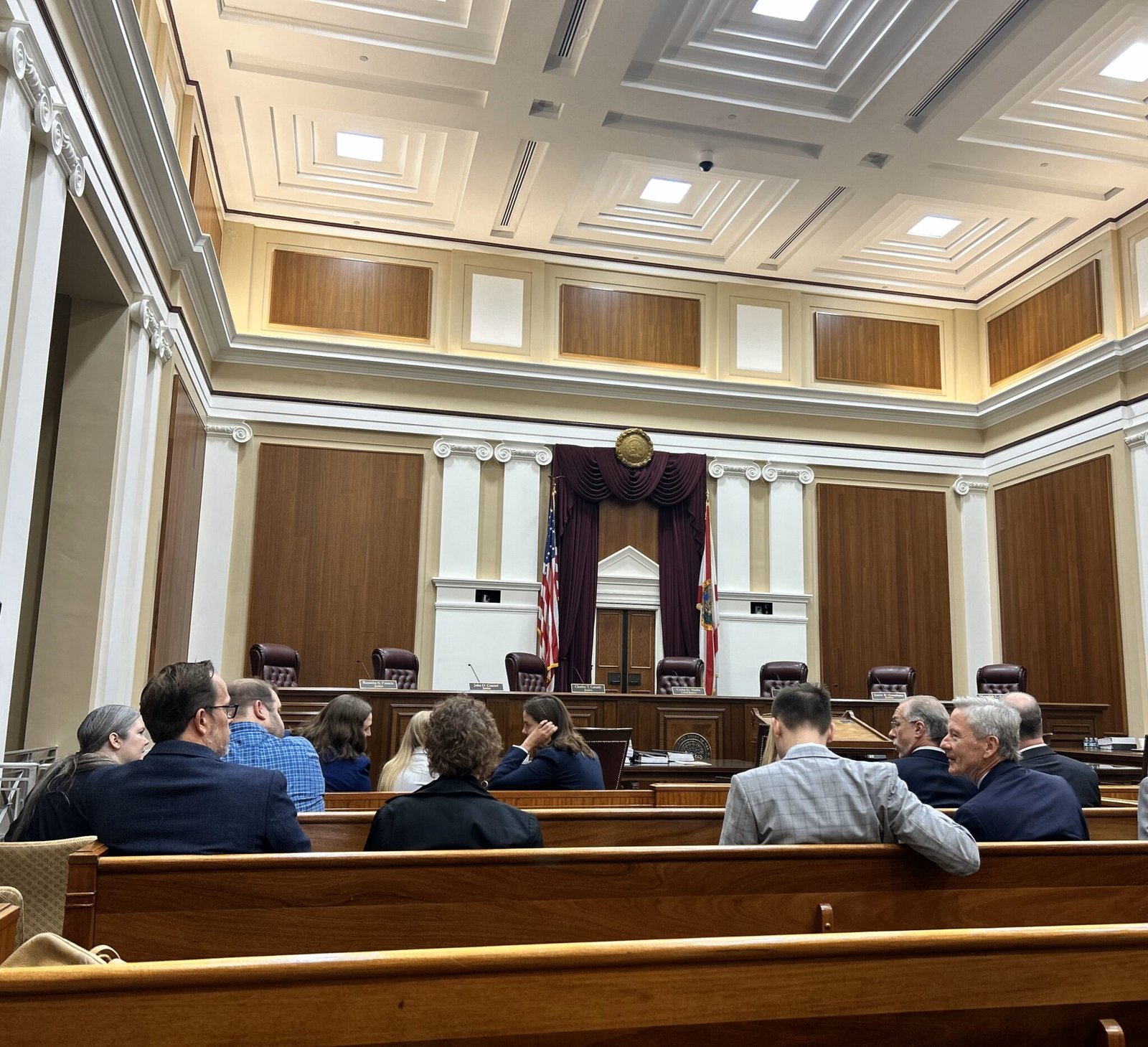
Six white men make up the group of finalists to fill the seat on the Florida Supreme Court vacated by Charles Canady.
Canady left the court as his wife, Rep. Jennifer Canady, R-Lakeland, is in line to become speaker of the Florida House after the 2028 elections and before he was age-limited off the court. He became director and a professor at the University of Florida Hamilton School for Classical and Civic Education on Jan. 1.
This could be the final Supreme Court appointment Gov. Ron DeSantis makes before he leaves office in about a year. Since taking office in January 2019, he has overhauled the court’s jurisprudence, creating an institution willing to jettison even longstanding precedent on abortion and capital punishment in the interest of conservative ends. He was assisted by the age-related retirements of the court’s moderate-to-liberal block.
Once the Judicial Nominating Commission submitted its candidates on Dec. 30, the governor had 60 days to appoint a qualified candidate — that is, by the end of February. The panel vets applicants for selection by the governor.
All six of the candidates are affiliated with the Federalist Society, as is the governor himself. The Federalist Society for Law and Public Policy Studies is a conservative-libertarian organization that promotes an “originalist” or “textualist” approach to jurisprudence. In practice, that means members tend to oppose economic regulation, affirmative action, and marriage equality and to support states’ rights an expansive reading of presidential power. Membership is a way for young attorneys to establish their bona fides with the conservative legal movement.
The sitting court comprises two white men, two white women, an Hispanic man, and a Black woman.
Learn more about the applicants:
Tallahassee
Adam Tanenbaum has served in all three branches of state government. He is a judge on the First District Court of Appeal, the most important state court aside from the Supreme Court itself, as it adjudicates cases arising from state law and policy.
He’s worked as an adjunct professor at the Stetson University College of Law, served a four-month stint as general counsel for the Republican Party of Florida, as a public defender, as chief deputy solicitor general in the Florida Department of Legal Affairs, and as general counsel for the Florida House and Department of State before becoming judge in the First District.
Has has taught at the Florida State University and University of Florida colleges of law.
“I would bring a deep-seated, long-standing principled commitment to ‘original meaning’ as a judicial philosophy in the faithful adherence to constitutional and statutory text while deciding cases,” Tanenbaum wrote in his application. “I also would bring a non-expansive approach to deciding cases and would seek to limit adjudication of a case, as much as possible, to the facts that are in the record before the court.”
A 1996 Georgetown University Law Center graduate, Tanenbaum graduated from high school in Pinellas County. He attended UF for his undergraduate degree.
At UF and Georgetown, he was in the Federalist Society. At Georgetown he was in the Republican Law Students Association and served as president of the Jewish Law Students Association.
He is still a member of the Federalist Society.
The appeals judge applied for the Florida Supreme Court in 2022 and the JNC certified his name to the governor as a nominee.
Tanenbaum was general counsel to the Florida House during Republican Richard Corcoran’s speakership, which ran from 2016 through 2018.
He said in his JNC application last month that he is most proud of his service as a public defender and as counsel to the Florida House, which he described as a “dream job.” Corcoran and his chief of staff comprised “one of the best clients I could have mainly because they really wanted to be bold, they really wanted to do bold things and they let me be creative and think of new solutions to problems using wit and legal argument to accomplish what they were trying to accomplish.”
Tanenbaum pointed to the significance of DeSantis’ Supreme Court picks.
“This is his 8th pick, presumably his last and it’s probably his capstone appointment to solidify what he’s accomplished in the last seven years in remaking the court. My reasons for applying though are the same as they were before. I’m answering the call from the governor for qualified applicants,” Tanenbaum said.
Tanenbaum was primary counsel in Corcoran’s lawsuit against the Florida Lottery over a vendor contract worth hundreds of millions of dollars that would have vastly increased the number of lottery machines above the number authorized by law. The Lottery ultimately settled the case.
In another case, Tannenbaum represented the Rick Scott administration in defending the state’s refusal to recognize same-sex marriages performed in other states — after the U.S. Supreme Court upheld marriage equality. The state lost.
As a judge, he heard Byrd v. Black Voters Matter Capacity Bldg. Inst. (2022 and 2025), a high-profile challenge to a redistricting plan that eliminated minority-access voting districts. The state ultimately prevailed.
In 2024, his income was $215,750, including payment from part-time soccer refereeing.
Tanenbaum’s net worth as of Dec. 31, 2024 was $1.34 million.
GET THE MORNING HEADLINES.
Orange County

Gannam earned his bachelor’s at the University of North Florida and went on to graduate from the UF College of Law and mostly worked as an attorney in Jacksonville and Maitland before being appointed to serve on the Sixth District Court of Appeals in Lakeland, the post he now holds.
Gannam said his son’s cancer diagnosis in 2003 shaped the way he serves as a judge. He had, he said, “to make weighty decisions under pressure, decisions about his treatment and exposure to the world outside the hospital where his life was at stake. Careful consideration of all information and maintaining composure under duress were essential to making the right decisions and generating confidence in them.”
Gannam’s last job was at Liberty Counsel, which litigates on behalf of an “historically Christian and biblical” worldview, according to its webpage.
“It is no doubt clear from my application that much of my prior public service and legal advocacy has a distinctively Christian bent,” he said.
“My public interest litigation in constitutional religious liberty cases was personally rewarding because it integrated my faith and my passion for the rule of law, which are central aspects of my life and vocation. But my faith-based associations have never required or tempted me to advance legal positions that are not supported by the law.”
The first reference he listed on his application was Florida Supreme Court Justice Meredith Sasso. He told the JNC that he hopes to emulate Sasso, who held the judgeship he now holds.
Other references include Republican state Sen. Clay Yarborough and Republican state Rep. and Speaker-designate Sam Garrison, and Joshua Mize, another candidate for the Supreme Court this round. Another reference is Jeff Aaron, legal counsel to Hope Florida Foundation during its scandal and who has worked closely with the DeSantis administration in legal actions.
Gannam has been a Federalist Society member since 2020.
From 2014-2023, he provided pro bono representation to individuals and organizations in “public interest, religious liberty litigation.”
In 2015, he wrote a column in the Florida Times-Union titled, “LGBT people in Jacksonville do not need a Human Rights Ordinance.” That column declared, “Wherever LGBT ‘rights’ laws are passed, discrimination against people of faith follows.”
“A large majority of Duval County believes in the historical definition of marriage — unchanged worldwide for millennia — the union of a man and a woman. But anyone who dares express this traditional belief in a consensual conversation with a coworker or customer is guilty if ‘discrimination’ is perceived by someone overhearing it.”
He represented members of the military in a class action challenging COVID-19 vaccine mandates during the pandemic. Those cases were eventually dismissed as moot when the vaccine policies were rescinded.
His net worth as of the end of 2024 was $205,715.
He made $206,504 in 2024 and was set to make about the same in 2025.
Plant City
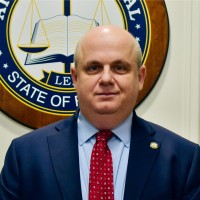
John Guard has worked in the Florida attorney general’s office since 2018 as senior counsel, chief deputy attorney general, acting attorney general, and chief deputy attorney general.
He took a brief hiatus from the AG’s office last fall while he awaited a nomination from President Donald Trump to the Middle District of Florida. Axios reported that nomination has been hung up because of his association with the Hope Florida scandal.
According to his application, in July he met with an investigator with the Second Circuit state attorney’s office “because I was a witness in connection to the transfer of $10 million to the Hope Florida Foundation from a settlement agreement with Centene Corporation.”
“My involvement in that settlement was limited to signing a settlement agreement after obtaining the Attorney General’s approval and a handful of emails. In October, the State Attorney contacted and told me that I was a witness in the matter, not a target, and that I had fully cooperated and provided truthful and complete information. I expect that investigation to be completed shortly.”
Law 360 reported Wednesday that Guard’s federal court nomination was not renewed for the new congressional session. Guard told the JNC that his preference is to serve on the Florida Supreme Court.
His top references were U.S. Sen. and former Florida Attorney General Ashley Moody, followed by Tampa Republican U.S. Rep. Laurel Lee and Florida Attorney General James Uthmeier.
Guard graduated from Tulane University School of Law in 2000. He earned his bachelor’s degree from Florida State University in 1993.
He was assistant U.S. attorney in the Middle District of Florida, Jacksonville Division, from 2009-2012, working on fraud, narcotics, unlawful firearms, and violent crime. He spent two stints at Holland & Knight in Tampa.
Guard has been in the Federalist Society since 2023. He is a committee member for the Tampa Bay-area Boy Scouts council.
Guard said he hopes to emulate the late Justice Antonin Scalia.
“I was recently reading an article where it said his name was invoked in Supreme Court arguments more than any other name, and that’s because of his courage, and because of his intellect and because of how willing he was to stand on his principles,” Guard told the commission.
If he has any disagreements with Scalia, it would be on his interpretation of the First Amendment. Guard said he disagreed with Scalia’s ruling in Texas v. Johnson, in which the justice protected the burning of the American Flag. “He often was siding with the more liberal justices of the Supreme Court when it came to the First Amendment,” Guard said.
He’s represented the state in several-high profile cases, including the case against Purdue Pharma alleging damages from opioid use in the state. That ended with a $680 million settlement with Walgreen in 2022. He led negotiations for cities and counties receiving that settlement money and for a separate $26 billion settlement with other major pharmaceutical companies. In all, according to his application, the state will receive $3.15 billion from opioid settlements.
He represented the state in a suit filed by Planned Parenthood challenging the state’s 15-week abortion ban and in litigation between the state and Juul, alleging the company marketed vaping equipment to children. Juul settled for $79 million. The Florida Supreme Court upheld the state’s 15-week abortion ban.
Guard’s income in 2024 was $197,371 and his net worth as of November was $1.55 million.
GET THE MORNING HEADLINES.
Tallahassee

Robert E. Long Jr. is the only candidate with military experience, and advertises that service as an asset.
“My selection would bring a new professional perspective and valuable experience to the court. As a lawyer, I have tried major felonies and advised a Navy Admiral on the Law of the Sea and Rules of Engagement,” Long wrote in his application.
“I have been a law enforcement officer and worked the ground level of our judicial system. I have managed complex and highly sensitive national security matters involving Taliban and al-Qaeda fighters and have worked as a civil litigator in state and federal proceedings.”
Long graduated from FSU with a bachelor’s in finance (2003), the UF College of Law (2008), and U.S. Navy Officer Development School (2008).
At UF, he was president of the Federalist Society. He was also a member of UF Law School Republicans and FSU College Republicans.
He was Tallahassee Federalist Society president 2015-2016 and is still a member.
Long now serves as a judge for the First District Court of Appeal in Tallahassee and has held that position since 2020.
Immediately before that, he was a judge in in Tallahassee for Florida’s Second Judicial Circuit Court.
He spent two years as the Leon County Sheriff’s Office general counsel from 2014 to 2016. He worked for that office as a sheriff’s deputy from 2002-2005.
From 2008-2013, he was a U.S. Navy Judge Advocate.
“I have spent the last 24 years of my life working through the great breadth of our justice system. My experience is not confined to one or two areas of the law and includes years of labor in the very-real daily work of those asked to breathe life into the opinions written by our appellate courts. This experiences will be a great asset on the court. Putting a wide variety of experience on the court is important to maintaining a thoughtful and skilled judiciary,” he wrote.
He’s been an assistant scoutmaster for a Tallahassee troop since 2021 and is a youth baseball, soccer, basketball, and flag football coach in Tallahassee.
In 2024 he made $236,034. His reported net worth is $409,494.
Long participated in the First District consideration of the congressional redistricting case that resulted in elimination of a minority-access district in North Florida.
Polk County

Joshua Mize was certified by the JNC for the Supreme Court three years ago but was not selected.
He graduated from University of Florida College of Law (2010) following an undergraduate degree from the same university in 2007. He was president of UF Law Federalist Society for two years and has been a member of the society since 2007. He was a member of the College Republicans and Law School Republicans at UF.
He has been judge of Florida’s Sixth District Court of Appeal, based in Lakeland, since 2023. From 2021-2022, he was trial judge in Florida’s Ninth Circuit Court in Orange and Osceola counties. Before that, he operated Mize Law from 2018-2021.
He, too, used Florida Supreme Court Justice Meredith Sasso as a reference. He listed Gannam as a reference, as well.
“I will never allow my personal views to influence my application of the law. I will never engineer an outcome to comport with my personal preferences. I will never make a decision out of a desire to be popular or to follow public opinion. Every decision I make will apply the law as it is written,” Mize wrote in his application.
Before he was a judge, he did commercial, intellectual property, consumer protection, and other civil litigation such as contract and tort claims.
“My in-depth and practical understanding of the trial process will assist me in making correct legal rulings on the Florida Supreme Court as well as in performing the Court’s rule-making function,” Mize wrote in his application.
In 2024, he earned $244,292 from his judicial salary and from a rental property in Winter Park that he owns.
His net worth as of Sept. 2025 was $1.71 million.
GET THE MORNING HEADLINES.
Tampa

Samuel J. Salario Jr. graduated from the University of Florida College of Law (1995) and holds a bachelor’s degree from The American University (1992).
In 2018 and 2019, he submitted applications to the Florida Supreme Court Judicial Nominating Commission. The JNC certified him for a nomination in 2018.
“I regard the rule of law as possibly the greatest gift ever bestowed upon a political community. Liberty, human dignity, and economic prosperity are nurtured and shielded when the rules that govern us are rational, procedurally regular, and neutrally applied. This demands a judiciary that is respectful of decisions that are committed to the political branches of government, resolves disputes on legal principles openly explained and defended, and that is prepared to correct its own errors,” he wrote in his application.
Most recently, he has worked as an attorney, but spent 2015-2020 as a Rick Scott appointee to the Second District Court of Appeal of Florida. Now, he’s a shareholder at Lawson Huck Gonzalez. Former Justice Alan Lawson and Paul C. Huck, shareholders at that firm, were his first references in his application to the court.
“My most important potential contributions are the characteristics I hope I developed a reputation for as a Second District judge and that I have tried to promote in my current role, both in the cases I work on and the amicus briefs I do pro bono: an unwavering commitment to the rule of law, discipline and diligence in decision making, and respect for the people the courts serve,” he wrote.
He spent two years as underwriting manager for a litigation finance firm from 2020-2022 and, earlier, spent 13 years at Carlton Fields in Tampa, mostly as a shareholder.
His current practice involves “handling state and federal appeals across a broad range of subjects, including government and political disputes, criminal prosecutions, business disputes, class actions, estates and trusts, and amicus briefing in matters of interest,” he wrote in his application.
At UF, he was a member of the Federalist Society. In his professional career, he joined in 2015 and has been a member since.
Among the nominees, Salario has the only notable presence on X.
In July, he replied to a post asking what late night talk show hosts Jimmy Fallon, Jimmy Kimmel, and Stephen Colbert have in common. “Low T.” he replied.
In September, in advance of the federal government shutdown, he replied to a video from Trump’s account that criticized U.S. House Democratic Leader Hakeem Jeffries.

“Dear President Trump: The country desperately needs a Hakeem Jeffries sombrero meme with Mexican Radio by Wall of Voodoo as the operative music. Thank you for your attention to this matter,” Salario wrote.
In another, he posted a photo in response to an article about former President Joe Biden’s sex life.
In 2024, he made $534,551. His net worth as of December was $5 million, the highest among the nominees.
He wrote a brief for Susan B. Anthony Pro-Life America in litigation opposing Amendment 4, the proposed 2024 constitutional amendment to make legal access to abortion.
Salario represents Trump Media & Technology Group Corp. in its legal battle with ARC Global Investments II. The investment company and media company, owned by the president’s trust, are in a contractual dispute over stock shares.
Independent Journalism for All
As a nonprofit newsroom, our articles are free for everyone to access. Readers like you make that possible. Can you help sustain our watchdog reporting today?



