
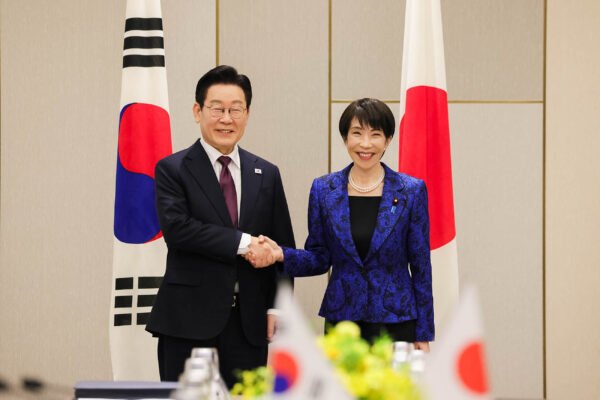
On January 13, Japanese Prime Minister Takaichi Sanae and South Korean President Lee Jae-myung met in Nara City, the ancient heartland of western Japan, for their second bilateral summit. Amid accelerating geopolitical turbulence, the meeting sent a clear signal: Tokyo and Seoul intend to deepen strategic cooperation across security, economic security, and regional diplomacy as the international order becomes more volatile and less rule-bound.
This meeting followed their first-ever summit in Gyeongju, South Korea, in October 2025. The choice of Nara was deliberate and symbolically rich. It is Takaichi’s political home base, but it also carries profound historical resonance in Japan-South Korea relations. In Korean, nara (나라) means “country” or “nation,” and Nara has long been intertwined with the Korean Peninsula through deep cultural and human exchanges. Known in ancient times as Yamato, the region absorbed waves of migrants from the peninsula between the fourth and eighth centuries. For many of them, Nara became a new nara – a new homeland. Some historians even argue that these layered historical experiences shaped the evolution of Yamato into what came to be known as “Nara.”
Yet the significance of the summit extended far beyond historical symbolism or reconciliation. At its core lay a stark strategic question: how should two U.S. allies – and quintessential middle powers – navigate an international system that is increasingly defined not by rules and institutions, but by power, coercion, and spheres of influence?
From Mutual Distrust to Strategic Convergence
At the joint press conference, Takaichi emphasized that “as the strategic environment surrounding both countries becomes more severe, we have shared our recognition of the strategic importance of Japan-South Korea relations and confirmed that our two countries should work together to contribute to regional stability.” She underscored the importance of Japan-South Korea and Japan-South Korea-U.S. security cooperation and pledged to maintain close, continuous communication.
Lee echoed this urgency. Opening the talks, he argued that “in a rapidly changing international order, cooperation between our two countries is more important than anything else.” Global politics and the international trade system, he warned, are being shaken in unprecedented ways, leaving no room to delay deeper bilateral cooperation.
Notably, Lee placed strong emphasis on forward-looking collaboration in economic security, including supply chain resilience, advanced technologies, and safeguards against economic coercion.
This shared sense of urgency has reshaped the tone of bilateral diplomacy.
Such convergence was far from inevitable. Japanese media had long portrayed Lee – who in the past made sharp remarks about Japan’s colonial rule – as an outspoken critic of Japan, while South Korean outlets frequently depicted Takaichi, known for her nationalist credentials and visits to the controversial Yasukuni Shrine, as emblematic of Japan’s far-right. Yet once in office, both leaders recalibrated. Rhetoric gave way to realism, and historical grievances were subordinated to shared geopolitical imperatives.
An Imperializing World Order
The Nara summit took place amid mounting concern that the post-Cold War order is giving way to what might be called an “imperializing world” – one in which great powers increasingly privilege spheres of influence over universal rules.
Under U.S. President Donald Trump, Washington has embraced a more openly transactional approach to diplomacy, questioning alliances and multilateral institutions in favor of bilateral deals that maximize short-term national gain. The U.S. military operation to capture the president of Venezuela shocked the world for its abrogation of long-held norms – if not outright violation of international law, as many argue. Trump also continues to threaten the use of military force against Colombia, Iran, and even NATO ally Denmark.
Meanwhile, Russian President Vladimir Putin has used military force to challenge international norms, most starkly through the invasion of Ukraine, signaling a return to 19th-century-style power politics.
China, for its part, has hardened its posture on sovereignty disputes in the East and South China Seas, demonstrating a growing willingness to alter the status quo by force or coercion. Taken together, these trends have accelerated a global shift in which power increasingly trumps rules.
For middle powers such as Japan and South Korea, the danger is not simply instability. The greater risk is marginalization – finding their vital interests sidelined as great powers strike deals over their heads. It was against this backdrop that Lee and Takaichi framed coordination not as a diplomatic option, but as a strategic necessity.
Middle Powers Between Giants
Japan and South Korea are archetypal middle powers, wedged between competing giants: the United States and China. Intensifying China-U.S. rivalry, North Korea’s advancing nuclear and missile capabilities, and the fragmentation of global supply chains have created a set of shared vulnerabilities. Acting alone, neither Tokyo nor Seoul has sufficient leverage to shape regional outcomes. Acting together, they can at least influence them.
The Nara summit reflected a growing recognition that the era of stable, U.S.-led multilateralism can no longer be taken for granted. A G2-style mindset – where Trump and Xi view global politics primarily through the prism of bilateral rivalry – poses particular risks for regional stakeholders.
For Japan and South Korea, the fear is a modern version of a “new Yalta,” in which great powers divide spheres of influence while the interests of others are quietly subordinated. Close coordination between Tokyo and Seoul is one of the few realistic ways to hedge against that outcome.
Security cooperation remains the most immediate driver of alignment. Northeast Asia faces converging pressures: China’s rapid military modernization, North Korea’s expanding nuclear arsenal, and Russia’s deepening strategic ties with both Beijing and Pyongyang. In such an environment, bilateral mistrust would be a strategic indulgence neither Japan nor South Korea can afford.
At the same time, the summit highlighted a broader agenda centered on economic security. Both leaders committed to strengthening cooperation on supply chains, critical minerals, semiconductors, and emerging technologies – sectors that have become increasingly weaponized in great-power competition. In an imperializing world, economic interdependence is no longer just a source of prosperity; it is also a vulnerability.
The Age of the Strategic Middle Power
Japan-South Korea cooperation has thus moved beyond symbolism. It is becoming a structural necessity. In an international order shaped by Trump’s transactionalism and Putin’s revanchism, stability in the Indo-Pacific may depend less on the restraint of great powers than on middle powers acting in concert.
For Tokyo, the era of “big power Japan” is already over, with Japan overtaken by India and falling to the world’s fifth-largest economy. But the era of the strategic middle power – embodied in pragmatic, future-oriented Japan–South Korea cooperation – has only just begun. In an imperializing world, that partnership may prove not only desirable, but indispensable.



