
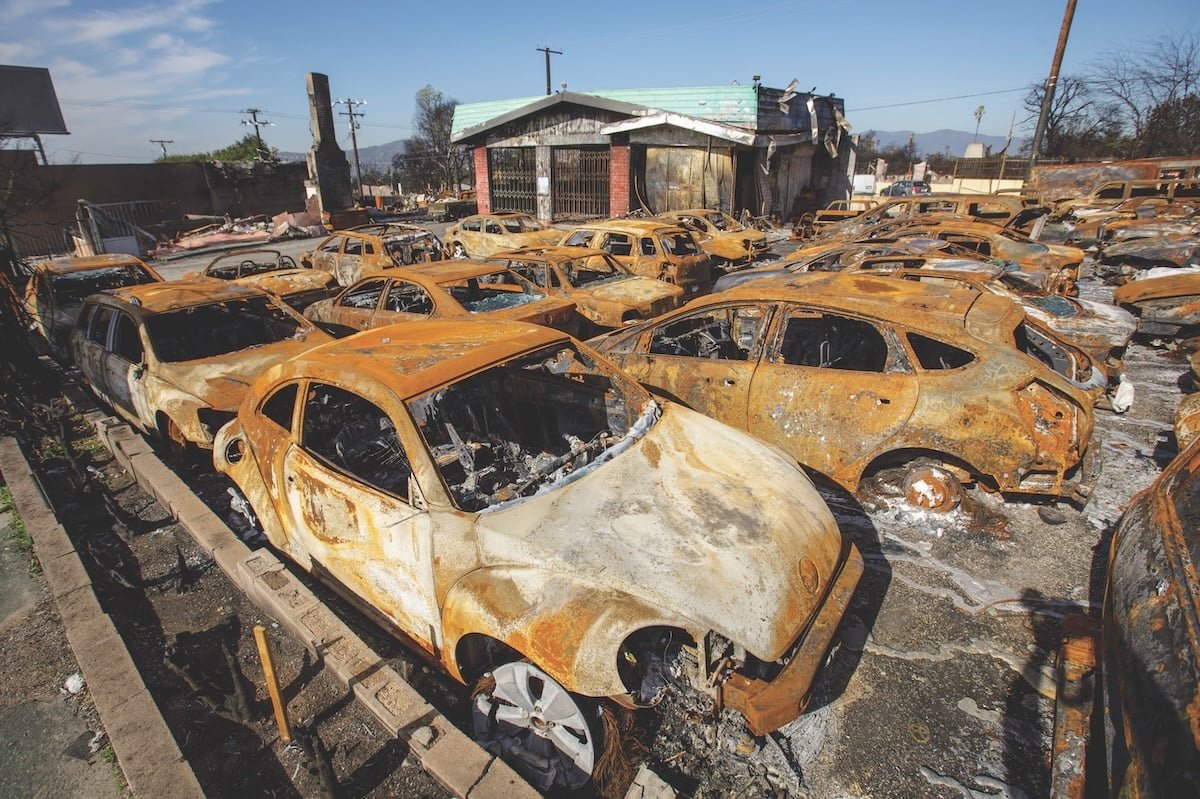
More than a year after the January 2025 wildfires first sparked, victims continue to navigate insurance, mortgage and construction hurdles on the road to rebuilding what was lost.
The recovery efforts of nonprofits, businesses and residents in and around Altadena and Pacific Palisades will see a boost from a new capital commitment from the Bank of America Corp. that expands on the banking sector’s fire-focused philanthropic aid. The financial giant announced in late December $10 million in zero-interest loans that’ll reach nonprofits, businesses and residents through local community development financial institutions, or CDFIs.
“We want to make as many loans as we can to support businesses of all sizes, particularly those businesses that were impacted by the L.A. wildfires,” said Raul Anaya, Bank of America president for greater Los Angeles. “[CDFIs] know how important it is that they deploy as much of that capital as quickly as possible in order for the businesses to get back on their feet.”

Bank of America is the largest private investor in CDFIs, to which it’s given more than $2 billion in capital grants, loans, deposits and equity investments.
Small business lending and housing assistance are central to the new funding, distributed to three CDFIs with track records in disaster recovery: Genesis LA, Pacific Community Ventures’ RESTORE LA Fund and Clearinghouse CDFI.
As non-traditional lenders, CDFIs extend loans to underserved or low-income borrowers, or those in unique circumstances – including L.A. businesses and residents directly and indirectly impacted by the wildfires that swept through tens of thousands of acres.
“There are going to be times where businesses may not qualify for traditional bank financing for various reasons,” Anaya said. “They may be unprofitable, or they may have had to restart the business after being out for so many months, and so it’s now a startup, or they might have too much leverage in those cases.”
Channeling funding through CDFIs can fill the need for more flexible lending, Anaya said.
Businesses and homeowners impacted by the fires would welcome that relief. A year ago this month, the wildfires destroyed more than 16,000 homes and commercial structures, displaced more than 100,000 residents and claimed nearly three dozen lives.
Rebuilding has been piecemeal. In June, the state unveiled the $105 million CalAssist Mortgage Fund, which provides grants covering up to three months of mortgage payments. The funds can be used for future payments, mortgage forbearance or to catch up on delinquent loans.
Permitting activity continues to pick up, though thousands of applications remain in review. In Los Angeles County, more than 2,900 permits have been submitted and nearly 1,300 have been issued, based on the latest data from the state’s Rebuilding L.A. web portal. Within the city of L.A., more than 3,100 applications have been filed. And of those, over 1,500 have been issued. In November, the city reported that more than 340 projects have begun construction.
Beyond infrastructural devastation, the fires’ economic toll has been substantial.
In a report released last fall, the Los Angeles County Economic Development Corp. estimates that the total economic disruption from the fires – including businesses in burn zones and those forced to close during mandatory evacuations – could reach up to $10 billion.
Altadena and Pacific Palisades businesses face longer-term impacts, while interruptions in surrounding “secondary fire areas” also caused significant losses.
A just-brokered partnership between a housing nonprofit and Clearinghouse, one of the three selected CDFIs, is an example of how the Bank of America capital could boost residential recovery.
The first loan Clearinghouse issued using the recent infusion went to Greenline Housing Foundation, a Pasadena-based housing justice organization that’s been buying charred lots in Altadena since last winter.
Greenline positions itself as a land bank, acquiring and protecting fire-affected properties from investors hoping to profit from inexpensive land.
“We’re just trying to help them solve the problem, which is keeping the land in the community and not being sold to outside parties,” said Kristy Ollendorff, Clearinghouse’s chief credit officer.
With $2.5 million revolving line of credit, partly supported by the new funds, Greenline will foray into development. The loan will support the construction of housing targeting the 80-120% area median income bracket in Altadena.
Clearinghouse also looks to use the capital to help homeowners fill gaps between insurance proceeds and rebuilding costs. Recent data from ClaimArchitect estimates an average $1.5 million shortfall between a Palisades homeowner’s insurance payout and the actual cost to rebuild.


Though a portion of $10 million “doesn’t go very far” in real estate, Ollendorff said Clearinghouse will leverage the Bank of America capital to lower borrower rates.
As the pipeline of post-fire rebuilding projects grows, nonprofits with “boots on the ground” are reaching out for financing help, the credit officer said. In the coming months, Clearinghouse will prioritize lending to organizations with clear plans and experience in development and emergency situations.
“I’m hoping within the next quarter we’ll have money out the door,” she said.
The new loans build on the Bank of America’s philanthropic investments in the fires’ wake, including a recently announced $1 million awarded to the YMCA of Metro Los Angeles to restore its burnt-down Palisades-Malibu club.
Bank of America is one of many that have poured millions of dollars into fire response and recovery grants since last January.
A September report from the New York-based nonprofit The Conference Board estimated that corporate donations in response to the wildfires topped $650 million when accounting for companies, philanthropic foundations, individual donors, workforce assistance and customer relief.
Just over half of Standard & Poor’s 100 companies publicly reported contributing to recovery efforts, the survey found. For the 39% who disclosed the amount of their contributions, the total was nearly $122 million. The median amount given was $1.5 million.
While the fires burned, downtown-based City National Bank put up $3 million in grants for emergency response, while JPMorganChase gave $2 million.
As focus turned to rebuilding, funding followed.
In October, BMO named dozens of recipients of its $3 million Wildfire Recovery Fund, a list that included neighbor-led rebuilding networks, mental health organizations and community gardens. A month later, a handful of fire-affected small businesses got relief from a $525,000 grant funded by Rick Caruso’s nonprofit Steadfast LA and Banc of California.



