
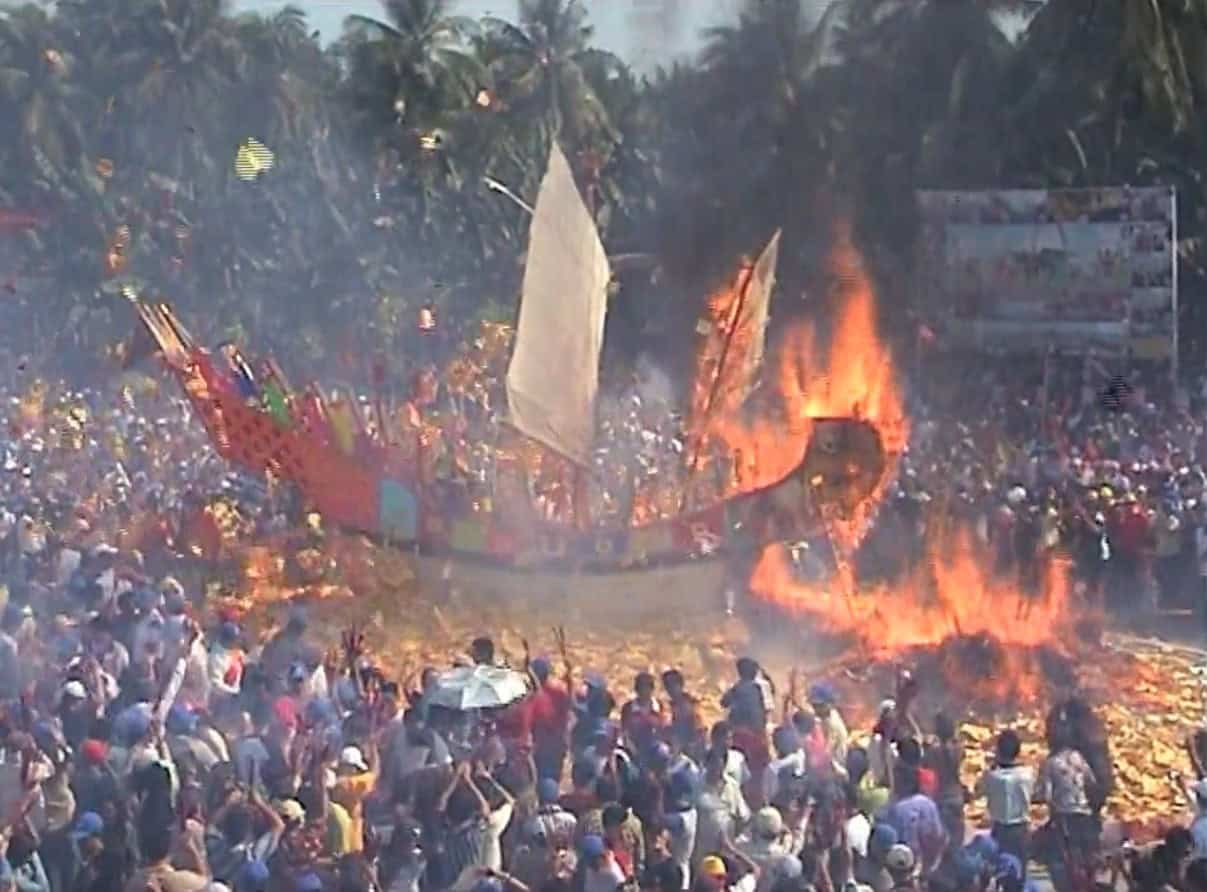
If there is not much debate anymore about who shot Liberty Valance, there is much more doubt about who was the Malacca Strait’s pirate, Tan Lian Lay. East or West, only the legend remains, and that is what Khoo Eng Yow is exploring in “The Pirate & The Emperor’s Ship” by following the field historian from Taiping, Lee Eng Kew, on the tracks of the now deified seaman. On the occasion of the Bagan Siapiapi’s Ship Burning Festival where a paper boat is ceremonially set on fire to end a day of procession, Lee is investigating how the mob-style buccaneer has become a god worshiped in this fishing town of Sumatra.
Watch This Title
on CathayPlay by clicking on the image below
As the documentary unveils, it all began with some weapons stockpiles left behind in 1945 by the Japanese after their occupation, which were reclaimed by the Hong Men, a secret society active throughout this marine corridor between Malaysia and Indonesia. Tan is believed to have grown up across the Strait, in Malaysia’s Perak coastal towns of Kuala Gula and Pulau Pasir Hitam. Nicknamed “Leprosy” for his distinctive appearance, he was reportedly a crab fisherman who ran a protection racket on charcoal producers. As one of the leader (“Ang Kun”) of the Hong Men society, Tan was called upon to defend the self-governed Chinese settlement of Bagan Siapiapi, who faced intimidation from Dutch colonial forces. With success.
But other sources say in a more matter-of-fact way that Tan fled to Bagan Siapiapi after killing Lim, another Hong Men leader and chief of Pulau Pasir Hitam, in a dispute triggered by the refusal to receive a stolen shipment of rice. When Lim declined support, the cargo was then spoiled, and revenge was taken by assassinating him. One account suggests personal grudges were the real cause. Welcome to the land of oral history. However, Lim was also deified locally afterwards.
From there, Tan established his piracy operations in Bagan without arming his protected coastal villages. Later, local Chinese authorities demanded the surrender of all illegal weapons. When Tan’s gang refused, two policemen were killed. Despite publicly executing a gang member as an act of blood revenge, Tan was tracked down and cornered in his building in the city. He was coldly shot even though he reportedly raised a white flag to surrender. But how exactly did he then become a god? Nothing more simple than having his spirit called by a local medium to bring good fortunes to gamblers around, with so accurate and successful lottery predictions that local people built a shrine for the “General” !
In parallel with Tan’s myth, the documentary explores the origins of the Ship Burning Ceremony. The legend tells that the Chinese emperor from Nanjing, Jian Wen Di, was overthrown by his uncle from Beijing, Yongle, and escaped with his court somewhere in Southeast Asia, a place never found by the trackers sent after him. One of the fleeing boat, carrying a religious artifact that can still be seen in a local temple, would have ended on this remote area of Sumatra. Here could be the origin of the festival. However, other voices attribute the settlement more simply to Chinese immigrants from Thailand, originally from Fujian. Legend again.

In terms of cinematography, the documentary employs mostly handheld cameras either to literally follow the historian during his interviews or in immersing viewers in the trance of the procession. It avoids any stylized visuals often praised in modern documentaries, opting instead for a straightforward edit punctuated by live moments from the ceremony. Nothing noteworthy here.
More interesting is the central idea of the documentary, which is to tentatively show how complex it is to dig into oral history investigation and how storytelling tends to merge into a convergence of history that is, in some way, officially retained. Another particularly remarkable feature is approaching how Chinese culture absorbs and digests other cultures‘ myths through its own “religion”- a constant in Chinese history – and how Confucianism, by placing respect for authority on a pedestal, can transform obscure figures into legendary references. Being a “General” of a triad can somehow grant one the status of a god postmortem, something still frequent nowadays in the semi-religious hierarchy of the triads.



