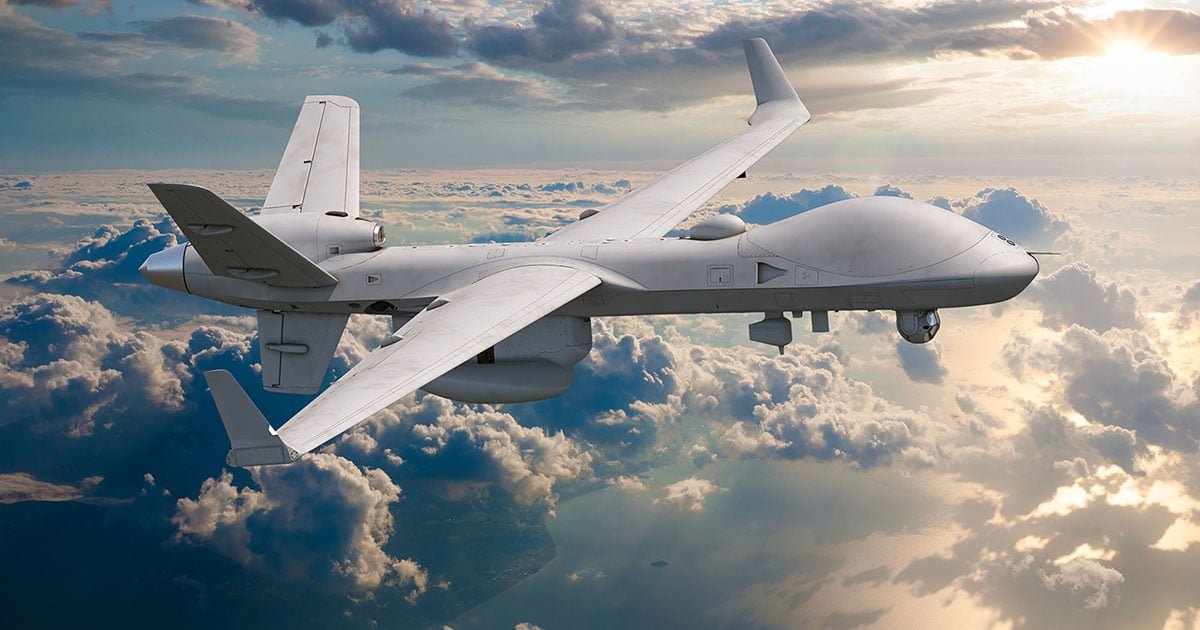
POWAY– Germany plans to buy eight MQ-9B SeaGuardian remotely piloted aircraft from General Atomics Aeronautical Systems Inc. (GA-ASI), the Poway business announced earlier this month (Jan. 12).
Germany’s program includes four certifiable ground control stations. GA-ASI said the first delivery is expected in 2028.
Financial terms of the deal were not disclosed. Published reports differ on aircraft costs and privately held General Atomics keeps such information confidential.
The deal with Germany is likely worth hundreds of millions of dollars. When reporting a 2024 deal for three SkyGuardian aircraft for Poland, a few media outlets put the price at $310 million, citing a report from Poland’s defense ministry. The Polish deal included ground stations and support services.
Common Platform for NATO Nations
“We’re thrilled that Germany has joined the list of NATO countries that have selected MQ-9B SeaGuardian,” GA-ASI CEO Linden P. Blue said in a statement. “The proliferation of MQ-9B in Europe delivers commonality between NATO countries and for Germany, it will provide opportunities for interoperability with their fleet of P-8As.”
The P-8A Poseidon aircraft, also flown by the U.S. Navy, is a militarized version of a Boeing Co. 737.
According to GA-ASI, the acquisition negotiation was executed on behalf of Germany by the NATO Support and Procurement Agency (NSPA), which has developed a contractual framework through the MQ-9 Support Partnership for supporting cooperation among member nations and enabling the procurement of MQ-9B for NATO Allies and Partners.
NSPA has added MQ-9B to its portfolio of defense systems to contract on behalf of NATO nations, with the goal of enhancing interoperability for joint training and operations.
The Poway company said Germany joins a growing list of NATO countries that have selected its MQ-9B remotely piloted aircraft (RPA) for its multi-domain capabilities with exceptionally long range and endurance. The platform provides pole-to-pole satellite control and de-icing capabilities to enable missions in cold climates. SeaGuardian features two multi-mode surface-search radars that deliver wide-area maritime surveillance, with an option to add Anti-Submarine Warfare capability. Additionally, MQ-9B’s Detect and Avoid System, developed in-house by GA-ASI, aids its ability to fly in unsegregated airspace for domestic civilian operations, making it highly versatile for operations from Germany.
In 2025, MQ-9B became the first large remotely piloted aircraft to obtain a Military Type Certificate from the UK’s Military Aviation Authority, certifying its safe operation without geographic restrictions, including over populous areas.
Viasat Announces Integrated Satcom Network
Viasat Inc. (Nasdaq: VSAT) announced what it called “a significant evolution” of its network for government customers by unifying Viasat Ka-band satellites, the Global Xpress satellite fleet and select partner satellites into a fully integrated global Ka-band satellite communications network. The Carlsbad company made the announcement Dec. 15.
Viasat acquired Global Express satellites with its 2023 acquisition of Inmarsat.
Satellites and spacecraft use several radio frequencies to communicate. Ka-band refers to a portion at roughly 26 gigahertz, in the microwave portion of the radio spectrum.
“Fully interoperable with MILSATCOM Ka-band networks, this evolved Ka-band network capability will provide seamless global, multi-orbit Ka-band connectivity for government and military users, offering increased performance, expanded coverage and greater resiliency for missions across air, land, and sea …,” Viasat said in a statement. “Moving forward, government users operating across domains will be able to access this evolved Ka-band network through upgraded, single terminal solutions rather than needing multiple hardware solutions.”
Victor Farah, Senior Vice President of Government Services and Solutions at Viasat, said in a statement that by unifying its Ka-band satellites into a single network, “we are delivering the resilient, secure and high-capacity connectivity that government missions demand around the world. This advancement reflects our commitment to providing trusted, user-centric communication services that give war fighters the global reach and information advantage they require in today’s increasingly contested environments.”
Army Corps of Engineers Puts KAI JV on Short List
KAI JV, a small-business joint venture based in San Diego, is one of three businesses that will compete for each order of the $9.9 million firm-fixed-price contract for architect-engineer services for geotechnical engineering, engineering geology, topographic survey, orthophotography, cadastral mapping and land parcel mapping for miscellaneous projects.
Also competing are ControlPoint Surveying Inc. and Sam O. Hirota Inc. The latter two businesses are based in Honolulu. Bids were solicited via the internet with three received.
Work locations and funding will be determined with each order. The estimated completion date is Jan. 6, 2031. U.S. Army Corps of Engineers, Honolulu District, awarded the contracts, announced on Jan. 7.