
More than two decades ago, Hong Kong presented the animated film “My Life as McDull” (2001), which went on to make history in the animation community and win numerous international awards. In 2025, first-time director Tommy Ng Kai-chung reignites hopes for global recognition of Hong Kong’s potential in animation with his latest fantasy epic, “Another World”. Adapted from Japanese author Naka Saijo’s novel “Sennenki: Thousand-Year Journey of an Oni”, the film was selected for screening at the prestigious Annecy International Animation Film Festival and has also been nominated for three Golden Horse Awards.
“Another World” will be released in UK and Ireland on January 29th by Central City Media
The narrating subject in “Another World” is Gudo (voiced by Chung Suet-ying, and called Siu Gwai / Little Ghost in the original Cantonese audio). Gudo used to be one of the many Soul Keepers, the little minions of the afterlife universe called Another World, whose job was to guide deceased souls toward their reincarnation. One day, Gudo is assigned to Yuri (Christy Choi Hiu-tung), a girl who stubbornly refuses to accept her death and is still frantically searching for her lost little brother.
Gudo’s duty is also to extract the seeds of evil from humans’ hearts, seeds that harbor and grow in any of us, fed by unresolved resentments and, in extreme cases, can turn people into evil monsters called Wraths. Yuri has seen things that threaten to turn her into a Wrath, but Gudo vows to Goddess Mira (Kay Tse On-kei) to keep an eye on Yuri for a thousand years and ensure her seed of evil won’t sprout.
Gudo will embark on an epic journey, accompanied and protected by his loyal friend and knight Dark Sky (Louis Cheung Kai-chung), and along the way they will meet various characters across different timelines. We meet Princess Goran of Flower City, shattered by the inexplicable death of her father, the King, who leads her reign into war and disruption, fuelled by her vengeance. We see Keung, a laborer from Wheat Village, leading a protest against the tyrant exploiting the village and starving the community. We also see Ying and her brother, two children working in poor conditions in a factory during the Industrial Revolution. By the time all the pieces fall into place for the final revelation, Gudo will have acquired a taste for and a discreet understanding of human feelings.
Despite characters and locations such as princesses, knights, and Flower City, and an aesthetic that recalls Japanese kawaii anime characters, not much cuteness or sweetness is shown in “Another World”. Instead, the film unfolds as a blunt dissertation on the origin of evil, the role of trauma in nurturing rage and resentment, and the bad karma generated by unresolved grievances.
These themes, along with the concept of the titular Another World, are deeply informed by Buddhism philosophy of impermanence (Anicca), one of the core ideas of Buddhism. Anicca means that all conditioned things are in constant flux and that much of human suffering comes from resisting impermanence. War, famine, tyranny, slavery, and exploitation are all intertwined in this compelling epic. It is hard not to see a direct reference to our uncertain present, where the ghosts of past mistakes and cruelties continue to haunt us.
For viewers unfamiliar with Eastern philosophies, this framework may prove slightly confusing and the non-linear structure, jumping from the afterlife to medieval warfare, from a starving village to the grotesque monsters of rage known as Wraths, does not make the story any easier to follow. However, do not give up: the third act of “Another World” holds the key to reading this compelling story, and all the threads come together in a choral ending.
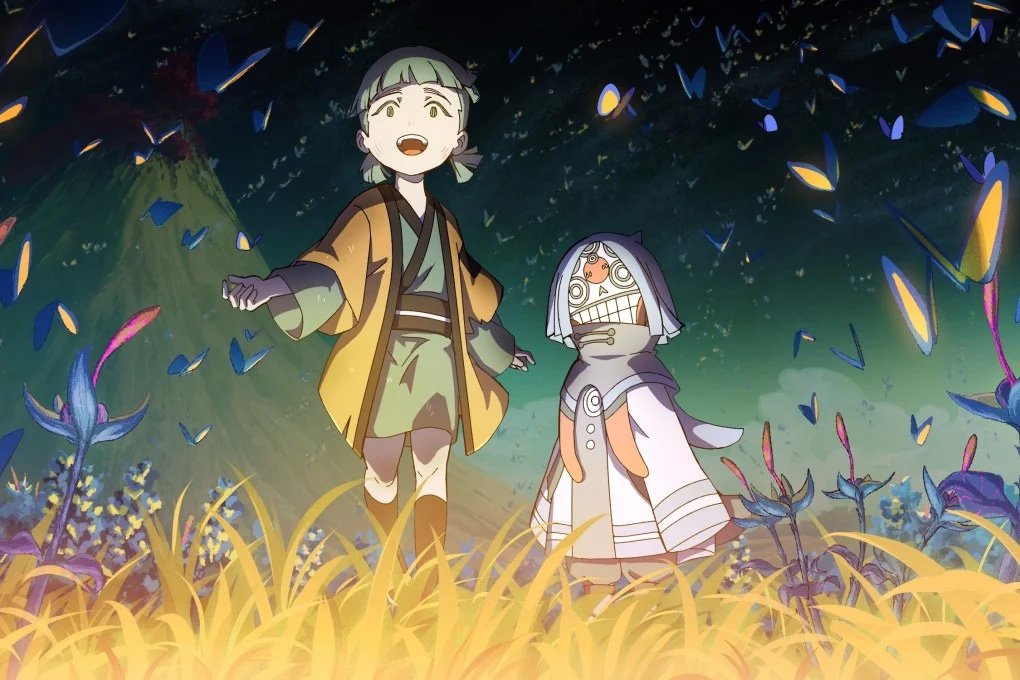
The animation in “Another World” is top-notch, with 2D and 3D elements unfolding harmoniously together. The beautiful backgrounds are brimming with colors, surreal visions, and a peaceful, ethereal atmosphere in the afterlife, while in stark contrast, the human world is defined by colors that are often dark and muted. As noted before, the style is very close to classic Japanese anime, to the point that the Cantonese audio can sound somewhat unusual, yet it is very welcome as a reminder of the film’s cultural identity. It was particularly amusing to hear the character Dark Sky (voiced by Louis Cheung)—perhaps the film’s only source of comic relief—speaking in his typical Cantonese, matter-of-fact tone about humans: “They reap what they sow”!
Great care has gone into designing the main character, Gudo, whose attire is apparently inspired by Tibetan ritual clothes and a crooked mask that at first glance seems more fitting for a horror movie than a sweet little gnome you end up caring deeply about. It would have been an easier ride just to make him cute, but the real success lies in the way we gradually come to love this oddly misshapen creature. A special mention must be made of the original score by Adlian Chou, CMgroovy, and Vicky Fung, which is consistently stirring and emotional, yet never spoon-feeds the audience’s reactions.
Heart-wrenching and exhilarating at the same time, “Another World” ultimately reaches deep inside its audience. Despite its narrative challenges, it stands as a significant achievement for first-time director Tommy Ng Kai-chung and one that could have a meaningful impact on the future of Hong Kong animation industry.



