
As the Asia-Pacific finds itself in the crosshairs of intensifying geoeconomic competition and strategic rivalry, plurilateral agreements provide a crucial safeguard – and strategic opportunity – to weather the volatility in the global economy.
Nowhere is this more evident, or more consequential, than in the Regional Comprehensive Economic Partnership (RCEP), the world’s largest trade agreement to date.
Being the first and only pan-Asian trade agreement, RCEP presents a significant opportunity to enhance the Asia-Pacific’s position in global production networks as firms reassess supply chains amid mounting global uncertainties.
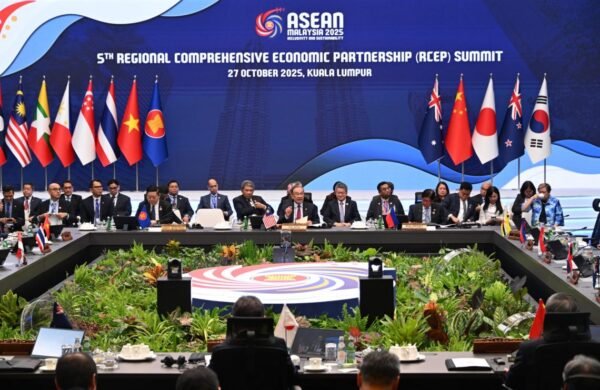
Speaking at the fifth RCEP Summit held at the 47th Association of Southeast Asian Nations (ASEAN) Summit in October last year, Singapore’s Prime Minister Lawrence Wong noted that RCEP “sends a very clear and important signal that we have a stake in each other’s development, and we are committed to rules-based trade.”
With RCEP’s first general review scheduled for 2026, this is a timely opportunity to assess its relevance and potential amid profound global uncertainty today.
Fast-tracking the full implementation and enhancement of RCEP may be the region’s clearest path to strengthening competitiveness and securing long-term economic resilience – and a chance to anchor Asia Pacific as a leading hub for trade, manufacturing, and investment.
RCEP: the First and Only Pan-Asian Trade Agreement
RCEP comprises 10 ASEAN economies (all except its newest member, Timor-Leste), Australia, China, Japan, South Korea, and New Zealand. That makes it the world’s largest trading bloc, accounting for roughly 30 percent of global GDP.
For the first time, RCEP brings together Northeast Asia’s largest economies – China, Japan, and South Korea – within a single framework. Together, these three countries alone account for over a quarter of global GDP and more than 80 percent of the bloc’s GDP.
By eliminating tariffs on over 90 percent of merchandise trade within the bloc, RCEP unlocks unprecedented preferential access among the three economies. This delivers significant gains for the scale and depth of regional trade and production linkages given that they are the top contributors to intra-RCEP trade.
Research from the Asia Competitiveness Institute (ACI) at the Lee Kuan Yew School of Public Policy found that, in 2022, China’s merchandise trade within the bloc amounted to approximately $714 billion in imports and $944 billion in exports, representing nearly one-third of its overall trade. Japan followed with around $420 billion in imports and $318 billion in exports, making intra-RCEP trade nearly half of its total trade. Comparable values and shares are observed in the case of South Korea.
These linkages are reinforced by investment flows, with China, Japan, and South Korea – ASEAN’s “Plus Three” dialogue partners – collectively contributing over 40 percent of FDI inflows to ASEAN countries.
The synergy between ASEAN and its Plus Three partners is a powerful engine for regional integration. Advanced manufacturing in the Plus Three economies complements ASEAN’s growing role as a major production base. High-value intermediates from these upstream economies flow into countries like Cambodia, the Philippines, and Thailand, which serve as final assembly hubs for regional consumer markets.
RCEP thus holds substantial promise for strengthening supply chains and economic integration across the Asia Pacific. Realizing these gains, however, will require members to move decisively to improve implementation, particularly with respect to what is arguably the agreement’s most significant feature: its Rules of Origin (RoO).
RCEP’s Crown Jewel: Unified Rules of Origin
RCEP’s crown jewel, its unified rules of origin (RoO), effectively treats all 15 members as a single market. The RCEP RoO allows inputs from any member to count as regional content and requires only 40 percent of a product’s value to be added within the bloc in order to qualify for preferential tariffs. In doing so, RCEP lowers the barriers to cross-border production in a region already sharing highly integrated supply chains.
The implications are significant. Firms whose products meet the above regional cumulation requirement gain preferential access to all 15 markets in the bloc, creating powerful incentives for firms to restructure supply chains within the region.
These incentives are amplified by the participation of China, Japan, and South Korea, which together account for 40 percent of global manufacturing.
The benefits of RCEP’s RoO extend well beyond the bloc. By locating production or sourcing key inputs from RCEP countries, firms based outside the bloc can qualify their products as RCEP-originating and gain zero-tariff access across all member markets.
This is a compelling opportunity for businesses eager to tap into the region’s fast-growing consumer demand and manufacturing base.
In theory, RCEP is thus well positioned to drive deeper supply chain integration across Asia Pacific. However, in practice, significant challenges remain.
Fast-tracking RCEP
For RCEP to deliver on its promise, it must offer additional value that motivates firms to expand and integrate their supply chains within the bloc.
The costs of switching from existing well-utilized ASEAN+1 FTAs to RCEP are a non-trivial hurdle to RCEP uptake. This is especially so when the RCEP tariff regime offers limited advantages for RCEP members that already have deep tariff elimination under their existing agreements, as ACI research found. For example, the ASEAN Trade in Goods Agreement provides zero tariffs on 98.6 percent of goods, and the ASEAN-China FTA has 94 percent coverage.
Fast-tracking RCEP therefore requires accelerating tariff schedules, the longest of which spans a 25-year period. But that’s not all. The real test lies in how effectively the RoO is implemented.
Streamlining the RoO process is critical to encouraging firms to leverage RCEP. Harmonizing protocols on the self-certification of origin would substantially reduce the burden of time and compliance costs typically associated with complex RoO procedures – costs that often deter firms from using trade agreements.
Concretely, this means standardizing operational certification procedures, including origin documentation and self-certification authorization procedures. It means digitalizing customs management systems to enable direct and secure exchange of origin certification data between customs authorities, which will expedite clearance. Also necessary is creating a centralized portal to help firms navigate complicated regulations by offering guidance and resolving compliance issues.
Taken together, these steps would dramatically reduce administrative complexity for firms, especially small and medium-sized enterprises. By lowering procedural friction, they help firms overcome the inertia of shifting from older deals to RCEP. This will determine whether RCEP becomes an agreement firms embrace or one they quietly bypass.
Becoming the World’s Next Hub
The shared imperative to foster stable and resilient supply chains is increasingly clear. The launch of the Future of Investment and Trade (FIT) Partnership – a non-binding agreement among 16 small to medium-sized countries including Malaysia, New Zealand, and Singapore – in September 2025 reflected a growing consensus around the need to reinforce predictable supply chains through rules-based cooperation.
This reality is further reinforced by the growing network of green and digital shipping corridors, which support supply chain integration by improving operational efficiency and interoperable maritime connectivity. Among RCEP members, Australia, China, Japan, South Korea, and Singapore are actively advancing such corridors.
These efforts coincide with a wider reconfiguration of global supply chains towards Southeast Asia, driven primarily by China+1 strategies and friendshoring. FDI flows to the ASEAN-6 economies (Indonesia, Malaysia, the Philippines, Singapore, Thailand, and Vietnam) jumped 5.5 percent in 2022 from the year before, underscoring the region’s appeal as a production and investment base.
By fast-tracking RCEP, its members can capitalize on these prospects to achieve deeper economic integration and consolidate Asia Pacific’s role within global production networks.
In Wong’s words, RCEP “keeps alive the promise that countries can achieve more together than alone.”
Echoing this sentiment, Philippine President Ferdinand R. Marcos Jr., has emphasized the need to strengthen RCEP as a platform that “ensures that our region remains a vital force in the global economy.”
Done right, RCEP can sharpen the region’s economic edge, anchoring Asia Pacific as a pivotal hub in the global economy.



