
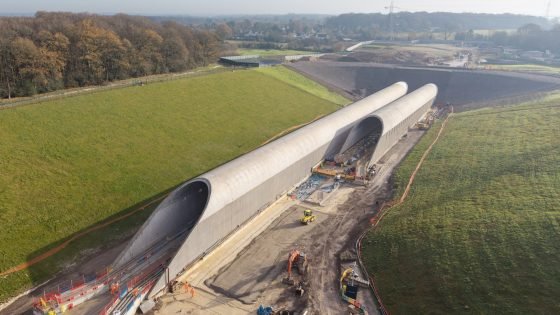
Creation of the porous portals on the North and South ends of HS2’s Chiltern tunnel required a series of technical concrete pours, NCE heard from the project’s engineering lead.
The twin-bore Chiltern tunnel is the longest on HS2, running 16km through the Chiltern hills between Hertfordshire and Buckinghamshire. It was built by Align JV (featuring Bouygues Travaux Publics, Sir Robert McAlpine and VolkerFitzpatrick), which completed the tunnel boring machine (TBM) drives for the main tunnels in early 2024.
However, construction of the extensive and specially-designed portals at either end continued for some months after.
On both ends of the tunnel bores, the portals extend out of the ground in a cutting. At each end, the entry is 220m long and the exit is 135m long. Initially the entries and exits were designed to be the same length, but this was changed to “avoid interfaces”, according to Align JV engineering lead for the porous portals Jean-Lou Grenard.
“If, by any chance, a train went in at the same time as a train went out [on adjacent portals], there would be some uncontrollable effects,” he added.
This begins to explain what is special about these portals; they have been designed to be “porous”, so that air can dissipate and not create a “sonic boom” heard on other high-speed rail lines around the world.
A sonic boom is an audible phenomenon heard as a loud “thud” coming out of the tunnels. It is caused by “micro pressure waves” that are pushed through the tunnel when a train enters at high-speed. The portals on the Chiltern Tunnel have been specially designed to have “windows” – i.e. holes – every 4m along their length to dissipate these waves and stop the sonic boom emerging.
The portals are “porous” as they have windows every 4m to stop micro pressure waves building up in the tunnel
While both the entry and exit portals have the windows, they are more critical on the entry portal, where the micro pressure waves would be generated if they weren’t porous. This is why the entry portal is longer, so it can have more windows and therefore let more pressure escape.
The solution to the problem is quite simple, but casting the portals was a technical process for the Align team.
Walls
Work started on the South portals sooner as that is where the TBMs launch from. By the time work had started on the North portals – where the TBMs concluded their drives – the method had been perfected.
For the walls, Align used a specialised formwork to pour both sides at the same time.
“Each formwork panel was 2m wide, but the length of the pours was 12m [on the North portals], so we had six formworks next to each other for each pour,” Grenard said. “They were held by a travelling gantry on rails which sat in the middle of the portal. It had two lifting beams on both sides and each held one set of panels, keeping them vertical.”
The height of each portal increases from 4.5m at the point where connects to the end of the tunnel bore to 7.5m at its finish, where the trains enter or exit.
“We were extending it as we went,” Grenard said. “Initially the formwork was 4.5m and every couple of pours we extended it around 500mm, always keeping safe access to the wall.”
One of the efficiency improvements at the North compared to the South was the decision to place the steel reinforcement for the walls ahead of time, instead of doing it on the floor in a prefab yard.
“[At the South portals] we didn’t foresee that the installation of the reinforcement would require a lot of time,” Grenard said. “So, at the North portal we did it in situ because the steel fixing was fairly easy; just straight horizontal and vertical bars.”
This meant it could be put in place ahead of the concrete pours – it was generally about 60m ahead of the concrete works. However, it meant the reinforcement had to be stabilised by steel columns to reduce the possibility of the steel bars becoming deformed in the wind.
To create the windows in the walls – to make them porous – Align used a square panel inside the formwork every 4m to leave a void. This was another element that improved as the team progressed from South to North.
“For the first portal that we did we used a wooden formwork panel that we were moving by hand and fixing into place, but this was a bit lengthy,” Grenard said. “At the North portal we managed to design a metal panel that we could just hang on the wall formwork, so it travelled with it. It avoided manual handling and any adjustments that might have been needed were fairly easy.
“The metal was also sturdier than the wood when it came to striking it out. Though, after the last one, it was a bit of a struggle.”
Another lesson from the South portals to the North portals was reducing the length of the wall pours from 18m to 12m.
“It was a mix between efficiency and price reduction because we noticed that the productivity of the wall seemed to be proportional to the length of the formwork, meaning if we had a shorter formwork it would be cheaper while being as productive,” Grenard said.

Architect Grimshaw stipulated that the external walls be textured
Setting up for the hood pours
Casting of the portals’ curved hood was the most technical part of the portals as it required two formwork gantries: an internal and an external. The internal gantry rolled on tracks between the walls, while the external gantry above it rolled on tracks affixed to temporary cantilevered platforms attached to the outside of the walls. Both were 18m long.
“Unlike the walls, we found that a shorter bay would not impact the duration of the cycle, so we kept the gantries at 18m for the North portals,” Grenard said. “Additionally, this saved a lot of time and money as the design of the gantries was already done.”
New gantries had to be ordered for the North portals as there was some overlap in the mobilisation with works on the South portals.
Explaining the process of constructing the hood sections, Grenard said: “The first step is the installation of the internal gantry. Just as with the wall formwork, the internal gantry was moved into place while slightly overlapping at the end of the previous pour. Once this internal side of the formwork is installed you can start oiling and ensuring there will be no leaks when it comes time to pour the concrete.”
The next step is to put in place the steel reinforcement cages. For each 18m bay, these came in four prefabricated sections – two for each side of the arch that would be positioned to meet in the middle over the top of the internal formwork.
Whereas on the South portal the crane would go to pick up the reinforced cages, at the North portal SPMTs were used to transport them from the yard to the crane. This simple modification shaved roughly a day off each 12-13 day cycle, according to Grenard.
The pieces were assembled horizontally on the ground and then lifted using a crane. A tilting tool meant that these prefabricated steel cage arcs could be rotated into the correct angle while being lifted by a crane.
“While it was in the air we used a remote control to incline the cage to the right position,” Grenard said. “This is a big improvement because traditionally this operation would be done with a chain, meaning people would have to be very close to the lifting, which can be dangerous. This was a very simple tool, but it was much more comfortable.”
Once the four quarters of the steel reinforcement cage were in place, some minor steel fixing was done in situ to complete the installation. After this was inspected, the Align team could move the external gantry over the top.
The external gantry was held up by temporary cantilevered platforms on the outside of the portal walls. This is another element that saw design improvements between the South and North portals.
Rather than have platforms that went along the whole length of the portal, Align had about “two and a bit” bays’ worth of the platforms – around 42m in total – that could be demounted from the walls when no longer needed and moved along to where the team was working. On the North portal, the sections of platform were made to be three times longer than they were at the South portal so that their demounting and remounting was more efficient.
Additionally, at the South portal, the external gantry ran on wheels on these platforms, but this was modified to rails for the North portal. “Sometimes the wheels went a bit too much right or left, so having it on rails made sure it was always at the correct location,” Grenard said.

Casting the curved hood sections on top of the walls was the most technical aspect
Pouring the hood concrete
Once the external formwork was rolled into position, its two sides were closed over the top of the reinforced steel cage arch.
“We pulled the two halves closer together and tightened it with some bars threaded through the walls,” Grenard explained. “We made sure it was aligned with the internal side so we knew it was in the correct position.”
The next stage was to pour the concrete through holes in the external gantry using mobile pumps on the back of trucks parked alongside the tunnel. “We needed to ensure that we had a balanced level of concrete on both sides,” Grenard said. “During the pour, the pressure increased on both sides of the formwork so we needed to make it symmetrical, otherwise there would have been too much weight on one side which could have tipped the formwork.
“The pours were pretty long because the concrete rose about 75cm to 1m per hour. Additionally, the pressure applied to the formwork was a limiting factor, so we had gauges throughout telling us how much force the concrete was applying. Also, typically, the concrete cured faster in summer and slower in winter.”
Lastly, the top of the arch was finished by hand, as the external formwork did not close completely and left a 2.5m gap.
“We looked at closing the top of the formwork but structurally this would have been really constraining because it would add massive upward forces pulling towards the top,” Grenard said. “It would have required a massive structure to keep the formwork in place.”
Usually, to compensate for the pressure in a situation like this, there would be holes through the concrete. However, there was a requirement for there to be no holes in the hood to ensure that nothing can fall on the trains or overhead line equipment, nor is there any risk of a maintenance worker falling in.
A possibility was to put bars through the concrete during the pour, to be filled in later, but “it would have been difficult to ensure that the filling product would never fall down onto a train”, according to Grenard.
“Also, not having any bars for the pressure meant that once we were finished pouring, we had a finished product,” he continued. “It saved us going back and spending some hours and doing some finishing which would look a bit crap on the curved surface.”

The final step was the tapered ends
Finishing the job
The last part of each of the portals are the tapered ends, where the concrete hood slopes down for the last 10m to the ground.
This was done using the same formwork systems, but with wooden formwork pieces inserted to create the angle in the concrete.
“There were eight pieces of wood, four on each side, which were symmetrical and installed in a similar manner as the reinforced steel cages,” Grenard said. “We used the same method to lift them into place, which saved people adjusting them by hand which would have been time consuming and possibly unsafe.”
With all of the design and efficiency improvements carried from the South portals to the North, the Align team was able to cut the time for construction from 20 months to 12 months.
Like what you’ve read? To receive New Civil Engineer’s daily and weekly newsletters click here.
Source: www.newcivilengineer.com



