
The Diplomat author Mercy Kuo regularly engages subject-matter experts, policy practitioners, and strategic thinkers across the globe for their diverse insights into U.S. Asia policy. This conversation with Dan Tadross – head of the public sector at Scale AI, co-author of the recent paper Agentic Warfare, and a founding member of the Joint Artificial Intelligence Center, a precursor to the Pentagon’s Chief Digital and Artificial Intelligence Office – is the 493rd in “The Trans-Pacific View Insight Series.”
Provide a high-altitude view of the current state of the China-U.S. AI race.
We are moving past the initial hype of generative AI and entering a decisive new era of agentic warfare. The agentic warfare race is about who can operationalize true AI agents – systems capable of independently planning, reasoning, and executing complex tasks. This evolution is critical to achieving decision advantage.
The United States currently retains a fragile first-mover advantage. We possess a thriving AI ecosystem, the world’s most advanced frontier models, and deep data repositories. That said, our counterparts on the global stage are rapidly catching up. China, in particular, is aggressively pursuing a strategy that couples industrial mass with AI sophistication to build what they have termed “command brains” that can coordinate autonomous swarms and optimize battle plans at machine speed.
The defining metric of this race is speed to decision. The nation that first fully integrates agentic systems into its command-and-control architecture will be able to observe, orient, decide, and act faster than its opponent can process. This includes the necessity to update our training and doctrine regarding how we integrate these technologies.
Identify the AI areas in which either country has dominance and the factors behind its competitive advantage.
The United States dominates in the underlying technology stack, specifically in the development of frontier models and the complex engineering required to align them. Our country’s advantage stems from a decentralized, fiercely competitive private sector that innovates faster than any state-directed apparatus could. The Pentagon and administration have recognized the importance of promoting the U.S. tech stack globally.
China, meanwhile, is a leader in rapid adoption and civil-military fusion. In the first half of 2024 alone, China launched 81 separate projects deploying LLMs (large language models) in government applications. Their success is not necessarily in the model architecture itself, but in their willingness to flood the zone with applications.
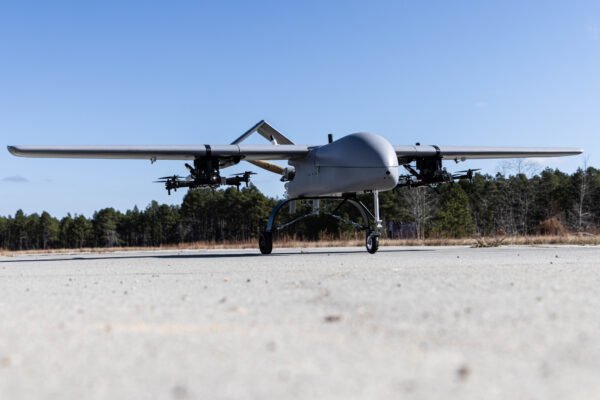
Specifically, China is aggressively fielding autonomous hardware. They are coupling AI with mass production to create drone swarms and “loyal wingman” concepts intended to saturate U.S. sensors. Their portfolio now includes hundreds-strong truck-launched drone swarms for Taiwan scenarios, loyal wingman escorts, experimental drone carriers, and heavily armed uncrewed surface and underwater vessels.
This highlights a critical emerging challenge regarding robotics data. Image-to-action models are foundational to the future of embodied AI. If we rely on data from China, then we will be at the mercy of bias in those datasets and the supply chain of data coming from China to drive U.S. development of robotics models.
Evaluate the U.S. military’s advancements in AI-specific defense capabilities.
The Pentagon is currently bridging the gap between experimentation and operationalization. Early efforts successfully brought computer vision into intelligence workflows. However, the most significant recent advancement is the shift from using AI as a chatbot to using AI as a mission partner with agentic capabilities.
We are seeing this in two critical areas: agentic alerting and agentic planning. In alerting, we are moving beyond static sensor fusion to dynamic systems, where AI agents actively hunt for anomalies across multi-modal data streams, identifying threats like hypersonic missiles or submarine signatures, even in crowded and noisy theaters.
We are seeing the most profound shift when it comes to planning. Traditional military planning cycles can take months; agentic systems are being architected to generate and validate courses of action (COAs) in minutes. Coupling agents with physics-based simulations aim to give commanders the ability to run thousands of “what if” scenarios before the enemy moves. The urgent priority should be to fully develop prototypes and quickly transition them into permanent Programs of Record.
Examine the quality of data that China and the U.S. are leveraging in developing large language models.
Data is the fuel of agentic systems, but quality matters more than volume. China benefits from a vast collection of civil data. However, military AI requires distinct operational data such as telemetry, logistics flows, and combat realism, where the U.S. holds an edge.
The U.S. military possesses petabytes of data from decades of global operations. The challenge has been data readiness, or cleaning and structuring this data so it is machine-readable. We are making significant strides here. However, as we enter the age of agentic warfare, we must remain vigilant against data manipulation, since data will be a high value attack vector. Adversaries will attempt “indirect prompt injection” or data poisoning to mislead our systems.
Furthermore, there is a distinct difference in trust. U.S. development emphasizes Test and Evaluation to ensure data integrity and model alignment. We are building systems where commanders can trace the logic behind an AI’s recommendation. China’s black box approach may yield speed, but it risks catastrophic miscalculation in a crisis. This is a vulnerability we must understand and prepare appropriately.
As China rapidly deploys AI systems, what actions should the U.S. military pursue to accelerate AI development for defense and national security?
To secure our advantage, we must reimagine our way of war. We need a doctrinal shift from keeping humans “in the loop,” approving every action, to keeping commanders “on the loop,” or setting intent and managing risk while machines execute at speed.
Tangibly, as we underscored in Scale’s new white paper on agentic warfare, this means the Pentagon must aggressively transition proven agentic prototypes into the hands of warfighters now, not in five years. This requires utilizing new acquisition authorities to bypass legacy bottlenecks. Pentagon leadership increasingly understands this need.
Second, we must transform our alliances into agentic coalitions. We should be integrating agentic planning and alerting layers with key allies like AUKUS and NATO partners. If we fight at machine speed but our allies are stuck on manual processes, the coalition breaks.
Finally, we need to treat decision advantage as a primary weapons system. This means rewriting professional military education to ensure officers are data-literate and capable of commanding agentic teams. The U.S. has the technology. We now need the trust and the training to unleash it. If we do this, we can deter potential adversaries by rendering their calculations of victory impossible.



