
China’s official rhetoric about NATO has hardened in recent years. China accuses NATO of stirring up “bloc confrontation” in Asia and has labeled the organization a “Cold War remnant.” Chinese spokespeople have further attacked NATO’s legitimacy, alleging that the alliance has “bypassed the U.N. Security Council and waged wars against sovereign states, creating huge casualties and leaving tens of millions displaced.”
Despite the tough talk, China is not that concerned about NATO. As we document in a new article in International Affairs, Chinese scholars and think tank analysts believe NATO’s Asia-Pacific engagement will have a limited impact on China’s security. The reason is twofold: They see NATO as divided and believe European member states lack the hard power to affect the balance of power in the Asia-Pacific.
The crisis in transatlantic relations has eased China’s concerns even further. In the past, many Chinese analysts argued openly in favor of engaging European states to keep the alliance divided. With U.S. President Donald Trump’s return to power, China sees less need to make such efforts. The chaos Trump has unleashed – most recently with his threats against Greenland – is a strategic gift, undermining NATO free of charge to China.
Plenty to Dislike…
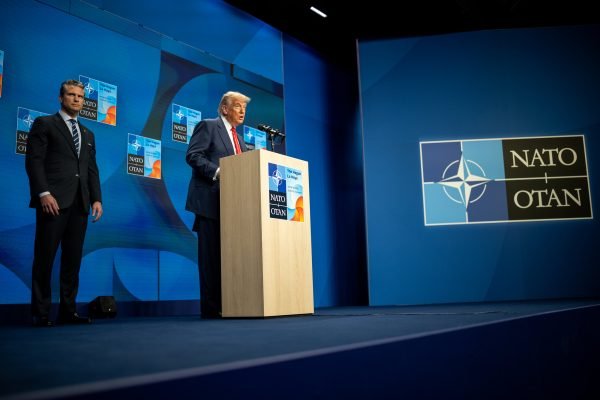
NATO’s increasing Asia-Pacific engagement began in earnest with the publication of the new Strategic Concept in June 2022, which claimed that China’s “stated ambitions and coercive policies challenge our interests, security and values.” NATO has been bolstering ties to its Asia-Pacific partners, including by inviting leaders from Japan, South Korea, New Zealand, and Australia to its summit meetings.
In addition, several European states have deployed naval vessels to the region in recent years. These deployments have not been NATO operations, but Chinese scholars sometimes misleadingly label them as such.
Like their leaders, Chinese scholars and think tank analysts find much to dislike about these developments. Many regard the United States as the real architect of the Asia-Pacific engagement policy and see this policy as one cog in a greater U.S. plan to contain China’s rise. They further claim the United States used Russia’s war in Ukraine as pretext to strengthen transatlantic unity over China policy. Chinese analysts worry the shift in NATO policy may damage Beijing’s relations with European states (albeit without much reflection on how China’s own support for Russia has contributed to this).
Chinese observers also dislike NATO’s deepening ties to Japan. Through cooperation in research and development and stronger defense industrial ties, they worry that Japan can bolster its military power. They see the United States as actively promoting a “remilitarization” of Japan to keep China in check, while reducing the U.S. strategic burden.
South Korea’s growing ties to NATO and European countries more broadly are also viewed with suspicion, as both South Korean arms sales and industry and technology collaboration may strengthen South Korean capabilities.
…But Less to Fear
Unlike government spokespeople, Chinese observers openly debate the shortfalls of NATO’s Asia-Pacific engagement. They find much less to fear than the official rhetoric would suggest. Being steeped in a deeply realpolitik paradigm, their assessments are frequently centered on how NATO may affect the balance of power in the region. This influence, they find, is ultimately limited.
The first constraint facing NATO – and European member states – is simply a lack of hard power. According to one group of scholars, “Even Britain, France and Germany, which are at the forefront of strength, find it difficult to project sufficient military power in the Indo-Pacific region.” Moreover, many believe that Europe will need to prioritize its limited capabilities on deterring Russia, which will further impede both European states’ willingness to operate in the region, and possibly also NATO’s Asia-Pacific engagement.
More broadly, they indicate that European members have lacked foresight by ignoring the importance of military might. In a particularly harsh analysis, a researcher from the Chinese Academy of Social Sciences argued that “the Ukrainian crisis exposed the huge drawbacks of the European countries’ power model based on normative power.”
The second constraint is a lack of alliance cohesion. Chinese observers recognize how divided alliance members have been in terms of their China policy. They highlight that many European states want to maintain their economic relationships to China, and that U.S. and European views of the threat originating from Beijing frequently diverge. In addition, they see weaknesses in NATO’s ties to partners in Asia and claim China has leverage to limit particularly South Korea’s security alignment with the alliance. As long as the alliance cannot agree on threat perceptions, there is, from Beijing’s perspective, less need for concern.
Trump-inflicted Wounds
In the not-so-distant past, many analysts suggested that China should take active efforts to keep NATO divided. Several claimed that economic and trade engagement of select European countries could ensure that transatlantic (as well as inter-European) perspectives on China would continue to differ. Others called for influencing European narratives. Through carrots, charm offensives, and potentially manipulation, China could continue to drive wedges into the alliance.
During the last year, however, Chinese leaders do not seem to have listened to this advice. The China-EU summit in July 2025 had no significant deliverables and did little to improve relations with Europe. Xi Jinping snubbed an invitation to Brussels. Clearly, Chinese leaders did not see a need for a charm offensive toward Europe.
A crucial reason for the lack of a charm offensive is the Trump administration’s disdain or even open contempt for Europe, and the chasm in transatlantic relations. For China, there is simply no longer much need to bribe Europeans – the United States is giving Beijing the divisions it wants for free. As the former secretary general of the European Parliament, Klaus Welle, stated back in February 2025, “This is what they have always wanted – to see the transatlantic alliance divided. I am just surprised they did not bring cake to celebrate.”
Seen through this lens, the U.S. president’s calls for obtaining control over Greenland give Beijing even more room for celebration. Trump is justifying his demands in part by pointing to China as a threat, including by making false statements about major Chinese (and Russian) naval activity around the island. Ironically, these falsehoods and the ruptures the Greenland debacle has created within the alliance strengthen China’s hand. As Kaja Kallas, the EU’s foreign policy chief, stated after Trump threatened to impose tariffs against Denmark’s supporters, “China and Russia must be having a field day.”
Speaking the Language of Power
A seemingly obvious way to address the current predicament would be to foster greater transatlantic unity. For European states, the prospect of greater coordination with the United States over China policy could also provide leverage over Beijing. Unfortunately, with the Trump presidency, such a suggestion appears detached from reality. The Trump administration is clearly uninterested in working with allies in a pragmatic manner, having instead chosen to repeatedly attack them. Moreover, Chinese leaders regard European leaders as weak and would likely view any coordination on China policy as the result of U.S. pressure alone.
Some European states may find it tempting to disengage from the Asia-Pacific. Although one can certainly debate whether it is a good idea to spend scarce resources by deploying European military forces to the region, continued engagement is in Europe’s interest. A Europe that must rapidly rearm needs defense industry partnerships, which both South Korea and Japan can provide. As the United States looks increasingly less reliable, purchasing weapons from other states – and reducing dependence on the U.S. – is beneficial. In addition, European states can collaborate with partners in the Asia-Pacific to build more resilient value chains.
More broadly, Chinese analysts’ thinly veiled disdain for weakness should be a lesson for European leaders. We are entering a world where might make right and where appeals to shared norms and values do not take you very far. Xi Jinping and Donald Trump are very different leaders – the former is shrewd; the latter is mercurial or even incoherent – but a trait they share is respect for power. To avoid being the prey in a world of strongmen, Europe needs to step up. It needs to learn to speak the language of power.



