
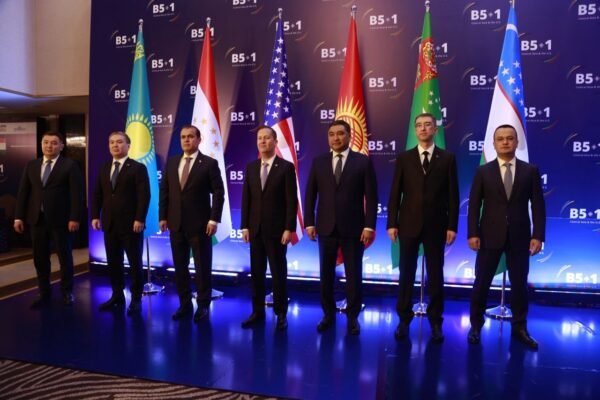
In Kyrgyzstan to attend the B5+1 Business Forum, U.S. Special Envoy for South and Central Asia (and simultaneously U.S. Ambassador to India) Sergio Gor brushed aside concerns about the tightening of visa policies toward Kyrgyzstan amid a push to deepen business relations with the Central Asian region.
Gor spoke at a press conference on February 4, highlighting the Trump administration’s ambitions in Central Asia.
He said he came with a “simple and clear message directly from President Donald Trump: The United States wants to work with Central Asia and views this region as a priority. This is a commitment that we intend to consistently develop over the next three years of the current administration.”
Gor argued that “for too long, the United States did not pay attention to this area. Under President Trump’s leadership, that is something we aim to change.”
He pointed to the C5+1 summit at the White House in November 2025 as illustrating the Trump administration’s focus on the region. Gor’s comments appear to purposefully ignore the efforts of previous administrations to reform and update U.S. relations with Central Asia.
The C5+1, launched in 2015 under the administration of Barack Obama, has served as a primary format for the U.S. approach to the region. In 2023, then-U.S. President Joe Biden hosted the first C5+1 presidential-level summit on the sidelines of that year’s annual U.N. General Assembly. The Biden administration also launched the B5+1, describing it as “a private-sector-led counterpart to the C5+1.” The inaugural B5+1 Forum was held in Almaty, Kazakhstan, in March 2024.
Gor said the November 2025 summit reflected “the strategic importance we attach to the region, and it is on this basis that we intend to build further cooperation.”
The November 2025 C5+1 summit was accompanied by a business-focused conference at which a bevvy of deals were signed. But the summit resulted in no overarching joint statement; rather it turned out a “Joint Statement of Intent on Economic Cooperation,” a statement on cultural heritage, and five separate bilateral statements, which together revealed the new math of U.S.-Central Asia relations. As I wrote in the wake of the summit:
The Trump administration’s approach is much more narrowly focused on economic and commercial matters, with achievements defined by dollar amounts. If once U.S. policy toward Central Asia hinged on Afghanistan, it now turns on issues like critical minerals, purchases of U.S. products, and investments.
How Central Asia – beyond narrow elite circles – will benefit is less clear. Other U.S. policies, particularly regarding immigration, chip away at the veneer of genuine U.S. interest in deepening connections with Central Asia.
In January, the U.S. State Department expanded the list of countries subject to the visa bond program under which travelers wishing to obtain nonimmigrant visas to the U.S. will have to pay between $5,000 and $15,000. Kyrgyzstan was included alongside Turkmenistan and Tajikistan in the list that now stretches to 38 countries.
Also in January, the State Department paused processing of immigrant visa for 75 countries, including Kazakhstan, Kyrgyzstan, and Uzbekistan.
Reporting last year by RFE/RL highlighted increased visa denials for those seeking student visas from Kyrgyzstan.
And so, regardless of visa type – travel, business, immigration, or student – barriers for Kyrgyz citizens seeking to enter the United States have been clearly erected under the Trump administration.
On this, Gor merely commented that the policies were not directed at any specific Central Asian country, but more than 70 countries.
“This, of course, concerns illegal migration – we must strengthen controls. Therefore, to ensure greater security, we are forced to review our policy. Our visa policy is not only for our own interests. The U.S. goal is to maintain its borders,” he said.
Applying for, and traveling on, a visa is by definition not illegal migration. U.S. concerns seem to be tied to visa-overstay rates, but the policies pushed out – such as the bond program – don’t actually address that issue.
U.S. citizens enjoy visa-free access to Kazakhstan, Kyrgyzstan, Tajikistan, and now Uzbekistan.



