
Software firm Autodesk made a $2.7-million investment Feb. 2 in Qualis Flow, a London-based company also known as QFlow that offers a platform aiming to improve how construction materials and waste data are captured, verified and used on project sites.
The San Francisco-based tech giant has diversified its investments in recent years into areas of construction such as prefabrication and materials management. QFlow’s artificial intelligence-enabled platform helps contractors identify supply chain and materials issues earlier in design and analyze their use on jobsites. Real-time material quality, quantity and supply-chain intelligence are added into design data using QFlow’s platform.
The company says it can help contractors pinpoint and resolve material-related issues before they cause delays, rework or budget overruns.
“Too often, materials and waste data are captured manually, fragmented across systems or reconciled long after the fact,” said Sid Haksar, Autodesk vice president and head of construction strategy and partnerships, in a statement. “That can limit the accuracy of sustainability reporting, mask opportunities to reduce rework or over-ordering of materials and create inefficiencies in quality control and supplier payment processes.”
QFlow. which remains an independent company, said its partnership with Autodesk’s cloud-based construction management platform launched the process that became the eventual investment.
“Construction teams are being asked to deliver more than ever before: better margins, lower carbon and stronger compliance,” said Brittany Harris, QFlow co-founder and CEO. “However, they can’t do that without better site data. This investment from Autodesk is a strong endorsement of our approach and vision of the role that construction-phase data and intelligence must play in building more responsibly.”
DeWalt Debuts Downward-drilling, Data Center-targeted Robot
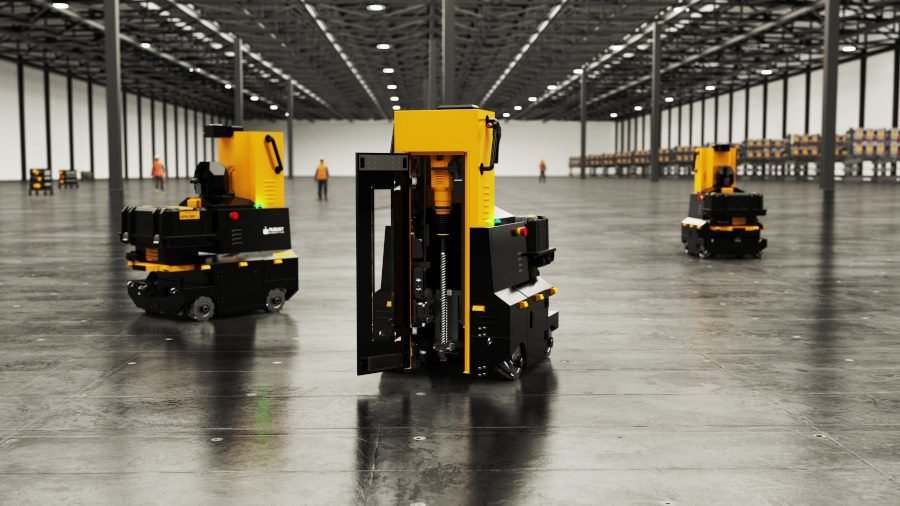
The DeWalt brand of equipment maker Stanley Black & Decker has introduced a new downward-drilling robot, in collaboration with international mobile robotics company August Robotics. It is the first downward drilling, fleet-capable robot to enable efficient concrete drilling that would accelerate data center construction, DeWalt said Jan. 20 at the World of Concrete trade show in Las Vegas.
Looking for quick answers on construction and engineering topics?
Try Ask ENR, our new smart AI search tool.
Ask ENR →
As the race to meet global AI processing needs intensifies, the company said the robot has completed 10 phases of data center construction over 10 projects—helping to significantly boost work output for one of the world’s largest hyperscalers, which it did not identify. Throughout the ongoing pilot program, the robotic driller was able to drill at speeds up to 10 times faster than traditional methods and reduced construction timelines by 80 weeks on the hyperscaler’s projects.The robot’s use is said to have decreased cost per drilled hole, also delivering 99.97% accuracy of location and depth for more than 90,000 holes drilled.
“Our customers consistently emphasize that speed of construction is critical, said Bill Beck, president of Stanley Black & Decker’s tools and outdoor unit. “The robotic drilling solution meets this need head-on through schedule
acceleration, cost savings, near-perfect accuracy and enhanced jobsite
safety.” The robotic platform will be available to customers by mid-year, DeWalt said.
Buildots: More ‘Work in Progress’ in North America
In analysis of thousands of high-rise units under construction in both the U.K. and North America, Buildots, an AI-powered construction project prediction and management platform, has found key differences in project team work in the two regions.
Buildots researchers sought to determine the accuracy of the long held industry axiom that most building teams are taught to move faster, limit simultaneous “work in progress” and deliberately curtail the number of active work areas, units or tasks that are open at the same time on a project. What they found, however, showed a large gap between North America and U.K. projects in tasks performed simultaneously and speed of delivery.
“North America tends to have more [work-in -rogress] areas than the U.K., but still finishes a higher ratio of open work faster,” said Amir Berman, Buildots vice president of industry transformation. “It wasn’t what we expected to find. We go into this kind of research with a hypothesis in mind, and all of a sudden, we … started to uncover more and more layers to it.”
Across both geographies, the researchers found that the same ramp-up took about 16 weeks for a residential high-rise project to find its flow, he said. “After week 16, projects reached a ‘steady state,’ consistently completing around 43-50% of the units in progress every 30 days. Then the gap emerged,” Berman said.
Despite much higher work in progress numbers, Buildots data showed that North American projects outperform U.K. projects by a significant margin. Teams completed more total units per week and converted a larger percentage of work in progress into finished units.
The North American completion-to-work in progress ratio was 15 to 20% higher than that in the U.K., on average.
Berman said Buildots will continue the research and seek to isolate what drives North America’s greater efficiency numbers and ability to put more work in place simultaneously on projects—applying lessons learned to those of U.K. users.
Doka to Show Formwork Platform at ConExpo
Concrete formwork and scaffolding giant Doka previewed its booth for the triennial Las Vegas CONEXPO-CON/AGG trade show set for March 3-7—touting the expanded Doka360 platform that it said now encompasses all aspects of formwork for contractors.
“Doka is offering more than formwork and scaffolding these days,” said Michael Kennedy, executive vice president of Doka North America at the Feb. 2 preview. “Doka 360 is a new digital platform for planning, ordering, site operations and return logistics in one place.”
The company will show its SuperDek Slab Formwork that Kennedy said refines slab forming with faster cycles, fewer components and a simpler setup. The company also will show Xlife top sheet, Doka’s first formwork sheet featuring a core made entirely from recycled plastic.
OpenSpace Launches OpenSpace Field
OpenSpace Field, an image-based field platform for creating and managing construction tasks and managing issues based off of information captured and stored in OpenSpace’s reality capture platform, was released to general availability Feb. 3.
Source: www.enr.com



