
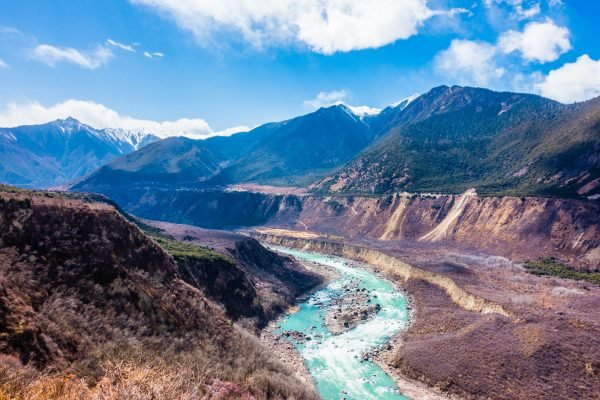
China’s most ambitious hydropower project to date officially entered the construction phase on July 19, 2025, when Premier Li Qiang presided over a groundbreaking ceremony in Nyingchi City in the Tibet Autonomous Region (TAR). Located on the lower reaches of the Yarlung Tsangpo River – known downstream as the Brahmaputra – the project marks a decisive step in Beijing’s long-standing effort to harness Tibet’s immense hydropower potential while advancing broader economic, technological, and strategic objectives.
Known as the Medog (Motuo) Hydropower Station, the complex comprises five cascade dams constructed along a steep Himalayan gorge at the river’s dramatic “Great Bend.” With a projected installed capacity of approximately 60 gigawatts (GW) and annual electricity generation of up to 300 billion kilowatt-hours (kWh), Medog is expected to supply power to more than 300 million people. Its output would roughly match the United Kingdom’s annual electricity consumption and triple that of the Three Gorges Dam. Estimated to cost 1.2 trillion yuan (around $170 billion), the project will surpass Three Gorges Dam as the largest and most expensive hydropower undertaking ever built.
At its core, the Medog project is driven by four interlocking imperatives: securing stable, low-carbon baseload power amid rising energy insecurity; accelerating the strategic integration and economic development of Tibet as a frontier region; providing reliable electricity for China’s rapidly expanding digital and advanced manufacturing sectors; and leveraging large-scale infrastructure to consolidate China’s geopolitical and territorial position along its disputed Himalayan border. Together, these drivers explain not only the scale of the project but also its timing, location, and political significance.
This project exemplifies Beijing’s broader drive to harness Tibet’s immense hydropower potential while advancing economic, technological, and geopolitical ambitions. Formally approved on December 25, 2024, after decades of discussion and inclusion in the 14th Five-Year Plan (2021–2025) and 2035 goals, it signals China’s strategic intent to link energy security, frontier development, and territorial consolidation in the Himalayan region.
Details of the Project and Project Site
The Yarlung Tsangpo originates on the Qinghai–Tibet Plateau and flows eastward across Tibet before turning south into India as the Siang River. Further downstream, it becomes the Brahmaputra in Assam and the Jamuna in Bangladesh before emptying into the Bay of Bengal.
Along this transboundary course, the river sustains roughly 130 million people. It supplies nearly one-third of India’s freshwater resources and approximately 40 percent of its hydropower potential. In Bangladesh, it meets around 55 percent of irrigation needs and supports fisheries that provide livelihoods for an estimated 2 million people.
For India, the river is central to both water and energy security. For China, while the river plays a more limited role at the national level, it remains vital for Tibet’s agricultural production and energy development. These asymmetries help explain why hydropower development on the Yarlung Tsangpo is perceived so differently in Beijing and New Delhi.
The project’s location amplifies both its hydrological and strategic significance. The site lies on the lower reaches of the Yarlung Tsangpo in Medog County, Tibet, just 30 kilometers from the contested border with India and near the river’s “Great Bend” – a dramatic U-shaped turn around Namcha Barwa Peak. At this point, the river, which generally flows eastward across the Tibetan Plateau, suddenly turns southward – plunging nearly 2,000 meters over a 50-kilometer stretch through deeply incised canyons toward India’s Arunachal Pradesh state.
Medog is the final county before the Line of Actual Control (LAC) separating China and India. This remote and mountainous terrain offers exceptional conditions for hydropower generation. Estimates suggest a technically exploitable capacity of nearly 70 million kilowatts, making it one of the most energy-dense hydropower sites in the world.
Strategic Infrastructure at the Himalayan Frontier
Beyond its engineering scale, the Medog hydropower project reflects Beijing’s long-standing approach to governing frontier regions through infrastructure-led integration. Situated in one of China’s most remote and politically sensitive borderlands, the dam complex serves not only as an energy asset but also as a mechanism for consolidating state presence, economic activity, and administrative control in Tibet.
Large-scale infrastructure has long played a central role in China’s strategy toward its border regions, from railways and highways to pipelines and power grids. In this context, Medog is best understood as part of a broader effort to embed Tibet more deeply into national economic and logistical networks. By anchoring local development around hydropower, Beijing aims to create durable fiscal revenues, employment opportunities, and industrial linkages that reduce the region’s dependence on central transfers while strengthening political integration.
The project’s proximity to the disputed Sino-Indian border further heightens its strategic salience. While Chinese officials frame Medog primarily as a civilian energy project, its location at the intersection of energy infrastructure and territorial sensitivity underscores how infrastructure development in the Himalayas increasingly carries geopolitical meaning.
Domestic Drivers: Energy Insecurity and Grid Instability
China’s push to build the Yarlung Tsangpo hydropower dam reflects a convergence of economic, energy, and technological priorities. Beyond stimulating the slowing national economy and promoting local socioeconomic development in Tibet, Beijing views large-scale hydropower as a part of China’s “Green Leap Forward,” essential to the country’s low-carbon transition and long-term growth.
China’s push to develop the Yarlung Tsangpo is also rooted in mounting concerns over energy security and grid stability. Although China possesses the world’s largest hydropower potential – approximately 676 million kilowatts – much of this capacity remains untapped. Tibet alone accounts for more than 200 GW of potential hydropower, or roughly 30 percent of the national total. However, installed capacity in the region stands at barely 1 percent of its technically exploitable potential.
The Yarlung Tsangpo represents nearly 70 percent of Tibet’s hydropower resources, with its lower reaches alone capable of generating an estimated 60-80 GW due to high flow volumes and extreme gradients. As one Chinese energy expert observed, “The day the development of the Yarlung Tsangpo is completed will be the day China’s exploitable hydropower resources are fully developed.”
These resources are increasingly important as Beijing pursues its climate commitments. Large-scale hydropower is a cornerstone of China’s low-carbon transition and broader renewable energy agenda, supporting goals to peak carbon emissions by 2030 and achieve carbon neutrality by 2060. In the nearer term, it contributes to targets of reducing carbon intensity by 18 percent and energy intensity by 13.5 percent by 2025.
Energy security concerns have further accelerated hydropower development. Power shortages and rolling blackouts in 2020-21 exposed vulnerabilities created by overreliance on intermittent renewables. Beijing responded with a dual strategy: approving new coal-fired power plants to stabilize the national energy grid while fast-tracking large hydropower projects capable of delivering reliable baseload electricity.
Although coal still accounts for just over half of China’s energy consumption, projects like Medog are seen as essential to maintaining grid reliability without derailing decarbonization goals.
Powering China’s Enormous Digital and Industrial Transformation
China’s technological ambitions add another layer of urgency to the Medog project. Rapid growth in artificial intelligence, cloud computing, and advanced manufacturing has driven a sharp rise in demand for stable, continuous electricity. For instance, by 2025, China’s computing infrastructure alone is projected to consume around 360 billion kWh annually, while 5G base stations are expected to add a further 140 billion kWh.
These energy demands come amid tightening power quotas and periodic shortages, particularly in eastern and coastal provinces where data centers and high-tech industries are concentrated. In this context, hydropower offers a rare combination of scale, reliability, and low emissions. Electricity generated at Medog is well suited to supporting energy-intensive activities such as large-scale AI training, cloud services, and precision manufacturing – sectors that Beijing increasingly views as key in the intensifying China-U.S. technology competition.
Medog also underpins China’s “Eastern Data, Western Computing” (东数西算) initiative, formally launched in 2022. The program encourages data centers to relocate to western regions rich in renewable energy and cooler climates, easing pressure on eastern grids while promoting greener data center development. In this light, Tibet’s hydropower resources, once considered geographically remote, are becoming central in China’s national computing architecture.
West-to-East Power Transmission and Tibet’s Economic Role
The new Medog hydropower project is closely tied to China’s long-standing West-to-East Power Transmission (西电东送) strategy, which channels electricity from resource-rich western provinces to energy-intensive eastern regions. Tibet’s integration into this national grid began with the commissioning of the Zangmu Hydropower Station in 2015. By 2024, Tibet was exporting approximately 1.791 billion kWh annually to other parts of China via ultra-high-voltage transmission lines.
Once operational (expected around 2033), the Medog hydropower project is projected to generate approximately 20 billion yuan (about $2.7 billion) in annual fiscal revenue for the TAR. The electricity will primarily be transmitted to China’s eastern provinces, including major industrial centers in the Guangdong-Hong Kong-Macao Greater Bay Area, helping meet high energy demand in these regions.
In the longer term, there is potential for Tibetan hydroelectric power – including from Medog – to contribute to electricity exports to energy-hungry parts of Southeast Asia through expanded regional grid interconnections. China is already a significant player in the region’s energy sector, particularly through investments in hydropower projects in countries like Laos and Myanmar, where much of the generated power is exported to neighbors like Thailand and Vietnam. While the Medog project itself is not planned for direct export to Southeast Asia, it could further strengthen China’s role as a key clean energy provider in the region and potentially increase interdependence in cross-border power trade.
The TAR’s own development plans reflect this alignment. Recent regional five-year plans designate hydropower and clean energy bases as core local industries, supported by partnerships with major state-owned enterprises such as China Huaneng Group, PowerChina, and China Three Gorges Corporation. Local authorities increasingly view hydropower as both an economic growth engine and a mechanism to narrow Tibet’s economic gap with the rest of China.
The Medog hydropower project encapsulates how energy security, frontier integration, technological ambition, and geopolitical calculation are increasingly intertwined in China’s infrastructure strategy. While framed domestically as a cornerstone of low-carbon development and regional growth, the project’s scale and location ensure that its implications will extend well beyond China’s borders, particularly for downstream states on the Brahmaputra.
How Beijing manages transparency, data-sharing, and regional engagement around the Medog project will therefore shape not only Tibet’s energy future, but also the prospects for stability and cooperation in the wider Himalayan region.



