
The basics:
- Bagel Bazaar launches a formal franchise model after decades of licensing
- CEO Paul Salas targets 50 franchisees by 2030, 250 by 2040
- Expansion initially focuses on NJ, PA
- Brand emphasizes consistency, quality and the ‘Ultimate Bagel Experience’
In a state that takes bagels seriously, Bagel Bazaar is carving out a name for itself in New Jersey’s breakfast scene with its mix of classic standbys, eye-catching creations and genuinely friendly service.
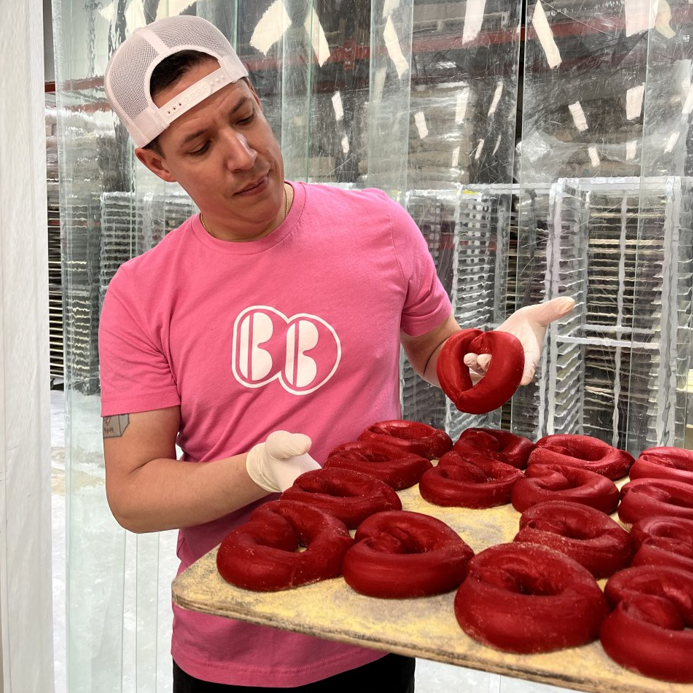
Founded 39 years ago in Edison, the chain is known for its traditional stone-baked, water-boiled bagels that are made fresh daily. Along with a wide variety of about 30 bagels, Bagel Bazaar also offers breakfast sandwiches, more than two dozen kinds of spreads and fair-trade coffee.
On an annual basis, its 10 locations statewide serve 10 million bagels, whip up more than 200,000 pounds of cream cheese, crack 2 million eggs, grill 50,000 pounds of pork roll and cook over 1 million slices of bacon.
Now headquartered in Hamilton, the company also operates a major production and distribution facility where it began baking and shipping bagels in 2024 to customers across the U.S. and Canada.
CEO Paul Salas has been part of Bagel Bazaar’s story for more than three decades.
“The bagel had so much power and endless possibilities for myself and the communities that support us,” said Salas, whose mother came from Puerto Rico and father immigrated from Peru.
Early start
After growing up in New Brunswick, Salas began working behind the counter at the Franklin Park store in 1994 when he was just 15 years old. By age 20, he invested in his first store and began laying the foundation of a lifelong career with the brand.
As CEO for the past decade, Salas is ushering in the chain’s next phase of growth via a newly launched franchise program.
Through the model, Bagel Bazaar aims to have 50 franchisees by 2030. Its long-term goal is to reach 250 units by 2040. According to Salas, franchising efforts will initially focus on New Jersey and Pennsylvania.
“At some point, we know we will want to enter into other markets, but more importantly, our goal is to find the right people with the right passion and the right purpose that align with our company and our brand that we feel can consistently deliver the ultimate bagel experience,” he explained.
According to information provided by Bagel Bazaar, the total estimated initial investment to open a shop ranges from $295,050 to $544,700. There’s also a $40,000 franchise fee payable to Bagel Bazaar, the company says.
What’s best for business
Up until 2025, expansion of Bagel Bazaar was done through licensing agreements. Under that model, the chain allowed local owners to use the brand, products and intellectual property.
It also gave Bagel Bazaar limited control over daily operations, which, Salas believes, is “not good for a food business” because it means individual licensees “essentially have the final say of pretty much anything.”
“It’s something that’s taken us a long time to understand and realize what type of direction we want for the future. And the only real way to do it in the food business, if it’s not going to be a family-run business, it has to be franchising,” he said. “Becoming a franchise now allows us to make a lot of those decisions that previously we could not make.”
Many of those aspects revolve around maintaining consistency and “all the fine details that really encompass a full brand,” Salas said.
“Just a few examples of what types of decisions would be if somebody that does not have much experience in the bagel business may think that a certain brand of ketchup is good or better or a certain brand of mayonnaise is good or better, or certain design that they think would look good in a bagel business,” he said.
Consistency is key
“Consistency is probably the most important thing when I think of a franchise and making sure that the consumer gets exactly what they expect when they place their order or when they get their delivery,” he explained. “They can always expect the same level of quality.”
Consistency is probably the most important thing when I think of a franchise and making sure that the consumer gets exactly what they expect …
– Paul Salas, Bagel Bazaar CEO
Salas said, “Understanding what Bagel Bazaar always was and just wanting to make everything official, creating a real franchise model for people looking to get into the business is something that I’ve always dreamed of.”
“Ever since we decided about two years ago to become a franchise company, it’s a goal of ours to make sure that every existing location gets up to speed and understands the principles and the values of the company today. And making sure that we get them aligned, as well,” he explained “So, at some point they will have to convert to a franchise if they choose to, or they would have to rebrand.”
Salas noted, “I have such good relationships with all of the store owners, and they do value my experience. Having been in the business for almost 32 years now, they understand that I have nothing but their best interest at heart. But at the same time, it’s my responsibility to make important decisions for the brand as a whole.”
‘Ultimate bagel experience’
Driven by a renewed vision centered on quality and service, Salas is intent in delivering what he calls the “Ultimate Bagel Experience” on both sides of the counter.
Salas said, “Our bagels are made fresh all day long right there in an open kitchen for everybody to see, creating a little bit more of an experience when you come in. And, above all else, it’s really just about making sure that every single person is given the attention that they deserve and the quality product that they expect.”
“It starts with planning, preparation and making sure that we pay attention to all of the fine details because we want everybody to know that they’re valued, we appreciate their business and we appreciate them choosing Bagel Bazar and want to make sure that every time they come, that they’re satisfied,” he said.

‘A people-driven company’
A minority-owned company, Bagel Bazaar is also committed to promoting diversity, equity and inclusion in all aspects across the 200-person operation.
According to the chain, nearly 50% of the business is made up of women “who play integral roles in decision making day to day.”
By the numbers
On an annual basis, Bagel Bazaar’s 10 locations:
- Serve 10 million bagels
- Whip up more than 200,000 pounds of cream cheese
- Crack 2 million eggs
- Grill 50,000 pounds of pork roll
- Cook over 1 million slices of bacon
Salas said, “We’re a people-driven company … We serve our staff as owners and leaders, making sure that we provide everything that the business needs, making sure that we have personal connections with all of our staff members, making sure that everybody is treated equally and fairly, and making sure that we always have a career path for everybody.”
“So, whether it be a 15-year-old kid who just wants a part-time job, whether it be a young 22-year-old college graduate who now wants to transition and pursue a career in quick service restaurant or somebody who’s retired and just wants to engage with people and keep busy.” said Salas. “Joining our team is not about finding a job. It’s about becoming part of our family – everyone is valued and respected.”
Bagel Bazaar has also taken steps to reduce its environmental footprint. After discontinuing use of all foam products in 2020, it has made additional annual commitments to reduce reliance on non-renewable resources and continue shifting to eco-friendly alternatives.
Community engagement is another core value at Bagel Bazaar. The chain offers discounts to first responders, nonprofit groups, local schools, churches, and other community entities to ensure its products and services are accessible and affordable to all.
Rolling out the dough
Ahead of transitioning into a franchise model, Salas and his team spent the past two years refreshing the menu.
“We wanted to make sure that we were using not only the best quality ingredients, but also that the final product was the best it could be,” he said. “So, we reformulated every single bagel that we were making at the time. And what we decided was we wanted a perfectly balanced bite … and we wanted to figure out the perfect combination of our savory and sweet ingredients.”
“I can’t tell you the exact ingredients that we use but I can say it is still very authentic and original – and just a different percentage of those ingredients, some of those being salt, malt syrup, yeast, high gluten flour. So, it’s still a very traditional bagel base,” Salas explained.
As for other menu updates, Salas said there’s “a fine line between focusing on what you do best and incorporating additional menu items that you think your customer or your market may want to see.”

“I’m constantly faced with different challenges when it comes to the menu and now becoming a franchise company. And trusted to make sure that we make the right decisions for franchisees in the future and understanding how having an extensive menu is not always a good thing operationally,” he said.
Additionally, Salas said he doesn’t want to stray too far from Bagel Bazaar’s longtime reputation. “Because that’s the bagels are that I’ve always known since I’m 15 years old. And I always want to make sure that so many of those menu items stay on the menu,” he said.
Changing it up
Given his expertise in bagels, Salas has been using that to incorporate some more fun into daily offerings at Bagel Bazaar.
“One of the things I enjoy most today is creating all of the new flavors … At this point, we’re making one to two new bagel varieties every month,” he said. “That’s my specialty. I will create the flavor profile and then I’ll give it to the marketing team and I’ll ask them what they think, if they think it suits well with today’s demand and then the market. They’ll finalize the flavor and then I’ll go into the production room and formulate it.”
Recent items include a protein-based bagel and cranberry maple oat bagel. Coming soon are sourdough bagels, along with the traditional red-heart shaped Valentine’s Day bagels.

After being showcased on social media by the Food Network, Bagel Bazaar’s Halloween “Monster Mash” bagel regularly sells out during the fall. The five-color rainbow bagel (purple, neon green, orange, black and white) was hit in stores as well as through Bagel Bazaar’s e-commerce business.
Salas credits the color combination and savvy social media marketing for the Monster Mash bagel’s success.
“I never thought it would because we’ve offered and we’ve showcased many different types of rainbow bagels, but this one in particular just was insanely popular,” he recalled. “ … It just skyrocketed out of this stratosphere. We were shipping hundreds of dozens around the country every single week.”
Customers get creative
“There’s always something new in the works. Customers love it. They love coming in, they love seeing something new … It’s a lot of fun for our customers, and it’s become such a huge part of our business today,” he said, noting that many of the creations are inspired by fans.
“We’re constantly asking people on social media, ‘Give us an idea for the next cream cheese or the next bagel,’ all the time,” he said. “We welcome that and we embrace it to the fullest extent.”
“Oftentimes we will get inspired by big brands also. If they’re focusing on a certain flavor, we’ll consider making a cream cheese out of it,” he explained. “Cookie brands, cereal brands. We also look at doughnuts sometimes. There are many different ways to be creative and get inspired.”
The lineup of cream cheese spreads at Bagel Bazaar ranges from plain to sundried tomato & basil to jalapeno to blueberry to walnut raisin to Oreo cookies.
Rebranding efforts also included designing a new logo, launching a direct-to-consumer website and developing a line of merchandise.
“We wanted to explore e-commerce and … be able to get our bagels to anybody who would see them on social media,” Salas said.
“People want bagels everywhere. Bagels are so hot right now, so we’re getting orders all throughout the day, every single day,” said Salas, noting that Texas and Florida seem to be the most popular states for Bagel Bazaar.
Fresh take
As for challenges, Salas said, “Overall in this business, the biggest that you will typically face is food cost. And making sure you can always find the right products and keeping the consistency in all your food menu items. Labor can also be an issue.”

Other bagel shops are another hurdle, he said. Because there’s so much competition in New Jersey, Salas believes a solid franchising model will enable Bagel Bazaar to better compete thanks to a strong support system, proper training and other resources.
“What I’ve learned over the years is that essentially competition is unpredictable and you’re always going to have to face it. What we do now as a company is focus on what we do 100% of the time … We no longer worry about the competition because we are working so hard and we are constantly educating ourselves so that we are, at this point in time, ahead of the competition,” he said.
Looking ahead, Salas feels his time “in the trenches” will continue to help shape how he leads the company. “It’s such a tremendous advantage to having started from the very beginning with no experience and having to work through every aspect of the business and really understanding what a staff member has to go through day in and day out,” he said.
Before that first bite of bagel
“There’s so many things to understand how to perform … you have to multitask a million things. And at the same time, you’re under pressure. So, when we have a line of people, we have to not only prepare the food, but we have to communicate with multiple stations, we have to stay organized, we have to keep everything clean, we have to make sure that the quality of the food and the presentation is all being taken care of properly. There’s a million fine details before somebody even takes your order to the time you’re actually biting into your bagel,” he explained.
Salas admitted he was “terrified” to take on a more involved role in the business when he was 20 years old.
“I really pretty much had mastered every aspect of working in a bagel store. And the owner – David Salva – was my boss and the guy I had learned under. He knew I had left school early and was happy to give me more hours as he was expanding from one store to two. Then, he had offered me a percentage of the third location that he was planning.
“And at such a young age, it’s really hard to make good, calculated decisions with not too much experience, but I led with what I felt. And I loved what I was doing every day. I loved the business, I loved the people. And it is what I wanted to do then, so I said, ‘I’m going to give it everything and we’ll see what happens,’” he said.
The post Bagel Bazaar bets on franchising to grow New Jersey brand appeared first on NJBIZ.



