
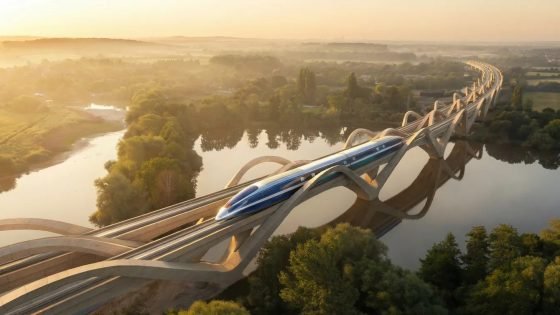
The president for the Royal Institute of British Architects (Riba) has proposed building a futuristic, interconnected high-speed railway for the North, Wales, Scotland, Ireland and Northern Ireland referred to as “The Loop”, akin Saudi Arabia’s The Line.
Chris Williamson’s ambitious £130bn proposal would link Liverpool, Manchester, Leeds, Newcastle, Edinburgh, Glasgow, Belfast, Dublin and Bangor in a continuous circuit with high-speed trains.
A rough map of how The Northern Loop could connect
The 50m trains would run every five minutes at speeds of up to 480km/h on an elevated viaduct and would operate on a point-to-point basis running directly between each city without intermediate stops. For instance, a Liverpool to Glasgow service would not stop anywhere on the way and neither would a Belfast to Manchester service.
“The Loop” would put all nine cities within 90 minutes of each other and eight international airports would be linked within the same time frame, creating what Williamson describes as “a new global city, dispersed but connected”.

Early concepts for a station on “The Northern Loop”
He further believes the mega-project “would allow people to live in Newcastle and work in Glasgow”.
The engineering concept for the vision was developed in conjunction with Elliott Wood at an early stage who have helped propose the viaduct of the trains using stone arches to elevate the tracks and pre tensioned stone beams to support the rails.
Williamson describes his plan as “a Northern Powerhouse comparable with other major global cities, bringing together a population of around 10M across nine centres of designated expertise”.
This futuristic proposal comes off the back of chancellor Rachel Reeves unveiling a major government plan to boost economic growth in the North of England, placing the long‑promised Northern Powerhouse Rail (NPR) at the centre of the programme last month.
NPR is billed by ministers as a transformational upgrade to east–west connectivity across the North, linking Liverpool, Manchester, Warrington, Leeds, Bradford, Sheffield and York and improving onward services to Newcastle and Hull.
Williamson has likened his hi-tech vision to Neom, a series of gigaprojects that will see the construction of futuristic cities and holiday destinations in Northern Saudi Arabia. From north to south they are Trojena in the mountains, Magna on the coast, the Line, islands of Sindalah and the port of Oxagon.
He has stated his vision for “The Northern Loop” was very much inspired by The Line, originally planned to be a 170km long and 200m wide linear development in the desert. The initial vision would have seen it bordered by two 500m-high walls, mirrored on the exterior and planned to be home to 9M residents in its 34km2 area.
However, the reality has seen the scope of the Line significantly scaled back, with only a fraction of it expected to be completed by the initial 2030 opening date – and even this is in doubt. Additionally, the project has been marred with controversy as its construction initially saw the brutal displacement of indigenous tribes and the construction so far has seen extremely poor working conditions leading tens of thousands of migrant worker deaths.
Williamson said: “Maybe I have been too influenced by the scale, the vision and the ambition of Neom The Line in Saudi Arabia, having worked on the high speed stations running alongside the one hundred and 170km long city for the last few years.
“But we in the British Isles should be equally ambitious about our future.
“At present the Government seems to expect each city to compete for the same investment funding, when we need to encourage connectivity and collaboration.”
Within Williamson’s proposal, automated vehicles would serve the final leg of journeys from the stations which he believes could extend the reach of the system “beyond the core network”.

Williamson’s proposal would connect nine across England, Wales, Scotland, Northern Ireland and Ireland
He further stated the inclusion of Dublin and Belfast within “The Northern Loop” would require negotiation over border arrangements and political cooperation.
Beyond transport, Williamson has conceived the Loop as a “ring main” in order to distribute energy as well as people.
Running alongside the rail system would be continuous infrastructure capable of “gathering and redistributing power from onshore and offshore wind, alongside small modular reactors located at key nodes”.
Williamson and Riba believe the “ring main” could create a highly sustainable way of living for the residents of the region.
“This concentration of reliable energy and connectivity creates the conditions for new forms of employment, including data centres, advanced manufacturing and energy intensive industry,” a statement from Riba said.
“Waste heat can be captured and reused, supporting food production and other productive uses. In turn, these new employment hubs create a demand for housing and services, allowing settlement to follow opportunity rather than speculation.”
The statement continued: “The Loop is an ambitious scheme, but one that responds to a clear need as Britain seeks to reestablish itself in the world. Sustainability and renewal are central to the proposal.
“While millions of people would want to experience it, the project is not a tourist attraction. It is intended as a catalyst for communities working together and for redefining collaboration between cities and regions.
The plan is due to be submitted to this year’s Royal Academy summer exhibition.
Like what you’ve read? To receive New Civil Engineer’s daily and weekly newsletters click here.
Source: www.newcivilengineer.com



