
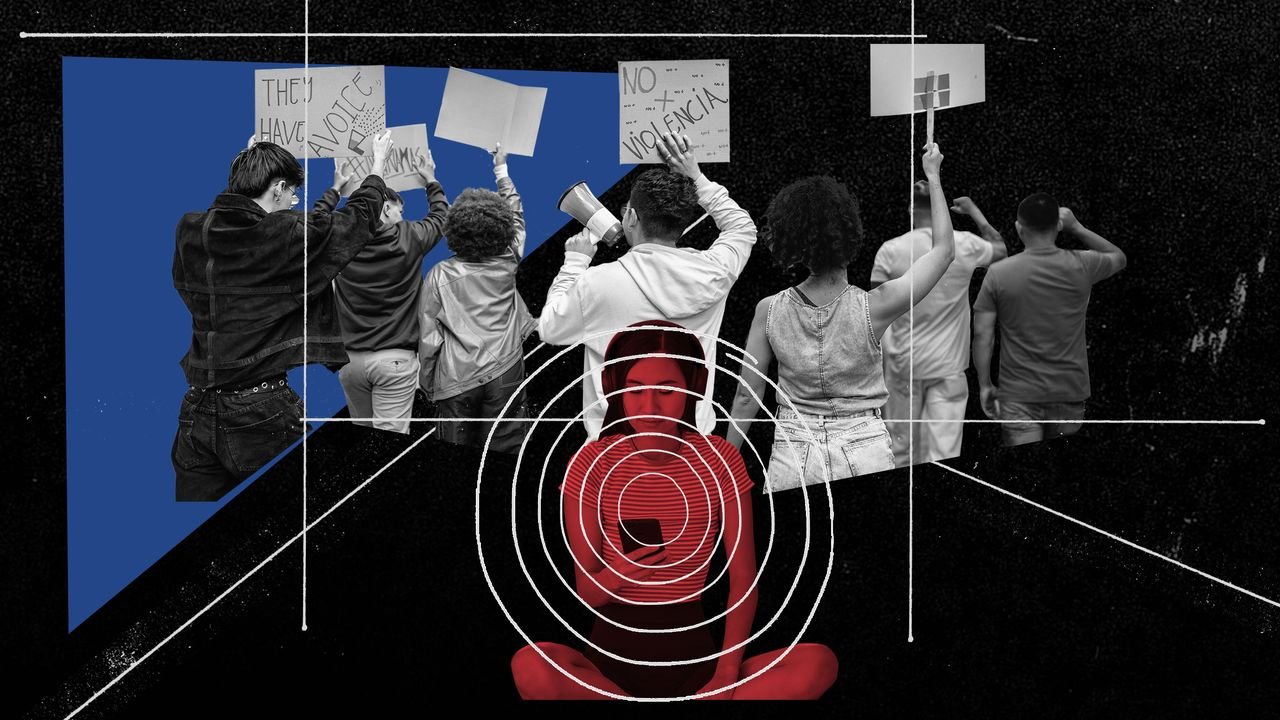
This monomaniacal and thoroughly individualized focus turned mindfulness into yet another personalized optimization ritual. You can detach your way into a state of intense dispassion for the suffering of other people; you can meditate yourself into callous vanity and mistake “personal growth” for enlightenment. Purser’s critique operates at two levels: he believes McMindfulness is a purposeful corporate intervention that manages the stress levels of workers and teaches them to not care about what’s happening outside the office. This co-opting has been aided by a hack social science—“happiness studies” and the like—that confer authority upon supposed experts in mindfulness, who then build media empires around coaching management types on how to ignore their neighbors in a gentle way.
What Purser preaches, instead, is “social mindfulness,” which he believes can allow people to see just how atomized and alienated we have all become from one another. I talked to him about how things went wrong and whether it’s possible, at this point, for them to go right. Our conversation has been edited for length and clarity.
You write that mindfulness has been stripped of its ethical teachings and of the liberating aim of dissolving attachment to a false sense of self. How did the idea go from something countercultural and deeply philosophical to the thing you get a pamphlet about when you join a company?
Anytime Buddhist traditions have migrated from one geography to another, they’ve always morphed and adapted to the host culture. Chinese Zen is very different from Indian Buddhism. When meditation got to the West, it became psychologized, scientized, instrumentalized, and eventually commodified—though that didn’t happen until after the year 2000. At first, it was confined to the hospital clinic, with Jon Kabat-Zinn, as a therapeutic modality. Having the scientific community come into being with mindfulness is really the watershed moment. A Time magazine special issue in 2014, with a beautiful blonde blissing out, was the pivotal time when the mindfulness revolution really became mainstream.
What is it used for now?
It began with mindfulness-based stress reduction in the hospital clinic—a legitimate therapeutic method for chronic pain, anxiety, stress. Then psychotherapists began integrating it into their practice. But, after 2014, corporations became interested, particularly in Silicon Valley. The poster child was Google. Corporate mindfulness training took off. Now it’s A.I. companies—Sam Altman practices mindfulness. These programs are offered by H.R. departments or consultants who sell them to companies. After my book came out, Amazon got into the game—with those Amazon coffins in its warehouses, little booths where you go in and watch a little video about mindfulness, do a little two-minute practice, and then get back on the warehouse floor.
Why do you think these corporations were so interested?
It’s a form of psychopolitics—that’s a term from Byung-Chul Han. Neoliberal capitalism is trying to harness the psyche as a productive force. People are overworked and stressed, and it’s much easier to put the burden on the individual employee than to actually address the corporate causes of stress: structural issues, lack of job security, too many work hours. It’s easier to pathologize stress and view it as a maladaptive response to the environment. The benefit to corporations is that they can squeeze as much productivity out of the worker as possible by having them reduce their stress and then have less absenteeism, less burnout, less complaining.
The introduction of medical experts seems crucial—it gave this idea legitimacy among the management class who would ultimately get interested.
Medical and psychological professions function as a form of neoliberal discipline. We internalize that discipline ourselves. And it functions as what’s been called a disimagination machine—the problem and solution are inside our own heads, which forecloses the possibility of looking at structural change. Neoliberalism wants atomization, managing our own human capital. There’s no sense of solidarity or collective power or action with others. The problems are pathologized as individual problems, and then we get sold back solutions. Here’s a mindfulness app on your smartphone—three minutes and you’ll be fixed. Headspace, Calm—billion-dollar companies.
What has been stripped out? Someone could argue that mindfulness does work, it confers benefits. What’s the harm?
I got that question so many times. I’m not saying mindfulness has no therapeutic value. People need to manage their immediate distress. The problem is when it becomes the only solution offered, when it becomes a substitute for actually looking at what’s causing the distress in the first place.



