
Goldsworthy’s reputation has occasionally suffered from the irresistible imitability of some of his gestures. He ruefully blames himself for a proliferation of copycat stone cairns, and also for making too many of them himself earlier in his career. (In the two-thousands, he swore off building any more, and has mostly kept his resolve.) The accessibility of his work, and his use of natural materials, means that it is often adopted by elementary-school curricula, and he has learned to smile politely when parents tell him that their kid “made an Andy Goldsworthy” out of sticks, stones, and leaves. He drew a line a few years ago, however, when, while he was taking part in a group show at the deCordova Sculpture Park and Museum, in Massachusetts, the institution made a similar gaffe. “They put a pile of stones outside with a sign saying ‘Make Your Own Andy Goldsworthy’—none of the other artists, only me,” he said. “I told them to take it down. It’s inappropriate.”
The sheer beauty of some of Goldsworthy’s work—sliced fronds of heron feathers arranged in stark geometries, or a boulder coated in blood-red poppy petals—has sometimes led him to be characterized as a visual version of an exultant nature poet. But Goldsworthy deplores the city dweller’s notion of the countryside as a picturesque escape. “For me, the landscape is not a place you go to for therapy and relaxation—it is to get challenged and have ideas, and to generate thoughts and feelings and emotions,” he told me. “It’s a very powerful thing to deal with.”
When Goldsworthy was a teen-ager, he had part-time jobs on dairy and cattle farms, and his art implicitly honors the demands of working the land. A field is “a battlefield,” he told me. “It’s been won through hard work and effort.” Some of Goldsworthy’s art has also required strenuous exertions. He has at times incorporated his own body, as with “Hedge Crawl,” completed in North Yorkshire in 2014, for which he made a video of himself clambering through a row of gnarly hawthorn trees—nature’s barbed wire. (He said of the experience, “It’s another world inside there,” adding, “I didn’t realize I was bleeding until I finished.”) Other experiments have been similarly challenging, such as putting foraged objects in his mouth and then spitting them out. “As soon as you put a petal or a flower in your mouth, the whole perception of it changes,” he explained, with undisguised glee. “It’s bitter. Is it going to kill me? You know? Until it goes in your mouth, it’s pretty. When it goes in your mouth, it’s ‘Oh, shit.’ I love that.”
In some ways, Goldsworthy’s rural life keeps him walled off from the world. He maintains a low profile online: he has no Instagram, and his website offers no contact information. Although he is represented by galleries in New York and Los Angeles, he has not been signed with one in the U.K. for decades. “He has an anti-sales approach to sales,” the collector David Ross told me. His studio is managed by Tina Fiske, an art historian who runs gentle interference for him. She is also his partner. (They have a fifteen-year-old son—Goldsworthy’s fifth. He has four grownup children from his former marriage.)
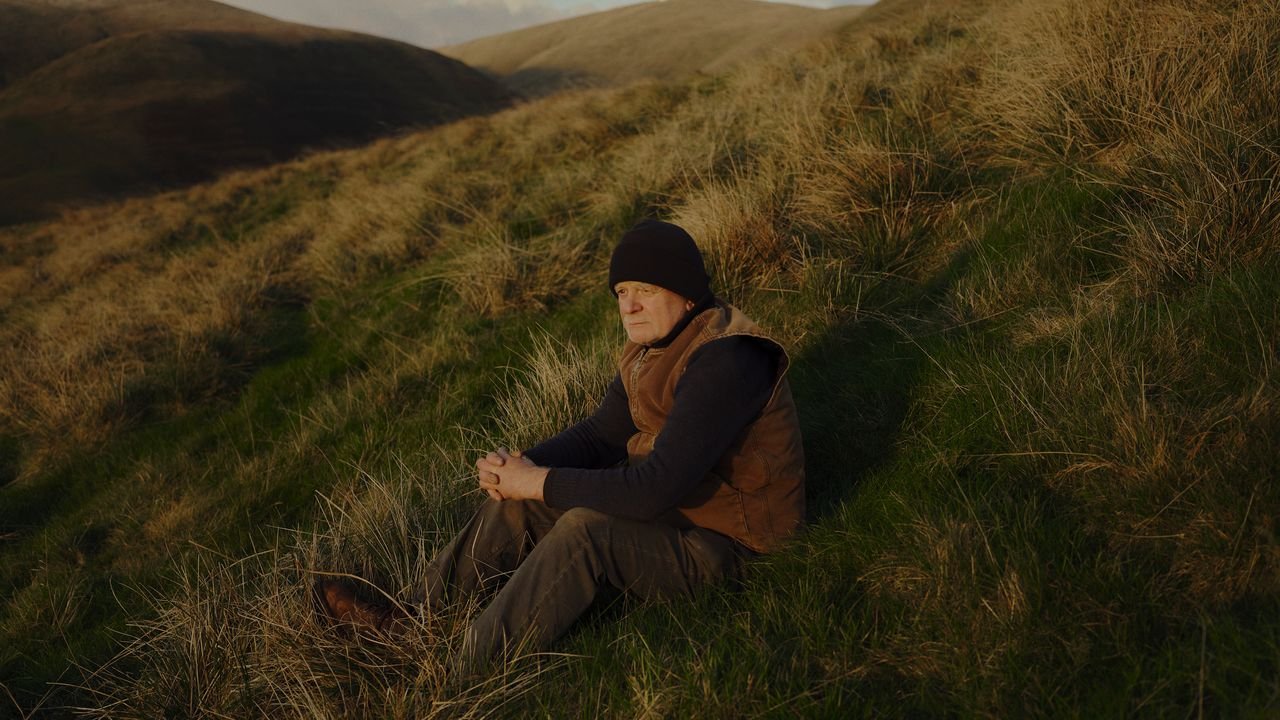
Once you have tracked Goldsworthy down, however, he’s affable and chatty. Mirth bubbles under his words, even when he is discussing the prospect of inevitable physical decline. Goldsworthy, who has a shock of white hair and a scruff of beard, is dauntingly hardy; despite Scotland’s habitually inclement winter, he rarely gets bundled up in more than a Carhartt jacket, and I once saw him test whether a rubber boot had a hole in it by standing in a frigid stream until his foot got wet. But, while installing the Edinburgh show, he was gently reminded by the chief curator, Patrick Elliott, that this would probably be the last time he’d lug stones across a gallery, or bob up and down a ladder while plastering a wall with clay. The granary he bought four decades ago has lately been turned into a climate-controlled archive for his photographs and canvases. The facility is designed to outlive him. “I’m still fit, I can still work, but that’s not going to last,” Goldsworthy told me. “I don’t know how many more years I’ve got left of doing what I do.”



