
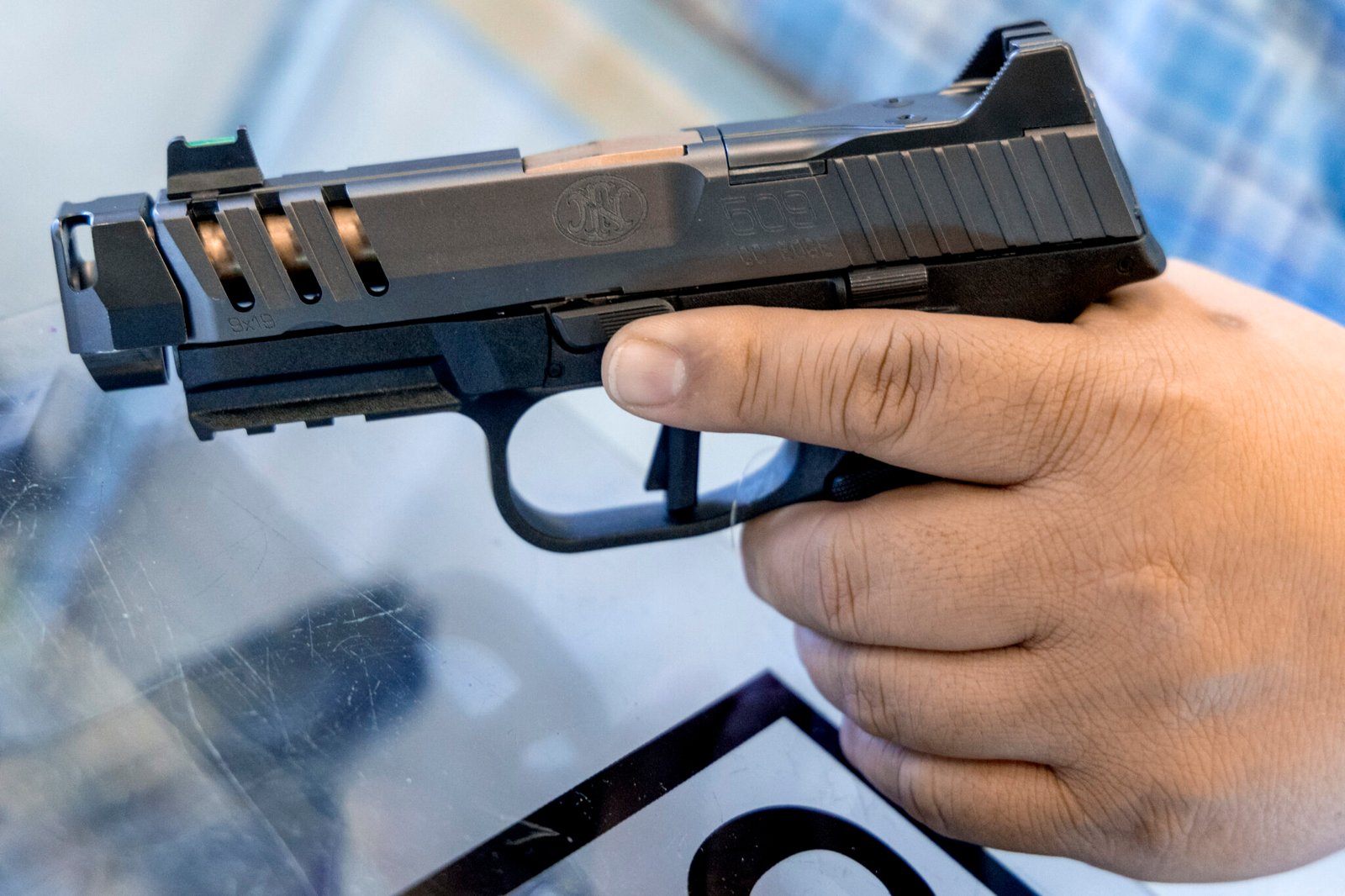
New Jersey gun owners got another crack at challenging a state law that bars firearms in 25 “sensitive places,” pleading their cause Wednesday before a 14-judge panel in Philadelphia.
The chief judge of the U.S. 3rd Circuit Court of Appeals agreed in December for the full bench to rehear the case after a three-judge panel largely rejected the challenge in a split ruling last fall that included a fiery dissent by a judge appointed by President Donald Trump.
Attorney Erin E. Murphy, who represents a group of gun owners, told the court Wednesday that New Jersey lawmakers took a “blunderbuss approach” when they passed the sensitive places law in 2022, six months after the U.S. Supreme Court declared states’ gun-carry restrictions unconstitutional in a decision known as Bruen.
“While Bruen acknowledged that the Second Amendment allows states to prohibit firearms in certain sensitive places, it went out of its way to make clear that the historical record revealed relatively few of these ‘exceptional places,’ and expressly cautioned against defining the category of sensitive places so broadly as to eviscerate the general right to publicly carry arms for self-defense,” Murphy said. “Rather than heed those teachings, New Jersey’s response to Bruen largely defies them.”
New Jersey’s law makes it a third-degree crime, punishable by up to five years imprisonment, to take guns into 25 places policymakers deemed sensitive. Those include sites where guns have long been barred, including schools, polling places, legislatures, courthouses, and airports, as well as other places where the public congregates including casinos, zoos, youth sporting events, public libraries and museums, concert venues, theme parks, transit hubs, churches, hospitals, nursing homes and other health care facilities, and private movie sets.
Gun owners have complained that the law prohibits carrying weapons almost everywhere, allowing them to take their weapons only on private property where property owners don’t explicitly bar guns, in private vehicles, at public film locations, and while hunting and fishing.
Murphy told the appellate judges that Bruen only allows restrictions that existed at the time the nation’s founders declared a constitutional right to carry in the Second Amendment.
But Executive Assistant Attorney General Angela Cai, arguing for the state to uphold the law, countered that guns weren’t as prevalent in the founding era as they were decades later in the Civil War and Reconstruction eras, when more states began to regulate them.
“Before 1850 or the 1840s and ‘50s, the commercial market for handguns was really just very, very small. And in fact, Samuel Colt himself had a hard time establishing a commercial base. And it wasn’t until the Colt revolver patent expired in 1850 that these relatively easy-to-obtain, cheap revolvers started flooding the market,” Cai said.
For the gun owners to be correct that present-day laws cannot restrict gun carry any more than colonial-era laws did, then guns would have to be permitted today in schools, courthouses, and other sensitive places that the gun owners have not challenged in New Jersey’s 2022 law, Cai added.
“I am not aware of any statute pre-1776 or enacted by a colonial legislature that prohibited firearms at schools or courthouses,” Cai said. “You only have one state that did so at legislative assemblies, and I’m aware of only one at polling places, and that’s Delaware. So that’s just the outcome, if that is the methodological angle that we’re taking.”
The judges peppered the attorneys with questions throughout the hourlong hearing as they wrestled with when exactly in history Bruen renders states’ gun restrictions impermissible, and what to do about sensitive places that overlap, like schools and playgrounds. The gun owners have not challenged the gun ban in schools, but they do object to gun restrictions at playgrounds and other places where students go and where school activities occur.
“If it had been contiguous with the school, your position would be: that would be a place that could be restricted. But is your position: simply because it’s located off the school grounds, it’s no longer protected? Even though the same activity is occurring?” one judge asked.
“We don’t think the fact that activity is happening somewhere that’s sanctioned by a school necessarily translates into converting that place into a sensitive place,” Murphy responded.
Murphy and Peter A. Patterson, an attorney representing another group of gun owners, told the judges that the sensitivity of a place should be measured by whether it’s a closed environment and has heightened security reflecting the dangerousness of its operations or occupants, such as power plants, commercial airplanes, and mental health facilities.
That prompted one judge to point out that polling places aren’t closed sites with heightened security, yet guns are prohibited there (and the gun owners aren’t challenging that prohibition).
Patterson responded: “What Bruen said is we analogize to founding-era polling places, and founding-era polling places did (have security) because there was not a secret ballot, and so there was a fundamental change in polling places when the secret ballot came into place, and all of a sudden the concerns about intimidation weren’t there.”
Any proposed restrictions also should rely on an armed person’s intent, Murphy and Patterson said, citing colonial common law that largely allowed everyone to carry guns except those “apt to terrify the public or in such manner as to make an affray of the peace.”
But Judge Cheryl Ann Krause, an Obama appointee who penned September’s majority opinion rejecting gun owners’ challenge, pointed to “significant technological changes” in firearms since the founding era that have resulted in public terror.
“We have firearms now that, for example, in Dayton, Ohio, killed nine people, injured 17, in 32 seconds,” Krause said, adding, “Why doesn’t that fit into your category of those locations that have the attributes that would make a firearm a safety hazard?”
Murphy conceded that “times have changed in a way where … we have to have a different conception of sensitive places.”
But New Jersey lawmakers have taken it too far, she said.
“It can’t be that sensitive places is a concept so broad that it covers everywhere outside the home, that people actually go,” she said.
Cai accused the gun owners and their attorneys of twisting themselves “into knots trying out theories that are totally unsupported by history.”
Of the 14 judges at Wednesday’s hearing, six were Trump appointees, two Bush appointees, three Obama appointees, and three Biden appointees.
A decision is expected to take months, with some observers predicting the 3rd Circuit judges will delay a ruling until the U.S. Supreme Court decides a challenge to a similar law in Hawaii that bans guns on private property open to the public. That court heard arguments in that case last month and is expected to issue a ruling before the justices recess for the summer in June or July.
GET THE MORNING HEADLINES.



