
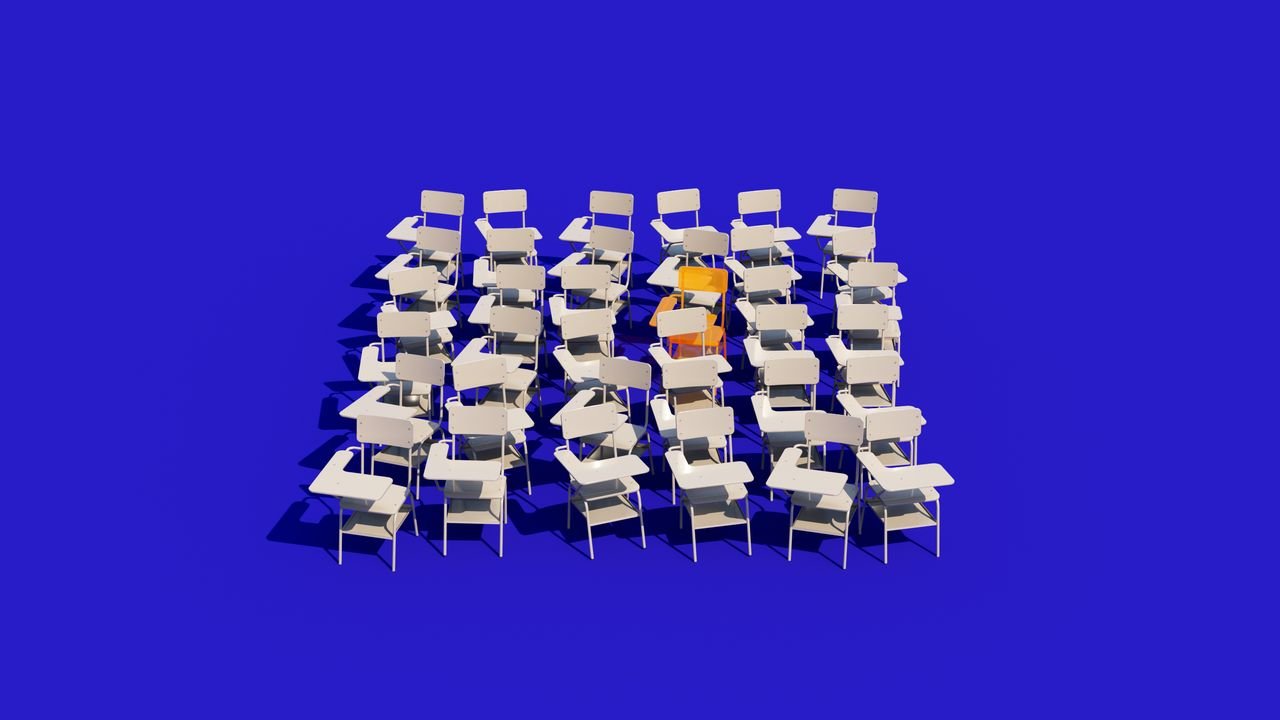
When the field of gifted education was first coalescing in the early twentieth century, it was mostly oriented toward children whom anyone would call gifted: your Mozarts and Doogie Howsers, your Little Men Tate. They were not merely bright and precocious but true outliers who, not unlike kids with dyslexia or other learning differences, needed a tailored curriculum and classroom setting in order to thrive. Troublingly, many of the early psychologists and educators who took the lead on studying and developing curricula for these children were steeped in eugenics, including the belief in intelligence as hereditary, race- and class-dependent, and largely fixed. For these thinkers—including Lewis Terman, who developed the Stanford-Binet Intelligence Scale—an exclusive gifted classroom logically doubled as a tool of racial and socioeconomic segregation.
In the mid-nineteen-thirties, the New York City Board of Education and Teachers College at Columbia University launched a five-year program in Harlem known as the Speyer School experiment, which, as a Board of Education representative later explained, was intended “to determine a desirable program of education for intellectual deviates.” There, kids who had earned either lower-than-average or exceptionally high scores on the Stanford-Binet test were divided into groups of “slow” and “rapid” learners.
The Speyer experiment wound down in 1941; one of its unofficial successors was Hunter College Elementary School, in Manhattan, founded as “an experimental and demonstration center for intellectually gifted pupils.” Prospective kindergarteners at Hunter must score off the charts on a modified I.Q. test just to get past the first round of the admissions process, which is, as the Times once wrote, “probably one of the most competitive in the world.” A Daily News piece from 1988 reported on the dilemma of “middle-class parents trying to make it in Manhattan” whose kids weren’t admitted to Hunter, despite I.Q. scores in the top one per cent. Many of these disappointed parents enrolled their children in private schools; others likely decamped to the suburbs. But a few instead began recruiting and fund-raising for what became one of the five ultra-élite citywide G. & T. programs, at the Anderson School on the Upper West Side. (Even today, Anderson is regarded among G. & T.-savvy parents in Manhattan as an exceptionally prestigious consolation prize, the Yale to Hunter’s Harvard.)
It’s easy to caricature some G. & T.-curious parents as grasping, status-obsessed, or slightly deluded about their child’s special brand of specialness. But research shows that the kinds of kids who might just miss a shot at Hunter or Anderson—not necessarily geniuses or savants, just very bright, driven, academically oriented kids—are likely to become inattentive, frustrated, or disruptive in a gen-ed classroom, with possible long-term effects on their academic performance and social-emotional development. Karen Rambo-Hernandez, a professor of education at Texas A. & M., told me that students suffer “when they show they need the challenge and are not challenged. They need opportunities to fail and learn from failure. They need the chance to say, ‘Oh, yeah, there’s an edge to what I know.’ ” These students, Michael Matthews, an education professor at the University of North Carolina at Charlotte, told me, “keep sailing through school without having to do much of anything—until all of a sudden they do, and then they don’t know how to respond.”
Gifted class sizes are not necessarily smaller than their gen-ed counterparts, but they can feel that way because students’ level of academic attainment is more homogeneous. “In your typical neighborhood school, a fifth-grade classroom has everything from kids who can’t read at all to kids who are reading at a high-school or almost-college level,” Matthews said. “Asking a teacher to meet the learning needs of all those kids is an impossible order. What tends to happen is that the teachers focusses on the kids who need the most help. They figure that the ones who are achieving above grade level will be O.K. on their own, and we know that’s not the case.”
A precocious kid who is bored in a gen-ed classroom might need gifted education, but decades of data and research suggest it’s more likely that he and everyone else simply need fewer classmates, so that his teacher can give each student more individualized attention. Even Mamdani, who has not made K-12 education a focus of his campaign or early mayoralty, lamented “crowded classrooms” in his inaugural address. In 2022, Governor Kathy Hochul signed a law requiring public schools in New York City to limit classroom sizes to between twenty and twenty-five students by 2028. But funding, construction, and teacher hiring may be lagging behind the goal. As of last year, according to reporting by Chalkbeat New York, the city had reached its legally mandated benchmark only by juking the stats: more than ten thousand classrooms had been temporarily exempted from the law, including in schools that did not request the exemptions.



