
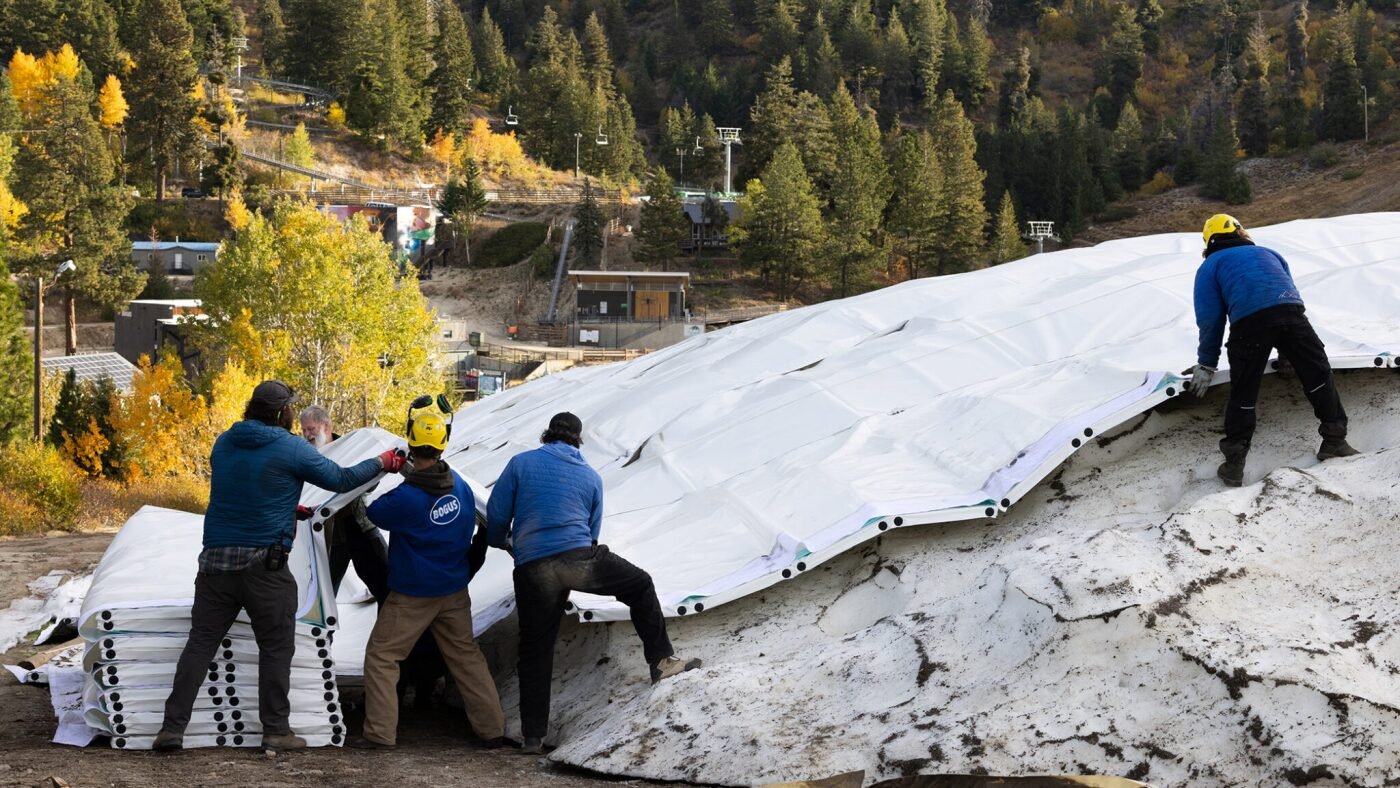
Bogus Basin employees unpack the snow blankets. They’re made of polystyrene panels that fold out like an accordion. This year, the mountains in the West have had the lowest snow coverage in decades.
Logan Brown/Bogus Basin
hide caption
toggle caption
Logan Brown/Bogus Basin
BOGUS BASIN, Idaho – This winter is being called one of the strangest in memory. For much of the season, mountain peaks in the West have been bare while at the same time Florida had snow flurries.
The lack of snow in the West didn’t used to be a big problem for most ski areas. If they didn’t have enough snow, they made it. But this ski season, it was so warm that snowmaking machines couldn’t work.
Winter sports are a multi-billion dollar industry in the US. And ski resorts have had to respond to the changing climate by opening later and limiting runs, hurting their bottom lines. Several ski areas at lower elevations have had to close.
The Bogus Basin Recreation Area, a short drive from Boise, Idaho, has seen the writing in the snow. Last year, when temperatures were still below freezing, they hatched a plan.
First, they needed snow, said Nate Shake, Basin’s operations director—a whole lot of it.
“I talked to the snowmakers and I was like, ‘just start making snow up there,'” said Shake. “We picked a spot, called it ‘Project X.’ We just made a giant pile of snow.”
Then their team covered the snow—a pile the size of a football field—with blankets made out of polystyrene plastic, to keep the snow from melting over the summer. They used blankets made by SnowSecure, a company in Finland, where resorts have used them for several years.
“It comes in eight-foot panels that interlink together with velcro and straps,” explained Rob Harms, Bogus Basin’s slopes manager. “And so you start on the uphill side of the pile and work your way down.”

Blankets ready to be rolled out to cover a mass of snow
Bridgette Johnson/Bogus Basin
hide caption
toggle caption
Bridgette Johnson/Bogus Basin
Harms said once the unfolded polystyrene panels covered the snow, they wrapped the pile in white plastic to keep the warm air out.
Last summer, temperatures in Bogus Basin were in the 70s and 80s. But when the staff uncovered the pile last October, 80 percent of the snow was still there. It was densely packed but usable. The ski area’s snowmaking crews then used special tractors to spread out the snow.
“Just think of like frosting on a cake,” said Harms. “Making everything even and smooth and building, you know, peaks and valleys wherever you want them.”
Bogus Basin was able to open their first small ski hill with the stored snow before there was any natural snowfall.
The cost of saving all that snow
Austin Smith, Bogus Basin’s innovation director, said their first kit cost about $120,000. It’s not cheap, he added, but it’s less expensive than the other option—storing vast amounts of water needed to run their snowmaking machines.
“We were estimating somewhere between, you know, $6 and $7 million to build another retention pond,” said Smith.
Smith considers the blankets to be an insurance policy.
“It is a bit of weatherproofing, to protect against a season like this season, where not only did we have lackluster natural snowfall, we actually had warm temperatures that didn’t allow for snowmaking,” said Smith.

Snow was late arriving in the West, again this year. In an aerial photo taken on Feb. 9, 2026, patchy snow remains on a Park City, Utah, golf course, which is normally used for cross-country skiing in the winter.
Mario Tama/Getty Images
hide caption
toggle caption
Mario Tama/Getty Images
Antti Lauslahti is the CEO of SnowSecure, the company that makes the blankets. He said the polystyrene panels aren’t intended to replace snow making or freshly fallen snow.
“It’s not like a curiosity,” Lauslahti said. “It’s like one tool in the toolbox.”
Smith, Basin’s innovation director, said they are buying more blankets, and expanding the area they plan to wrap for the next season. He expects to spend around $600,000.
Smith wants to open an entire ski trail, from top to bottom, on time, by Thanksgiving. And he plans to do it, even if a single snowflake hasn’t yet fallen from the sky.



