

WASHINGTON — For weeks, President Donald Trump has delayed federal funding for Gateway, the bridge-and-tunnel project linking New Jersey and New York. It’s the largest active public-works program in the Western Hemisphere and one with funding that Congress approved months ago.
On Monday, Trump called Gateway a “boondoggle” expected to cost billions of dollars more than planned — a false comment that drew criticism from elected Democrats including New Jersey Gov. Mikie Sherrill. “The only person who can make Gateway a boondoggle is Donald Trump,” Sherrill said in a statement Monday afternoon.
Trump’s effort to terminate Gateway funding fits a larger pattern.
In his first and second presidencies, Trump has repeatedly used the federal budget process to corner political rivals and wreak havoc in programs and agencies, often in left-leaning states like New Jersey.
He has also demanded governors “ask nicely” to receive federal funding for natural disaster cleanup. And with the flick of his pen, Trump has reshaped the landscape in and around New Jersey, from writing an executive order to halt offshore wind projects to halting hundreds of billions of dollars’ worth of loans and grants, a move that left nonprofit groups last year wondering how they would fund their day-to-day operations.
“If he doesn’t relent and pull this back, we’re going to find ourselves in a crisis,” Sen. Andy Kim (D-NJ) said about that freeze that left nonprofits scrambling.
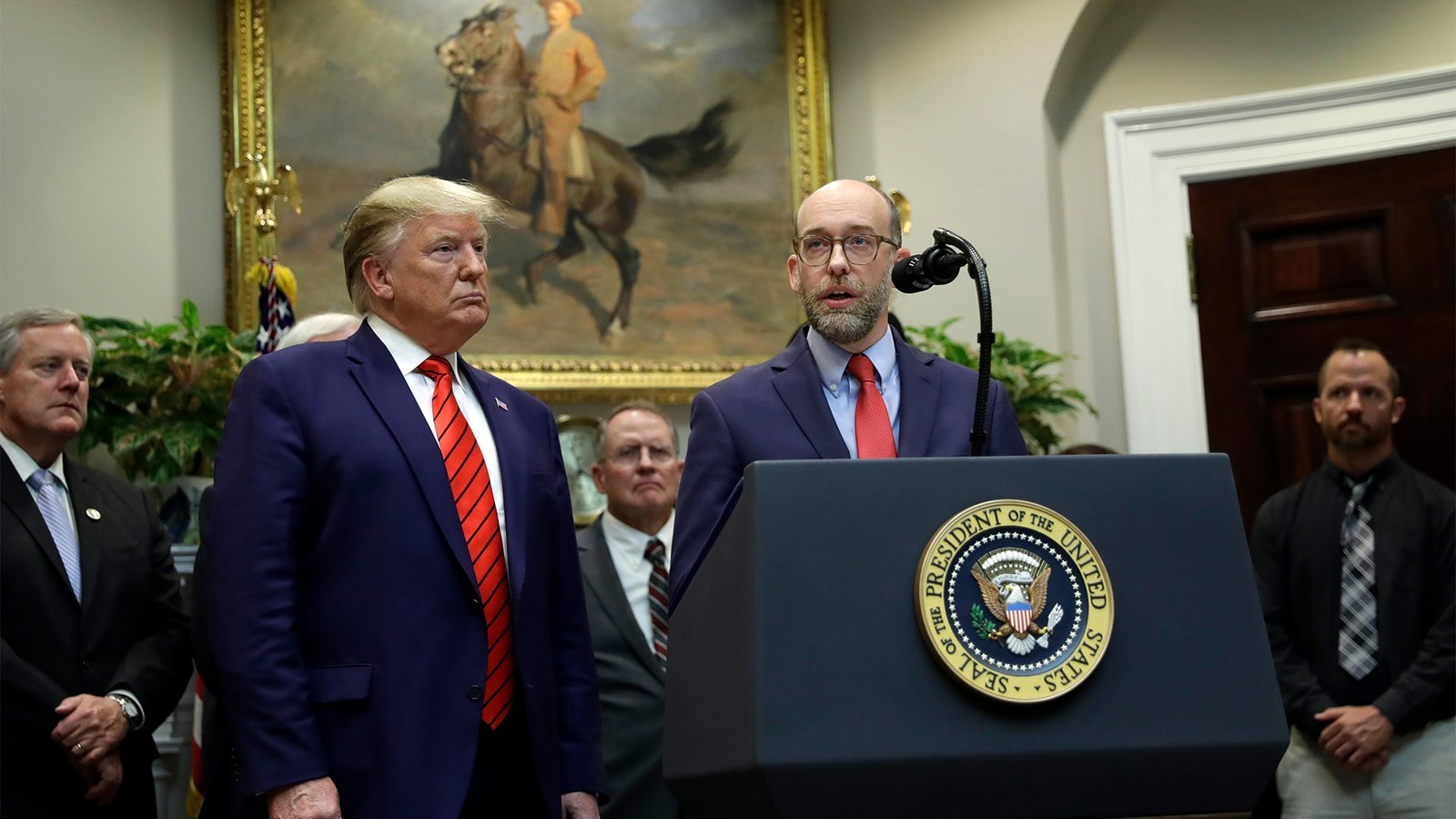
The man behind the Trump administration’s budget strategy is Russell Vought, who in an interview with conservative talk-show host Tucker Carlson compared the White House’s budget office to a “nerve center” central to the president’s agenda.
 Credit: (AP Photo/Jacquelyn Martin, file)
In the interview before Trump was sworn in but after his reelection, Vought telegraphed that the second Trump term would try to get federal agencies and departments to “come to heel and do what the president has been telling them to do.”
The second Trump administration has carried out a bruising budget approach — a style that has repeatedly broken federal law, according to the Government Accountability Office, a nonpartisan investigative arm of Congress.
This administration has broken a federal budget law — the Impoundment Control Act of 1974, which says money Congress has approved must be spent — five times across five different programs, according to the GAO.

Early in this term, the administration violated that law by blocking funding for a national electric vehicle charging network, which had allocated $104 million to New Jersey.
It also violated the law when it blocked funding for the Institute of Museum and Library Services, a section of the National Foundation of the Arts and the Humanities, according to the GAO. The watchdog found the administration separately violated the law at least three other times last year, including when it tried to block Head Start money, when it attempted to stop grants at the National Institutes of Health and finally when it delayed funding for emergency services through the Federal Emergency Management Agency.
The GAO has not investigated every budget decision the Trump administration has made. But in congressional testimony in April 2025, the then-head of the GAO, Gene Dodaro, told members of Congress the agency had started 39 different investigations into the administration.
The GAO has also not examined funding moves the administration tried to carry out before relenting, such as an attempt in July 2025 to withhold about $160 million in federal education funding for New Jersey.
“The president ran on the notion that the Impoundment Control Act is unconstitutional,” Vought told senators at his confirmation hearing. “I agree with that.”
Kim and Sen. Cory Booker (D-NJ) voted against Vought’s confirmation.
During his first term, Trump’s administration violated that law three times, including by holding back about $214 million in military aid Congress had approved for Ukraine.
“The President has narrow, limited authority to withhold appropriations under” the 1974 law, Thomas Armstrong, general counsel at the GAO, wrote in a letter explaining the watchdog’s opinion.
The White House budget office told the agency it withheld the funds to ensure that they were not spent “in a manner that could conflict with the President’s foreign policy,” Armstrong said.
That’s not how the law works, as Armstrong wrote: “The law does not permit OMB to withhold funds for policy reasons.”



