
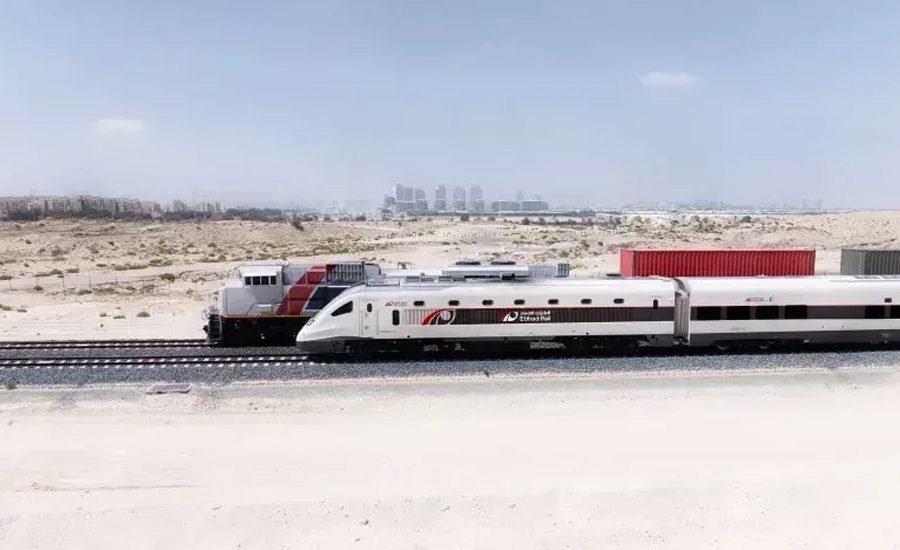
Etihad Rail Mobility, a joint venture of United Arab Emirates-owned Etihad Rail and France-based transport operator Keolis, awarded contracts earlier this month for first phase development of a high-speed rail line that will connect Abu Dhabi and Dubai with trains able to reach speeds of up to 350 kph. The initial project phase, set to deliver a 150-km line by 2030, could cost up to $8 billion.
Two key design and build contracts for civil works and stations were awarded in February: one multi-million-dollar contract for the Abu Dhabi section, with the exact total not disclosed, went to Abu Dhabi’s National Projects Construction as lead contractor. Its consortium partners are UAE-based Trojan Tunnelling, Turkey-based Kalyon and China State Construction Engineering Corp. Jacobs Solutions, Dallas, will supply the design.
The contract for the Dubai section went to India’s Larsen & Toubro as lead contractor, with China Harbour Engineering Co., Wade Adams, Egis of France and Surbana Jurong of Singapore as partners. Engineering consultants are Spain-based firms Sener and Ineco.
The phase one line will extend from Al-Zahiyah in Abu Dhabi to Al-Jaddaf in Dubai, with a total of five stations, three of which will be underground, including at Abu Dhabi International Airport. Stations will be integrated with metro and bus transport.
According to the Middle East Economic Digest, work on the high-speed line is divided into four sections: Al Zahiyah to Yas Island in Abu Dhabi, covering 23.5 km; Yas Island to the Abu Dhabi/Dubai administrative border, 64.2 km; from the emirates’ border to Al Jaddaf in Dubai, 52.1 km; and a branch to the Abu Dhabi International Airport, covering 9.2 km.
Etihad Rail Mobility intends to expand the high-speed system to eventually create a 10-station inner-city network within Abu Dhabi, a link between Abu Dhabi and the desert city of Al Ain and a connection with the Emirate of Sharjah, according to media reports.
The company is now in late-stage negotiations for high-speed rolling stock with manufacturers that include Siemens Mobility of Germany, Alstom of France, Hitachi of Japan, China Railway Rolling Stock Corp. and Spain=based Talgo. Bidders must supply high-speed electric train sets that can reach 350 km per hour design speed and operating speed of 320 kph.
Looking for quick answers on construction and engineering topics?
Try Ask ENR, our new smart AI search tool.
Ask ENR →
Etihad Rail Mobility also is introducing passenger service this year using rail lines comprising its existing country-wide rail freight network. Test runs, which will run at about 200 kph, have begun and will extend to the Indian Ocean port emirate of Fujairah.
The passenger service, which will connect 11 cities and reduce travel times between major hubs now reached primarily by road transport, is expected to carry 36.5 million riders annually by 2030—making a significant impact on regional connectivity and reducing road travel, which will contribute to lower carbon transmissions, more sustainable transport and boosted economic diversity, according to Etihad Rail.
The country expects introduction of passenger rail services to contribute the equivalent of $39 billion to its GDP over the next 50 years.
The company also has a partnership with Italian high-tech firm IronLev to introduce magnetic levitation for freight trains on part of the UAE National Rail Network. Testing at the Al Faya Depot will determine if the technology could work under actual freight loading conditions. The test involved transporting a fully-loaded 7-ton container over a 1.2-km distance using a levitating platform installed on the rail line. Etihad Rail operates freight service that links the country’s major industrial zones and ports.
Elsewhere among Gulf Cooperation Council countries, Saudi Arabia and Qatar are planning an electric high speed rail connection between their two capitals—Riyadh and Doha, respectively. The 785-km rail line will connect key stations and travel at speeds of over 300 kph, reducing travel time between the two cities by two hours. The project, still in initial planning, would service 10 million passengers per year
Earlier this month, council Secretary General Jassim Al-Budaiwi said a project to connect railway networks between the countries would begin in 2030. Other council countries are Kuwait, Bahrain and Oman.
Source: www.enr.com



