
For over one hundred and fifty years, New Jersey has been known as the “Medicine Chest of the World.” Our state’s economy revolves around its innovation sector, which has been saving lives globally for generations. Life sciences companies in New Jersey contribute 15 to 20% of the state’s GDP, support hundreds of thousands of jobs, and generate billions in construction activity and vendor spending.
More importantly, these companies have spearheaded some of the most remarkable medical breakthroughs in the past 20 years, discovering treatments and cures that impact nearly every family worldwide.
However, New Jersey’s position as a global leader is not assured. Other states and countries desperately try to lure away our companies and the accompanying talent, construction investment, vendor spending, and jobs that have anchored New Jersey for over a century.
Here’s a tough reality: Pennsylvania, North Carolina, Delaware, Texas, Indiana, and several other states have aggressively invested in and strengthened their ecosystems. They are competing more directly for New Jersey’s capital, talent, and facilities. They’ll continue to lure away our economic crown jewel unless New Jersey shifts its focus in a few important areas.
The HealthCare Institute of New Jersey (HINJ) has created a policy roadmap to strengthen our innovation ecosystem and ensure that high-paying jobs, cutting-edge research, and life-saving discoveries remain in New Jersey. We call on all stakeholders to prioritize this plan, and we thank Governor Sherrill and her administration for the steps they have already taken to begin addressing some of these issues.
Doing so will help sustain New Jersey’s global leadership and our innovation economy, making the state the most attractive place to live, work, and raise a family.
- New Jersey must become a more competitive place to do business. Today, our state has the highest corporate tax rate in the nation. Combined with a dense web of regulatory hurdles and some of the most complex permitting processes in the country, companies looking to build or expand often find it easier to invest elsewhere. Pennsylvania, for example, is cutting its corporate tax nearly in half and aggressively streamlining its regulations to entice companies to cross the river. New Jersey cannot afford to fall behind. In 2026, we need to lower our corporate tax burden, eliminate the temporary corporate transit fee, modernize permitting, simplify how companies access state incentives, and lower energy costs. These are strategic investments that attract long-term economic growth and job creation.
- We need smarter, not simply more, regulation. Life sciences manufacturers are already subject to strict federal oversight. When the state introduces new or duplicative rules – even if well-intentioned – it can cause manufacturing delays, disrupt supply chains, and threaten patient access to vital medicines. Before establishing new regulations, authorities should assess existing federal safety measures and determine if new rules would significantly enhance outcomes. A thorough review of New Jersey’s regulatory environment is long overdue. Similarly, long overdue is a thorough review of NJ’s liability expanding judiciary.
- We must protect and grow our world-class workforce. One of New Jersey’s greatest advantages is its deep pool of scientific and technical talent. However, an aging workforce, a high cost of living, and slower population growth threaten our long-term competitiveness. In 2026, we must strengthen partnerships between industry and our K-12 schools, community colleges, vo-tech programs, and universities; expand recruitment programs to attract out-of-state talent; and create targeted incentives to encourage graduates to build their careers here.
- We need a modern, unified strategy to support innovation. New Jersey once had a Department of Commerce that coordinated the state’s economic development efforts. Today, responsibilities are spread across multiple agencies, making it harder for entrepreneurs and companies to navigate available resources. Re-establishing a Department of Commerce and Innovation would give New Jersey a clear point of coordination – and a clear message to the world that we are serious about leading in life sciences.
The life sciences industry has called New Jersey home for more than 150 years. But when it comes to the innovation economy this industry generates, it’s become clear that other states will continue trying to lure it – and its benefits – away from New Jersey. They all covet the jobs, construction, spending, reputation – and global leadership – that this industry brings.
In the past decade, we have become a hub for the film and television industry, a sector with little historical connection to New Jersey. We achieved this thanks to a targeted, strategic approach to economic incentives and tax policy and a clear strategic mission to attract the industry’s growth and investment.
If New Jersey wants to remain the global leader in medical innovation, with the extraordinary economic benefits that position brings, then we need to prioritize competitiveness and common-sense reforms. With smart policy decisions today, New Jersey can continue leading the world for generations to come.
Chrissy Buteas, President and Chief Executive Officer, HealthCare Institute of New Jersey
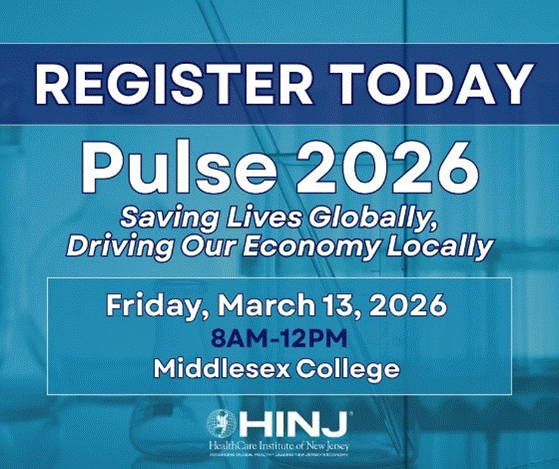
To learn more about retaining New Jersey’s global leadership in the life sciences,
join us at our upcoming event,
Pulse 2026: Saving Lives Globally, Driving Our Economy Locally,
at Middlesex College on March 13 at 8 am.



