
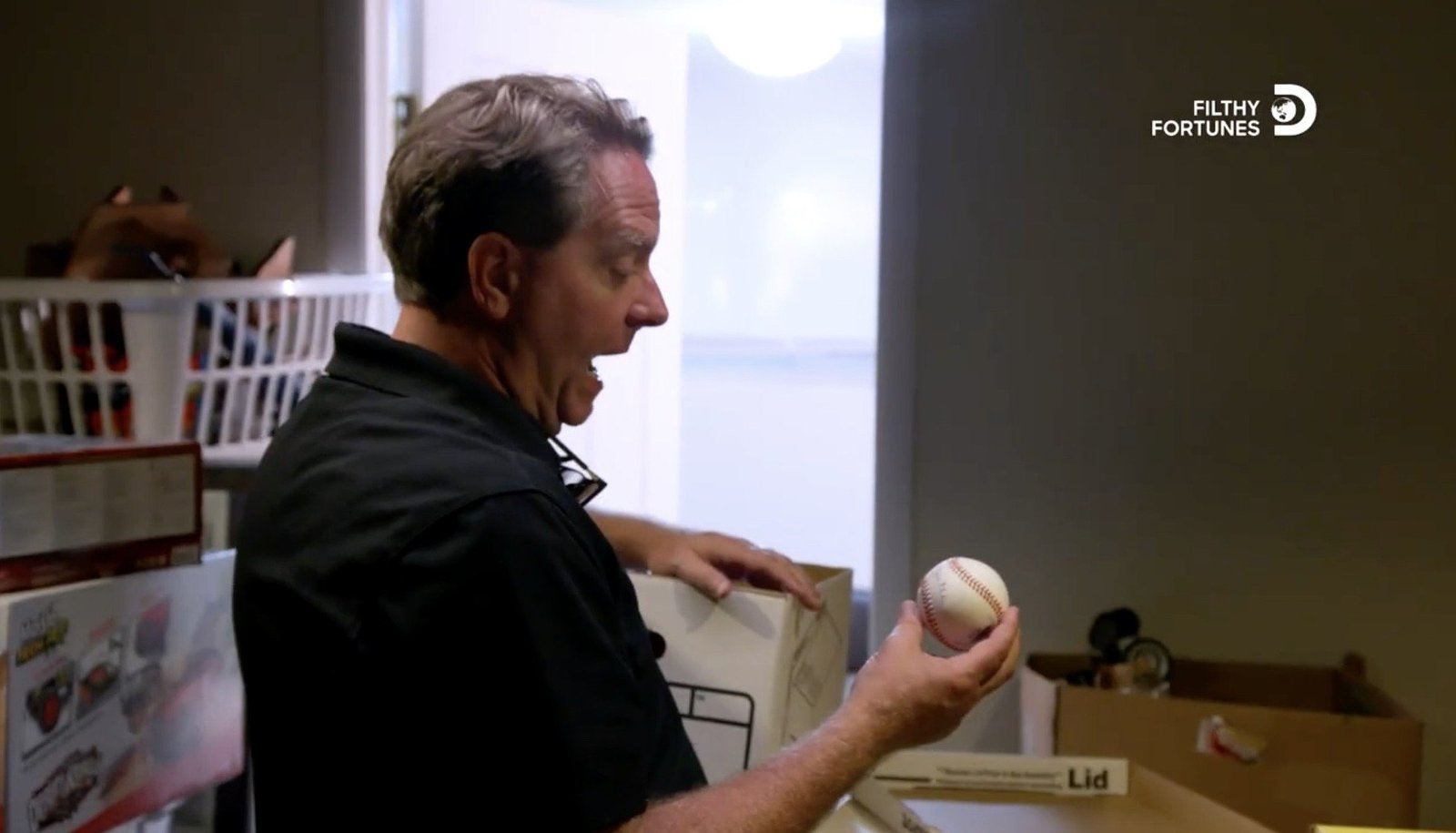
Discovery Channel star Matt Paxton‘s well-developed knack for discerning treasure from trash has helped countless families cash in while clearing out messy houses on “Filthy Fortunes.”
Now, the decluttering expert is going on record about whether limited edition vinyl collections, like the ones Taylor Swift sells, are rare enough to be worth storing.
The 50-year-old extreme cleaner has accumulated decades of decluttering experience as the owner of estate cleanup company Clutter Cleaner and through his long run on the A&E show “Hoarders.”
Now on “Filthy Fortunes,” Paxton’s sorting through hoards of belongings has uncovered more than $1 million in sales on the jobs he and his team take on during the series’ sophomore season, which debuted Feb. 15.
Speaking to Realtor.com® about some of the “insane finds this season,” Paxton rattles off awe-inducing items such as the “self-lacing Nike Mag shoes” from “Back to the Future 2” and a Levi’s jeans “sign from the Gold Rush in the 1860s” worth $10,000, along with boxes of vintage jeans “worth 10, 20 grand per pair.”

The Atlanta-based expert declutterer even managed to put a price on “bat poop” he found piled in a barn that brought in a serious buyer.
“It turns out it’s really good fertilizer,” he explains.
Yet, Paxton is quick to point out that what’s often more surprising is that items widely considered to be of value are, unfortunately, worthless.
One of the most common items clients assume will command top-dollar are vinyl records, though Paxton insists not every album is a hit in the resale market.
“People think their vinyl is worth a ton of money—if it’s in mint condition, it is, and if it’s rare, it is,” he declares.
Paxton tells Realtor.com he believes Taylor Swift is a “brilliant” example of an artist who is indeed creating real value in rare album drops.
For her latest album, “The Life of a Showgirl,” Swift released more than 30 versions between all the vinyl, CD, cassette, and digital variants offered.
Yet, unlike artists from earlier decades who attempted to create value in rare releases that weren’t actually restricted in size, Paxton says Swift’s approach could really pay off for fans.
“Taylor Swift has done it very well,” he states. “She’s actually battling the issue we’ve seen. The ’80s and ’90s, they would print 20,000 of one copy and it would say ‘limited edition’ and it’s not.
“The Beatles’ ‘White Album’ is a great example,” he illustrates. “I think there’s 80-something different copies, different drops. There’s only one that’s really worth, like, $1 million, but the other 88 versions, they’re not.”
Paxton warns that simply owning a certified rare album doesn’t always translate into a large payday. He adds the value of vinyl is very much dependent on how well it’s held up over the years.
“Condition is everything,” asserts Paxton. “If it’s not in a temperature-controlled situation, like, if it was in Tahoe, great, because it probably never got above 65 [degrees], so you’re OK.
“But if you stored that collection in Palm Springs, it probably melted. A lot of times, people are going to think it’s really worth a lot of money but it’s not because the condition is just not there or it’s not the exact one drop that is.”
While Paxton cautions against assuming every limited vinyl record will result in a windfall of cash, he still encourages taking the time to investigate.
“You just can’t think that you always have the one [because] the reality is you probably don’t, but what we’ve found on this show is, you might, and so it’s worth checking,” says Paxton. “Why not check it? But don’t go out and buy a new car and don’t think of your next vacation until you’ve actually checked.”
Thankfully, technology has made verifying the authenticity of an item and getting its going rate easier than ever. Paxton shares many of the appraisal resources he personally uses in his book, “Keep the Memories, Lose the Stuff,” but admits “AI’s really made it a lot easier” to research potentially high-priced objects online.
“You can look things up on Google Lens, look it up on eBay … you got to look on Everything But The House, see what it sold for and that’ll let you know,” he says.
When additional help is required to determine an item’s value, Paxton explains how he goes about recommending a vetted expert.
“If I need to find an expert, I go to an organization called the National Association of Senior [& Specialty] Move Managers,” he shares. “There’s about 800 of us around the country that do this. Anyone under NASMM has to go through the ethics standards that our entire industry does and a lot of times, we’re partnering together, so for me, if they’re NASMM certified, they’re good.”
Researching, listing, and negotiating sales is a tedious task, so Paxton suggests placing a value on time to avoid working for next to nothing.
“You’ve got to value your time,” he orders. “I value my time at $25 an hour. I would encourage everybody to do that … so if you have an offer that someone’s going to come and take all these items now, for one price, they’re going to haul it, they’re going to carry it out, that’s probably better than you spending another 20 hours.
“Make sure you’re not spending 20 hours to make $100 because then in reality, you’ve lost $400,” he adds.
Another decluttering pitfall Paxton personally avoids is hanging on to belongings after the emotional value decreases. He admits that after years of storage, he recently got rid of his children’s artwork.
“I have seven kids so I have a lot of art that I wasn’t ready to get rid of when they were in elementary school, [but] now that they’re all in high school and middle school, we found that we don’t need the art,” he says.
Paxton arrived at the same conclusion about belongings he inherited from his father and grandfather, who died within the same year and whose cluttered homes were the first ones Paxton cleaned before turning the chore into a career.
“I finally started getting rid of a lot of my dad’s and grandpa’s tools,” he details. “The reality is, I build businesses, not houses, and I had to accept at 50 that I don’t even know what half these tools are.
“They were my grandfather’s. They were my dad’s. I don’t need them, so I finally just started selling them or donating them to people that need them.”
Letting go of those special items after decades of holding on to them was a hard-earned journey for Paxton, and his experience serves as a valuable lesson to anyone who still appreciates the sentimental value over the resale value of their so-called clutter.
“Sometimes you’re just not ready, so if you’re having a hard time letting go of it, give yourself a pass, don’t worry about it,” advises Paxton.
“What I found is, you will know when it’s time. I promise you, it doesn’t matter what stage of life you are [in] if you’re not ready yet, your body will tell you when it’s time to get rid of it.”
“Filthy Fortunes” airs Sundays at 10 p.m. on the Discovery Channel.



