
For those who thought that hunter-gatherers were lost to the pages of history, think again. They are still roaming and foraging if you know where to look.
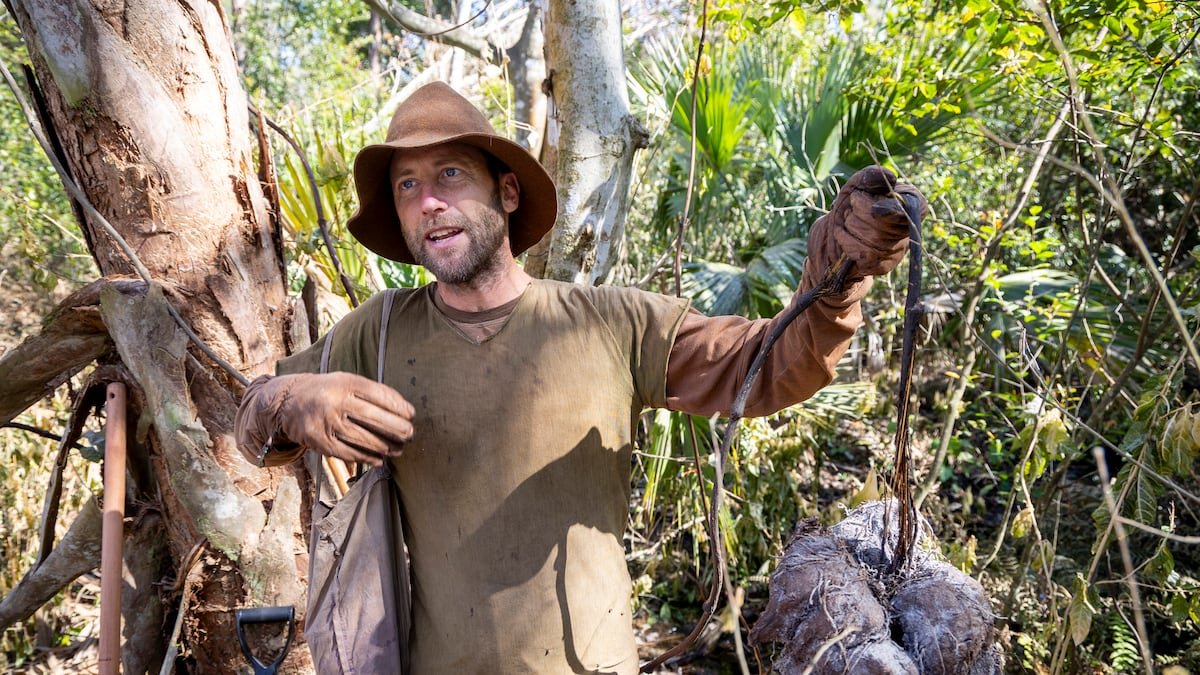
A small team of volunteers, myself included, followed environmental activist Robin Greenfield to Oakland Nature Preserve recently to forage invasive wild yams. Rather than buying potatoes from the grocery store, these starchy roots are completely free and removing them is a benefit to the environment.
As Greenfield seeks to forage all of his food for one year — now about a third of the way through his experiment — wild yams make up a good portion of his calories.
He learned how to identify and dig up Dioscorea alata — more commonly known as the winged yam or white yam — during his year of foraging and growing all of his food in Orlando, which wrapped up in late 2019. His latest yearlong challenge goes a step further.
“This is a deep exploration of belonging on this earth … I know that I’m from this earth, but I want to feel that and know that with every cell of my body,” he said. “This immersion in foraging 100% of my food and medicine for a year is a practice of just that. It’s a test of my philosophy, and it really is taking things to another level from a year of gardening and foraging all my food.”
Harvesting an invasive species from our backyard in Central Florida was one stop along Greenfield’s journey.
By the time I arrived at Oakland Nature Preserve, Greenfield and several volunteers were already hard at work unearthing yams with permission from the preserve.
Finding food
Greenfield must have known exactly where to look for yams, as the identifying vines were brown and devoid of leaves. Following the vines down to the ground, he identified and unearthed buried treasure.
Shovels in hand, we all got to work severing roots and digging up the potato-like yams, which were sometimes found in clusters totaling at least 20 pounds. Some yams Greenfield previously encountered weighed in at more than 100 pounds.
Our team of a half dozen volunteers worked for a little over an hour, amazed at the size of these starchy beasts in the earthy soil. We took delight in removing them from the environment where they competed with native plants for precious resources and space. An even more gratifying feeling came from the knowledge that these could soon be dinner.
By the time our work had finished, we had filled two wheelbarrows full of yams. Greenfield took as many as he could but left us with plenty to sample back at home.
Species identification
The leaves of the winged yam can be commonly confused with those of Dioscorea bulbifera, the toxic and inedible air potato, which takes over natural landscapes with vines that snarl native trees and other flora.
“Green Deane” Jordan, a Florida-based foraging expert who writes about what he’s finding and eating on EatTheWeeds.com, said that the leaves of D. bulbifera resemble a ball-shaped heart that is singular, while D. alata has arrow-shaped heart leaves that are found in pairs.
When showing its greenery, expected to begin around April, D. alata can also be identified by a vine that climbs up other branches and plants from the lower left of the surface closest to the viewer to the upper right in a “Z-twist.”
Bulbils are another way to tell the two plants apart. The potato-like structures that hang from the vines of D. alata are dark brown in a variety of shapes, while those of D. bulbifera tend to be more round and tan.
Jordan said that D. bulbifera tends not to put down roots in Florida, meaning any underground roots found will typically belong to D. alata.
When starting out foraging, it’s best to go out with an expert. Jordan and other foragers lead classes, which can be found on his website. The Florida School of Holistic Living offers “wild weeds” plant walks in Central Florida and REI offers classes periodically.
A foraged feast
After bringing the yams home, the first big task came with removing all of the soil from the tubers’ outer skin. The spray of a hose wasn’t nearly enough; a full soak in a tub of water was helpful in loosening the big dirt.
From there, several clusters of yams made their way into the kitchen, where they were washed and skinned, revealing the white starchy insides. From a distance, they looked exactly like potatoes. The main difference came with the texture, which was slightly more slimy and sticky than the average russet potato.
Still, the thin slices crisped up in the air fryer just like potato chips, although the yams had a slightly denser and more grainy texture. In a french fry variety, the yams were also similar but perhaps a little more white than golden on the outside, and slightly less fluffy than a fry made from potato.
Boiling the tubers seemed to be the best option for softening before turning them into mashed yams. With some butter and milk, they did closely resemble the taste and texture of mashed potatoes, albeit perhaps a little more sticky.
Then I had the idea to turn the mashed yams into the topping for a shepherd’s pie. A little extra butter and Parmesan cheese helped the yams crisp up nicely on top of a chicken and vegetable filling.
Virtually indistinguishable from potatoes by this point, we delighted in our dinner and the knowledge that we helped sustain ourselves while helping Florida’s environment.



