
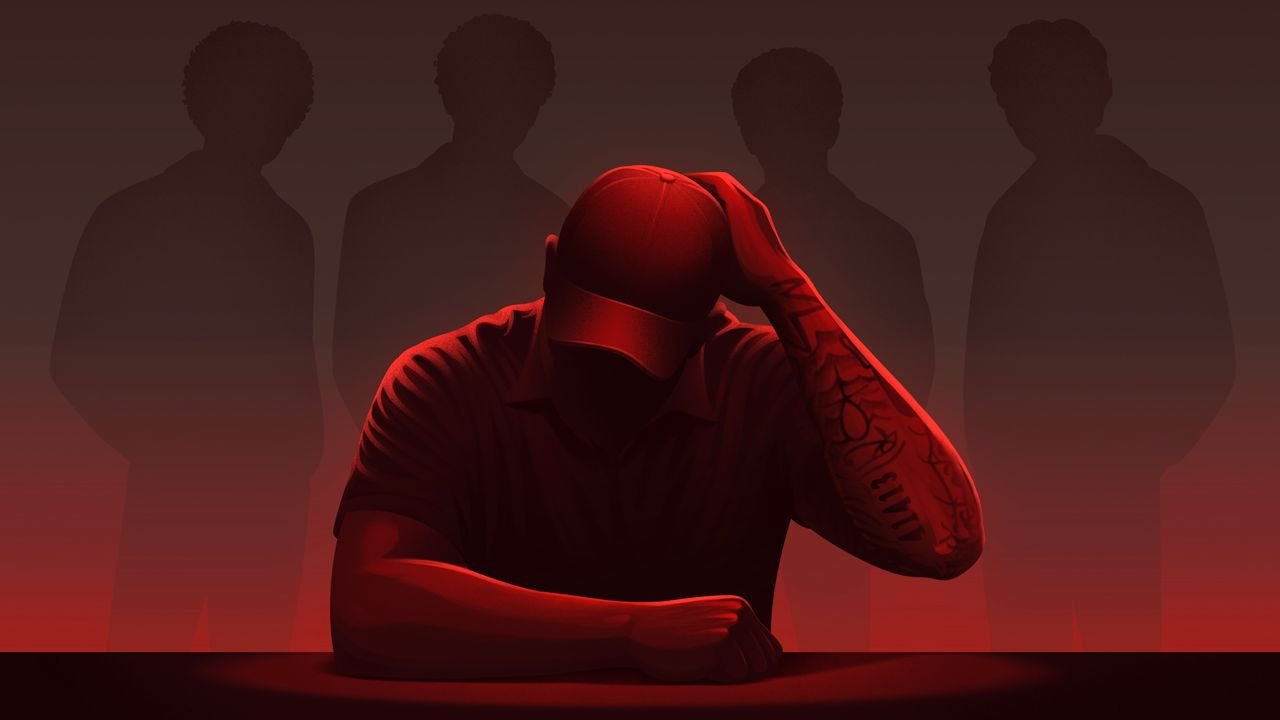
A month later, with his friends still in jail, Woodruff was called to testify before a grand jury. Detectives spoke with him beforehand, and in their subsequent reports they claimed that he gave them new details about the crime. According to a detective’s memo, Woodruff said that one of his friends had suggested they all go to Fillmore Avenue that night, because “maybe somebody in one of the bars has cashed a check,” and that two of them went into the Golden Nugget, after which they told the others about “an old white dude at the bar with some money.” The teen-agers allegedly “waited till the white man crossed Fillmore Avenue,” and, when he did, Gibson “hit the man about the head and face with the piece of pipe he had up his sleeve.”
When Woodruff was brought before the grand jury, he repeated some of those details. Timothy J. Drury, the lead prosecutor, was taking notes that day, and even he appears to have had doubts about the veracity of Woodruff’s testimony. Drury’s notes reveal that he was still considering two other suspects—Watson and another man. If they were culpable, that would mean, he wrote, using Woodruff’s nickname, that “Tony is lying.”
Walker and the other three friends could not understand why Woodruff was telling lies that could send them to prison for decades. In March of 1976, Walker wrote from jail to a friend that he did not know what was happening with Woodruff. Remembering that time, Walker recently told me, “We couldn’t believe it. How could he do something like this?” The four would talk about what they “wanted to do to Tony, at the time, for what he was doing to us.”
Woodruff has described himself at the time as “quiet and confused.” He never confided in his parents about giving false testimony, because, he said, “I didn’t know how to go about it. I didn’t know how to communicate with them.” He told me that, before he testified, Drury shaped his story. When he tried to imagine details of the crime, the prosecutor would respond with guidance such as “It couldn’t happen like that. Well, maybe it happened like this.” (Drury has repeatedly denied any misconduct in the case.) Woodruff recalled thinking, about his predicament, “‘Man, I done dug myself into some bullshit that I don’t know how to get out of.’” He added, “I should’ve just said, ‘You know what? I ain’t doing nothing. Y’all do what y’all got to do.’ ”
Instead, in 1977, he took the witness stand at four separate trials to testify against his four friends. Each time, he was presented as the only eyewitness to the crime. Defense attorneys pointed out inconsistencies in his statements and argued that he was lying, with Boyd’s lawyer saying that the judge should dismiss the indictment because Woodruff’s testimony was “uncorroborated” and “unbelievable.” Woodruff gave an incorrect time, date, and place for the murder, the lawyer noted; “he couldn’t identify the victim, he could not identify the house.” Drury told the jurors, “Look, if we had fed Woodruff stuff, you wouldn’t have that blithering idiot up there talking like he did. He would be a lot smoother.”
Drury added, “He is a ghetto kid. . . . He is a snook. You saw him—he is an idiot, a nitwit.” But, the prosecutor continued, “I am asking you to believe him.” Walker, Gibson, and Boyd were convicted of second-degree murder and sent into the state’s adult-prison system. Martin, who went on trial last, was acquitted. Martin’s lawyer later explained that a crime-scene photo that he had received had been crucial to the acquittal but that he did not know if the other defense attorneys had been given it. As he recalled, the photo showed a single set of footprints in the snow walking from the crime scene—evidence, he argued, that there had been only one assailant.
After high school, Woodruff joined the Army. He was assigned to the 503rd Military Police Battalion, stationed at Fort Bragg, where he worked as a cook. But he did not last long in the Army. “My mind was in chains. I couldn’t really focus, so I requested to get out,” he told me. Soon after, he moved back in with his parents in Buffalo, but being in his home town was stressful—“I was afraid of the streets,” he said—and he went into what he described as survival mode. “I was Casper the Ghost. Now you see me, now you don’t,” he said. “That’s just how I taught myself to move—just trying to stay out of the way.”



