
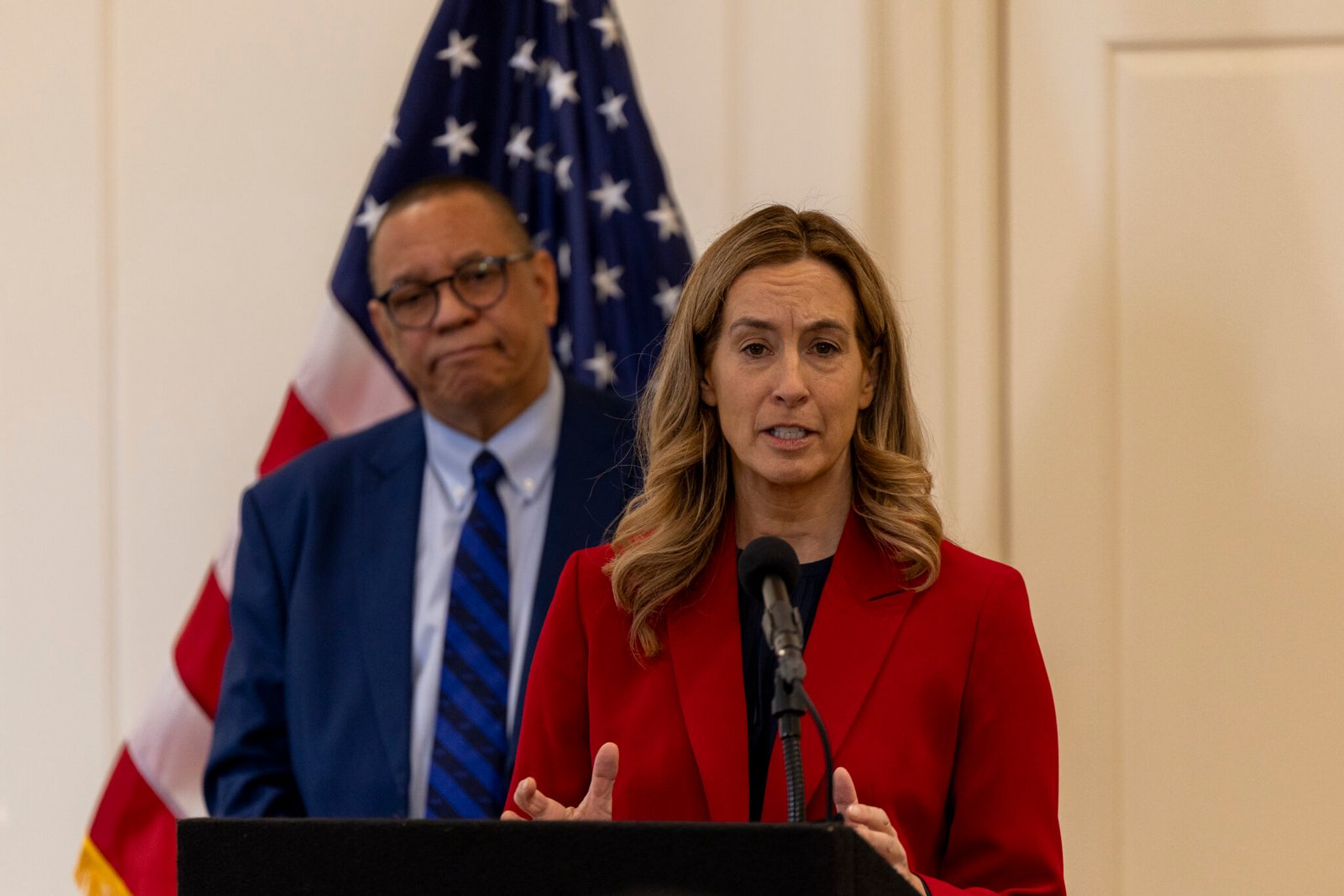
Gov. Mikie Sherrill warned the state’s current spending trajectory would see New Jersey’s reserves drained before June 2028 as she again pledged to cut spending to constrain the dwindling of the state surplus.
Sherrill presented her grim outlook on the state’s finances to reporters at the Statehouse in Trenton on Thursday, and said there will be “tough choices” ahead. Sherrill, a Democrat who took office on Jan. 20, is expected to present her first budget proposal to the Legislature on March 10.
“I’ve been doing hard things for most of my life, and that’s what I was elected to do now,” Sherrill said. “So to be clear, we’re not going to raise taxes on New Jerseyans. We are going to look for savings because together, we need to fix Trenton’s historic spending problem.”
Roxbury ICE jail plan takes center stage as Rep. Tom Kean Jr. seeks reelection
State officials on Thursday said expenses for Medicaid, school funding, public worker pay and benefits, and property tax relief were expected to drive increases in state spending over the next two budgetary years, which run from July to June.
The Sherrill administration’s projections show that, if the current budget was extended to future years, built-in cost increases would drive the state’s surplus down by roughly $3 billion in the coming fiscal year and by as much as $4.9 billion in the one that follows.
That trajectory would see New Jersey’s surplus go into the negatives despite officials’ expectation that the surplus at the end of the current fiscal year will be $7.2 billion.
Because the state’s constitution requires its budgets be balanced — that expenses equal revenue — New Jersey must cut spending rather than spending money it doesn’t have.
The fiscal picture could prove even more dire. The administration’s projections do not include the whole of federal cuts to Medicaid and other programs that would affect the budget in coming years.
Federal cuts have already increased the amount the state would have to spend in the next fiscal year by more than $100 million, state Treasurer Aaron Binder said. The full impact of those cuts was not reflected in the materials shared Thursday.
“The impact of many of the more painful cuts, particularly to our state’s health care systems, are not scheduled to go into effect until later in 2027,” Binder said. “The current structural deficit projections at this point do not factor in adjustments that will need to be made to account for the loss of the additional federal funds.”
Sherrill declined to detail what specific line items or categories of spending she would like to see reduced. Binder has said cuts to Stay NJ, a tax relief program for seniors that began sending its first payments this month, are not exempt from consideration.
The governor suggested funding could flow to some of her priorities when asked about a proposal she campaigned on last year to increase the state’s child tax credit.
“There are those areas that we are focused very much on, and much of that has to do with driving opportunity in the state, so we are trying to balance all of that, and that’s what I call a fiscally responsible budget, when you are looking at programs that aren’t delivering, aren’t working and then investing in those programs that deliver best,” she said.
Sen. Declan O’Scanlon (R-Monmouth), his chamber’s budget officer, appeared to welcome the administration’s stance on spending cuts.
Republicans have for years called for reductions in the state budget, which grew to a record $58.9 billion in Phil Murphy’s final year as governor after he ramped up pension payments and school funding, amid other increases.
Some observers were heartened to see the governor looking beyond the next budget, having long advocated for reforms that would require New Jersey to budget over multiple years.
“We’ve been urging the state to take a multi-year approach to budgeting for years, and it’s good to see the governor following up on her promise during the campaign to take a multi-year budgeting approach,” said Mark Magyar, director of the Rowan University Steve Sweeney Center for Public Policy.
The Sweeney center produces budget forecasts that have warned the state’s spending would, over years, drain its surplus.
Peter Chen, senior policy analyst for New Jersey Policy Perspective, echoed praise over Sherrill’s raising of red flags, noting the progressive think tank raised similar concerns over New Jersey’s long-term fiscal health and reliance on temporary revenue sources in prior years. But he said fixing New Jersey’s finances could require the state to raise more money in addition to spending less.
“You can’t paper over $3 billion easily, and as the governor mentioned, there are difficult decisions to be made,” Chen said, referring to the deficit projected for the coming fiscal year. “The state needs to look at the revenue side of the ledger as well. This is not just an expenditure side issue. There are more revenues that can and should be raised.”
GET THE MORNING HEADLINES.



