
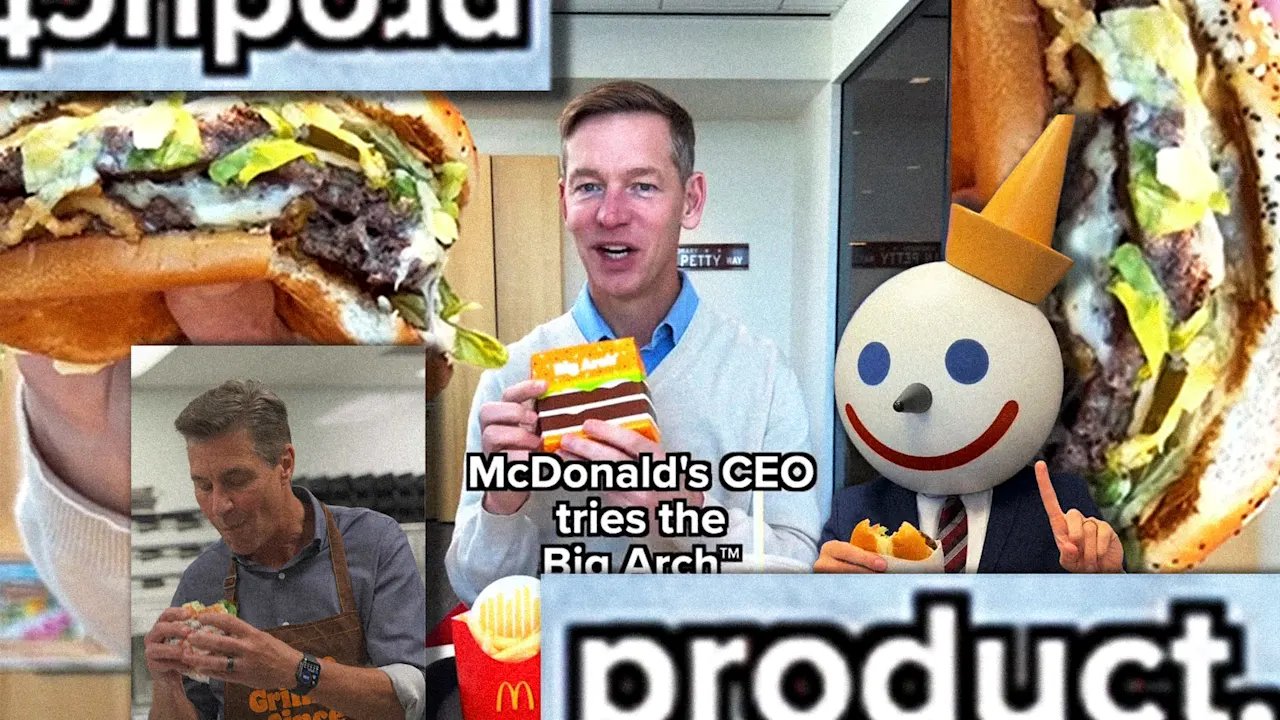
By now, anyone who follows major brands has seen it or heard of it: The small bite that went ‘round the world.
McDonald’s CEO and chairman Chris Kempczinski recently posted a video of himself on Instagram trying the brand’s newly launched Big Arch burger. It was basically the golden arches version of a dorky corporate unboxing.
When he got the Big Arch into his grips, he took a reasonable, if small, bite and said, “I love this product. It is so good.”
Cue the online mockfest.
Kempczinski didn’t deliver the news like an amphetamine-laced nano-influencer. No, here he was eating like some quarter-zip normie on a first date. On a scale of 1-10 in executive public performance, if one is Bank of America’s 2006 adaptation of U2’s “One” and 10 is Steve Jobs unveiling the iPhone, this was somewhere in the gaping maw of middleground.
It’s amazing how a seemingly small moment—a lo-fi social post—can blow up bigger than most ambitions for a major ad campaign. The earned media value here for McDonald’s is easily in the millions, which is exactly why so many CEOs from its fast food rival brands fervently jumped on the moment as an opportunity to soak in some of that sweet, sweet attention with their own take on the big bite.
As the video spawned cringe-inducing knock-offs from the CEOs of Burger King, Wendy’s, and others, it entered the natural cycle of online brand virality: A video goes viral; it gets mocked; rival brands capitalize on the moment, squashing any last trace of organic attention; people turn on the pile-on brands; suddenly, the original video starts to look brilliant.
It’s a brutal but beautiful cycle that ended with Kempczinski and the marketing machine behind him being heralded by some as calculating geniuses. There are theories floating around now that this is all a big orchestrated stunt meant to hype the Big Arch’s U.S. launch, and that Kempczinski & Co are playing 4D social media chess knowing this would happen all along. Sources familiar with the company have assured me this isn’t the case. Kempczinski has been doing tasting videos for years, and until people began making fun of it weeks after it was originally posted, it was in no way a stand-out among all his other takes.
Serving consistency
Kempczinski has an impressively consistent record of just this sort of dorky unboxing taste test video. In May 2024, he took a solid chomp out of a Ghost Pepper McChicken from Canada. In September 2024, it was a big normal bite out of a Samurai McSpicy from Thailand. Back in May last year, it was the McCrispy Strips. Totally normal. In July, it was the Snack Wrap. Guess what? Normal.
Why did this video take off? For many, the sheer Squidward of it all made it a slow, arching meatball of a pitch right over home plate to hit with jokes about out-of-touch executives. But let’s just roll with the idea that the Big Arch video does, in fact, make Kempczinski look like an out-of-step corporate CEO. I hate to break it to everybody, but every burger-eating CEO jumping on this bandwagon is in the same club. Burger King president TomCurtis made more than $6.9 million in 2024, and $5.4 million in 2023.
Meanwhile, Wendy’s has taken things a step further and is now advertising for a “Chief Tasting Officer.” The smell of desperation is clear. The brand is on its third CEO in three years, and has been forced to close hundreds of restaurants due to a sales slide. It’s got bigger burger issues to fry.
If I may address the executives flexing their big boy bites directly for a quick second: Gentlemen, this is beneath you. You may think this makes your brand look strong. It makes it look small. Throwing rocks from the sidelines shows everyone just how much bigger McDonald’s actually is.
As dorky as Kempczinski’s tasting videos may be, his consistency is the reason why any real attempt to frame this single video as disingenuous falls flat.
Cultural goodwill
McDonald’s has worked for years to build up enough cultural goodwill to make this Big Arch episode seem quaint in the grand scheme of its marketing. From all the various Famous Orders collabs, to the 2024 anime-inspired WcDonald’s work, to last year’s headfirst dive into the Minecraft Movie, and making Grimace an unofficial New York Mets mascot.
But just as important is how the brand navigates fan-driven social media moments. Sources familiar with the company, not authorized to speak on the record, tell me that it wasn’t a question of if McDonald’s would respond or comment in some way, but how.
It could’ve been a press release. Or at the other end of the spectrum, a limited edition Kempczinski Happy Meal on the McD’s app that’s just a hamburger, small fries, small Diet Coke. Instead it went with a just-fun-enough wink, acknowledging the joke but not ruining it.
The approach when something is decidedly fan-driven online, is to keep it that way. This is in the same vein as how the brand only very subtly nodded to the hilarious 2023 Grimace shake TikTok trend, which saw users act out their mysterious-yet-gruesome murder at the hands of the purple shake.
As a general rule, McDonald’s doesn’t participate in the brand-on-brand violence that so often flushes through our feeds.
It’s weird enough when brands on social talk to people as if they’re people, but when it’s brands talking to other brands, the sheer thirst for our attention and approval is suffocating. Like a Dutch Oven of corporate pseudo-comedy. Nothing could illustrate this more than this week’s scramble of social media managers trying to cook up the best quip.
I wrote the same paragraph almost word for word in 2019. Great job, everyone.
A little fun between brands is obviously fine, but these big biting CEOs all need to remember that the public is the real boss in these social media feeding frenzies. And unless they’re using more energy building up their own cultural goodwill, the next time, say, there’s a horsemeat situation, or maybe a kerfuffle over AI-driven price surging, it’ll be them and their brand on the menu.



