
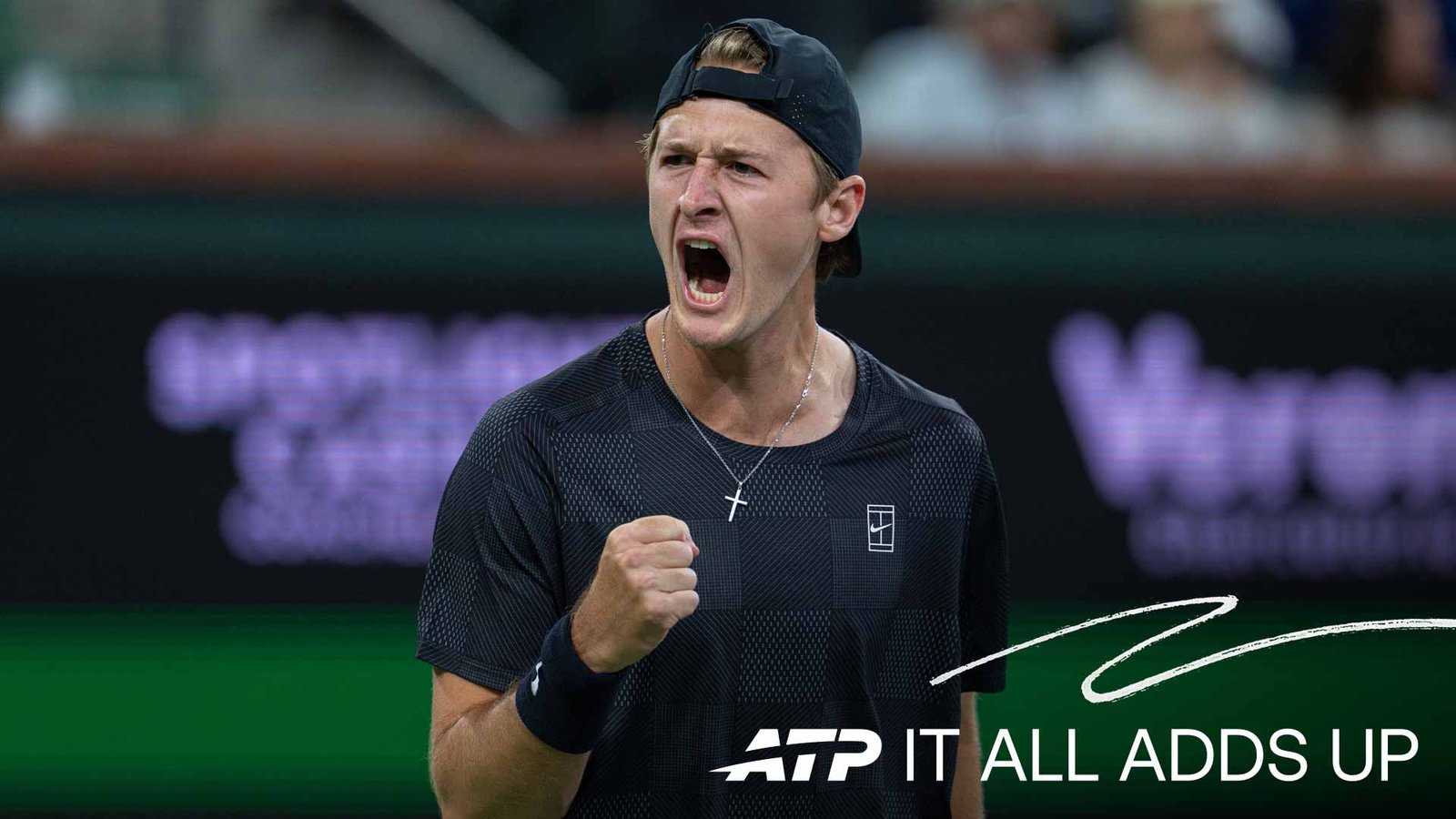
It All Adds Up
Inside Korda’s ‘long journey back’: No driving, crutches & a lot of hard work
Former World No. 15 finding success following injury struggle
March 07, 2026
ATP Tour
Sebastian Korda has climbed as high as No. 15 in the PIF ATP Rankings.
By Andrew Eichenholz
When Sebastian Korda won the Delray Beach Open last month it was a memorable scene. With a huge smile across his face, the American took his young nephew, the son of professional golfer Jessica Korda, down from the stands and soaked in the moment.
Last August, Korda fell to No. 86 in the PIF ATP Rankings, his lowest mark since April 2022. In large part, the drop was because the American suffered a stress fracture in his right shin that kept him out of action for three months. From the lows of spending his days in a boot to claiming his third ATP Tour title, it has been an interesting ride.
“It was cool. Had a long journey to get back to winning a title. Especially with my whole family there, it was something I’ve never experienced before,” Korda told ATPTour.com. “It was emotional, it was cool. It was a lot of hard work behind the scenes, but I was just super happy with it.”
It was only the second time Korda’s nephew had been to a tennis tournament despite Uncle Sebi and Grandpa Petr Korda’s history in the sport. Jessica lives nearby to Delray Beach, so Sebastian hung out at their house a bit. All was right in the world.
Less than a year ago, Korda was in pain and physically unable to do things that most take for granted.
“It was tough. I couldn’t drive around. I couldn’t do things. I had some crutches for a couple of weeks as well,” Korda said. “It wasn’t a fun experience. I never realised how tough crutches are as well. It wasn’t a fun time…
“Last year was pretty dark, and whenever I’ve gone through an injury, I kind of disconnected myself a little bit. Definitely had super tough moments, but a lot of people on the team really helped me come through.”
Sebastian Korda celebrates his Delray Beach triumph with fiancée Ivana Nedved.” style=”width:100%;” src=”https://www.atptour.com/-/media/images/news/2026/02/22/23/18/korda-delray-beach-2026-kiss.jpg”>
Korda and fiancee Ivana Nedved in Delray Beach. Photo: Getty Images
Korda returned last August in Winston-Salem, where he made the semi-finals. In his last tournament of the year in Athens, the American again made the semi-finals and fell just short to Top-10 star Lorenzo Musetti in a three-set tussle. His tennis had not simply disappeared.
But there were also difficult moments: opening-round losses at the US Open and the Australian Open, for example.
“The toughest part was coming back. Different environments, you kind of disconnect yourself from the stress of playing matches and nerves and just getting back to that and getting comfortable again,” Korda said. “Being in those situations definitely was the toughest part.”
It was not about forehands, backhands or even the serve. It has been about the mental side of the sport.
“You look through those moments, uncertainty, you don’t know how you will perform, maybe [how you will] be with the pressure,” Korda said. “The mental is definitely a lot tougher than the physical.
“I felt like I was playing good tennis, but I couldn’t really translate it into a match atmosphere. I think the last two months of just playing a ton of matches has been really helping.”

After losing three consecutive matches in January, Korda played an ATP Challenger Tour event in San Diego, where he reached the final. Since then, the 25-year-old advanced to the quarter-finals at the ATP 500 in Dallas, lifted the trophy in Delray Beach and is now competing in the first ATP Masters 1000 event of the season at Indian Wells, where he will challenge sixth seed Alex de Minaur in the second round.
Coach Ryan Harrison, who recently joined Korda’s team, has been happy with what he has seen.
“He’s responding really well to every situation that comes at him,” Harrison said. “Sometimes you’ll be in a match, and you’ll have some bad luck happen — guys will play well, and then other times you might not be feeling your best at the very beginning.”
But mentally, Korda has been locked in and navigating his way through matches, building more confidence each time he steps on the court.
“Every time he’s been playing, he’s been finding a way to get better and better throughout each match,” Harrison said. “[He has been] very resilient out there, even when there are those moments in a match that things can get really tricky to stay on it. He’s been very, very strong mentally.
It has not been the easiest year for Korda. But the former World No. 15 is moving in the right direction.
“Grateful for these experiences,” Korda said. “And then learned from them and tried to get better from them.”



