
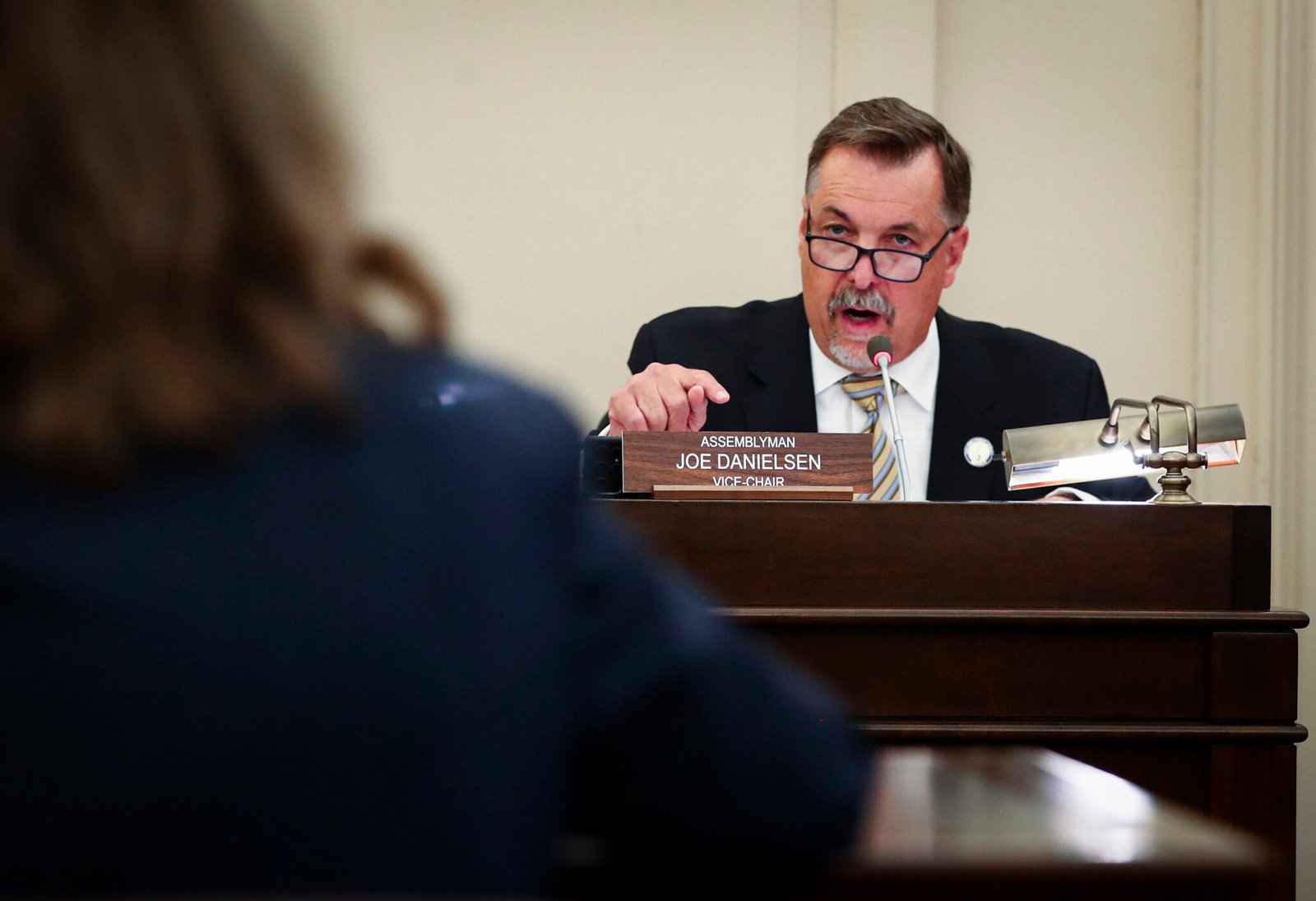
New Jersey lawmakers passed a raft of bills Monday meant to protect abortion access during a Statehouse hearing that grew so heated when human trafficking entered the debate that antiabortion activists accused one legislator of bullying.
Testimony on the five bills, which were up for discussion before the Assembly women’s affairs committee, went sideways after the antiabortion advocates repeatedly warned lawmakers that most of the measures would help sex traffickers better victimize women.
“This is a human trafficker’s dream! You vote for this, you vote for the sexual exploitation of women and children!” the Rev. Gregory Quinlan said of one bill to limit license plate data sharing.
Antiabortion advocates cited a recent Rutgers study that more than 3,000 women traveled to New Jersey from other states for abortions in 2024, kicking off a long stretch of squabbling with Assemblyman Joe Danielsen (D-Somerset), who challenged the advocates to prove their claims.
“You keep dropping this word bomb ‘trafficking.’ How many of the 3,000 were trafficked women?” said Danielsen, the committee’s co-chair.
“We don’t know,” conceded Marie Tasy, who heads New Jersey Right to Life.
Danielsen pressed on: “Is it fair to force a raped woman that produces a pregnancy to have a child?”
“We’re being bullied here! We’re being bullied!” Quinlan complained.
Danielsen retorted: “No, you’re being accountable.”
The hearing was just the latest of several where antiabortion advocates have inserted human trafficking into the debate about abortion, an increasingly common strategy of abortion foes around the country that has driven frustrated human trafficking experts to urge people to stop conflating the two.
Jean Bruggeman is executive director of Freedom Network USA, a nonprofit coalition of advocates and service providers that supports trafficking survivors.
“When we restrict bodily autonomy, we empower traffickers,” Bruggeman told the New Jersey Monitor. “It is very frustrating to me to see human trafficking be used as an excuse to restrict rights, to restrict freedom, to make conditions harder for the people who are already most at risk of trafficking. All we’re doing is increasing vulnerability.”
What the bills would do
The committee took testimony for more than two hours on five bills meant to strengthen abortion protections here as other states increasingly restrict the procedure, four years after the U.S. Supreme Court struck down the landmark Roe v. Wade case that declared abortion a constitutional right.
The bill that provoked the most contentious testimony is meant to stop abortion-restrictive states from using automated license plate readers to track and punish women who travel to New Jersey to end their pregnancies. Texas law enforcement officers used data from 83,000 such readers in multiple states, including those where abortion is unrestricted, to aid abortion probes, according to an investigation last year by 404 Media.
Danielsen and bill sponsor Assemblywoman Mitchelle Drulis (D-Somerset) assured critics that the bill is “micro-focused” and would only prohibit sharing license plate data with authorities investigating abortions. Officers investigating human trafficking and other suspected crimes still would be able to access license plate data if they sign a written declaration that the data won’t be used in an abortion probe, the bill says. Violators would face fines of up to $5,000.
The antiabortion activists weren’t buying it, though. Quinlan, founder of the Center for Garden State Families, called it “a selective data sanctuary policy.”
After the hearing, Drulis told the New Jersey Monitor she was offended to be accused of protecting human traffickers.
“It really bothers me that they are conflating these two issues, because we are doing everything we can to protect women in all cases, period,” Drulis said.
Kaitlyn Wojtowicz, executive director of the Planned Parenthood Action Fund of New Jersey, noted that medical providers are mandated reporters, meaning that if they suspect a patient who comes to them for care is a trafficking or abuse victim, they’re required by law to alert authorities.
The panel passed that measure along party lines. Committee members also advanced bills that would:
- Enter New Jersey into an interstate “reproductive health care compact” that’s meant to protect abortion patients and providers by prohibiting the disclosure of records and extradition of patients or providers to states looking to hold them criminally or civilly liable for abortion services. The bill passed 6-1, with Assemblywoman Dawn Fantasia (R-Sussex) voting no and Assemblyman Don Guardian (R-Atlantic) abstaining.
- Establish a reproductive health travel advisory to alert New Jersey women about reproductive health care restrictions in other states. The panel passed this bill 7-1, with Fantasia voting no.
- Prohibit deceptive advertising by anyone who provides pregnancy-related or abortion services and bar people from claiming to provide health care services if they don’t. This bill originally was intended to crack down on “crisis pregnancy centers” that hide their antiabortion mission, but the committee amended the bill to remove verbiage about the centers, as the U.S. Supreme Court weighs a challenge to the state’s consumer fraud investigation into the centers. The panel’s six Democrats approved the bill, while Fantasia and Guardian voted no.
- Protect access to assisted reproductive technology such as in vitro fertilization.
What human trafficking experts say
Human trafficking has bubbled up in almost every tangent of the abortion debate.
Antiabortion activists have warned that funds created to help poor women end unplanned pregnancies would instead fund the abortions and sterilizations of trafficking victims. They’ve claimed making abortion pills available by mail would help traffickers coerce victims into abortions. They call it abortion trafficking when someone crosses state lines to help a minor access abortion.
Experts, though, say there’s no evidence that protecting abortion rights facilitates trafficking.
But trafficking has become “weirdly politicized” and widely used by conservatives especially since QAnon made the sexual abuse of children a common rallying cry, according to researchers at Montclair State University’s Global Center on Human Trafficking. QAnon is the debunked, decade-old, far-right conspiracy theory that a satanic cabal of pedophiles and cannibals controls the world. One of the antiabortion activists who spoke at Monday’s hearing referenced “the cannibalism of babies … and satanic rituals.”
Trafficking lends other issues political clout because it has a potent rhetorical power that “instantly elevates the concern and really energizes people,” said Bond Benton, a communications professor at Montclair who has co-authored research papers on trafficking and abortion.
“There is a tendency to say, ‘everyone I don’t like is a trafficker,’” Benton said. “This is probably one of the lasting legacies of the QAnon movement — if I want to demonize a political position that I disagree with, I can simply say, ‘well, your position supports trafficking.’”
Daniela Peterka-Benton, the center’s director, agreed that trafficking has entered political debates beyond abortion, with right-wing activists demanding expanded immigration restrictions to thwart traffickers and labeling LGBTQ people “groomers” bent on trafficking children.
“We’ve seen a lot of scares around the topic of trafficking,” Peterka-Benton said.
Using trafficking to argue against abortion protections and other political proposals can be dangerous for trafficking survivors, Bruggeman warned.
“It causes confusion in the public, in law enforcement, in service providers, and if they’re confused about what human trafficking is, then when a survivor comes forward, it’s more likely that they won’t be recognized, they won’t be understood, they won’t be believed,” Bruggeman said.
GET THE MORNING HEADLINES.



