
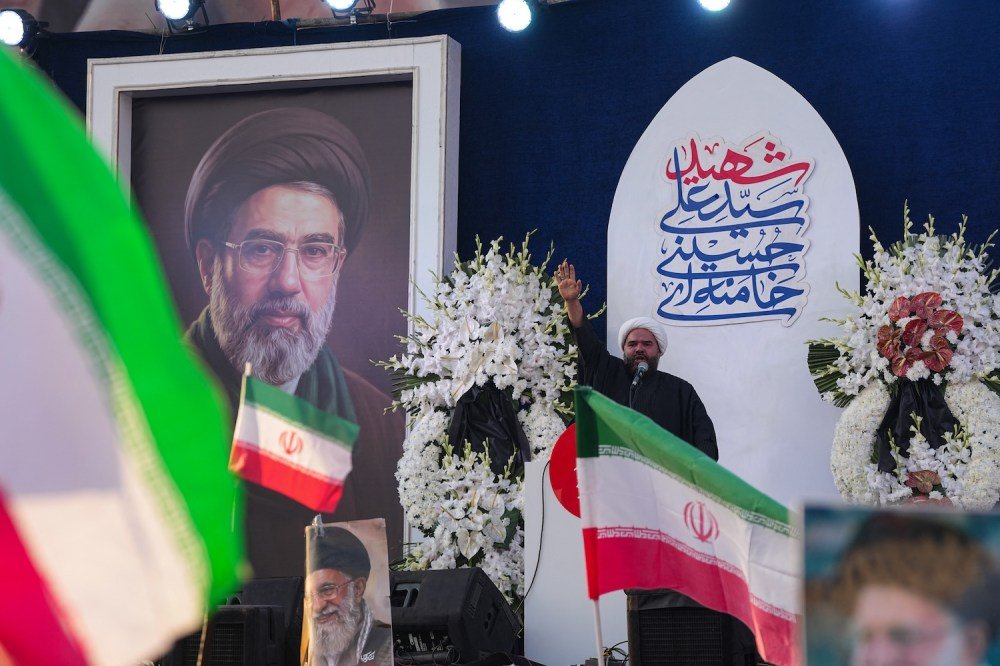
Nine days after Ayatollah Ali Khamenei was killed on Feb. 28 by Israeli and American airstrikes, the Islamic Republic announced that his second son, Mojtaba Khamenei, had been chosen as the next supreme leader. The decision was made in a highly opaque manner. Yet whether it reflects a genuine institutional decision or a wartime power grab, the political meaning is the same: Mojtaba’s elevation is a turning point for the regime.
Mojtaba Khamenei has long been a shadowy but influential figure inside the Islamic Republic. He entered politics after his father was appointed as the second supreme leader in 1989, and he gradually built power behind the scenes. In his memoir published in 2000, Hashemi Rafsanjani mentioned Mojtaba’s interference in politics frequently. In 2005, Mehdi Karroubi publicly accused him of engineering the presidential election that brought hard-liner Mahmoud Ahmadinejad to power.
Nine days after Ayatollah Ali Khamenei was killed on Feb. 28 by Israeli and American airstrikes, the Islamic Republic announced that his second son, Mojtaba Khamenei, had been chosen as the next supreme leader. The decision was made in a highly opaque manner. Yet whether it reflects a genuine institutional decision or a wartime power grab, the political meaning is the same: Mojtaba’s elevation is a turning point for the regime.
Mojtaba Khamenei has long been a shadowy but influential figure inside the Islamic Republic. He entered politics after his father was appointed as the second supreme leader in 1989, and he gradually built power behind the scenes. In his memoir published in 2000, Hashemi Rafsanjani mentioned Mojtaba’s interference in politics frequently. In 2005, Mehdi Karroubi publicly accused him of engineering the presidential election that brought hard-liner Mahmoud Ahmadinejad to power.
In the years that followed, Mojtaba exercised power in the shadows and without accountability. During the 2009 Green Movement, following the fraudulent presidential election, Mojtaba supervised the regime’s suppression of protesters. (Like his father, Mojtaba was fascinated by security and military domains.) It was during that crackdown that many Iranians first began chanting directly against him: “Mojtaba, may you die, and never become leader.” Seventeen years later, the regime imposed exactly what many Iranians feared.
Since the announcement of Mojtaba’s ascent, I have received messages from relatives and friends in Iran expressing the same fear: “If Mojtaba stays in power, he will pulverize us.” On social media, too, posters are concerned that repression will become even harsher. These reactions reflect a broader public mood. Many Iranians do not see Mojtaba as a stabilizing figure. They see him as the embodiment of the most closed, corrupted, punitive, and hereditary form of the Islamic Republic.
As Iran’s second man since the early 2010s, Mojtaba has the same mentality as his deceased father. He believes in the creation of the Islamic Shiite ummah and shares his father’s deep hostility toward the United States, unrelenting enmity toward Israel, support for the so-called axis of resistance, and a belief that coercion is the main instrument of rule. His elevation sends the clearest possible message to Iranian society, to the region, and to the outside world that the Islamic Republic is no longer even pretending to renew itself. It signals hard-line continuity, regime closure, and a deeper fusion of clerical authority with the coercive apparatus.
That is precisely why the Islamic Revolutionary Guard Corps (IRGC) is supportive. Reuters has reported that Mojtaba has long had strong ties to the Guard and to the political network around his father’s office. His leadership may preserve cohesion within the regime’s core for a time, especially the security establishment. For the IRGC, this is not the moment for an unknown figure or a semi-pragmatic cleric who might reopen elite bargaining, tactical moderation, or negotiations with the West. It needs someone it trusts, someone who protects its institutional interests, and someone who accepts the security state it has helped build. Mojtaba meets that requirement better than figures such as Hassan Rouhani or Sadiq Larijani.
Mojtaba Khamenei did not build an independent public constituency. He did not rise through visible institutions in the way earlier clerical elites did. His importance came from proximity, access, and networks. Over time, he appears to have cultivated close ties with not only parts of the IRGC but also the Basij and conservative clerical circles that viewed him as a reliable guardian of his father’s doctrine. In the middle of war, internal purges, and leadership decapitation, this continuity becomes an asset for those whose first concern is regime survival.
His selection preserves the ideological framework of the late Khamenei era while keeping the center of gravity where it has, increasingly, been for years: in the alliance between the clerical establishment and the security and military apparatus. In that sense, Mojtaba does not simply succeed his father; he inherits a system he helped shape, a system that has already evolved into a theo-security state in which coercion matters more than charisma and institutional loyalty matters more than clerical prestige. But to an even greater extent than his dad, Mojtaba owes his leadership and survival to the security forces.
A Mojtaba supreme leadership will likely produce short-term elite consolidation. The regime’s surviving hard-liners will rally around him because he reduces uncertainty. He will offer the IRGC, the judiciary, the intelligence services, and the loyal clerical establishment a common figure behind whom they can rally. In moments of existential danger, authoritarian systems often choose predictability over innovation to ensure their survival. Mojtaba represents fear, continuity, and internal discipline, the tools the regime needs to maintain power.
This is politically significant because the regime is already in an existential crisis, and repression has only made it worse. Many Iranians didn’t just oppose Ali Khamenei’s rule; they also celebrated his death, even while facing gunfire, as security forces shot anyone who dared to cheer his demise. For Iranians, Mojtaba’s succession is an insult rather than a fresh start. His appointment told society that after mass killings, war, economic collapse, and international isolation, the regime’s answer is to keep power in the same family and in the same security networks.
His appointment’s domestic consequences are likely to be severe. Mojtaba and the hard-line security establishment have already read the public celebration of Ali Khamenei’s death, protest activity, and even private dissent as signs that fear has weakened and that parts of society have turned openly against the regime. Their answer to this shift will almost certainly be a new wave of repression, deeper and more brutal than before. The pattern is already familiar. After the 12-day war, when many people celebrated the Israeli attacks, the regime responded with punishment. On Jan. 8 and 9 alone, it killed more than 10,000 people as retribution against a society it believed had betrayed it. If the regime survives, it will try to reimpose psychological domination over a society that has repeatedly shown that it wants nothing more than regime change.
In brief, Mojtaba’s selection may keep the true believers together for a while and help the IRGC preserve the regime during an existential crisis. But it would do so by confirming the bleakest reading of the Islamic Republic’s evolution: that it has become fully closed, hereditary, and inseparable from the machinery of repression. This is not a sign of renewal. It is a confession of political exhaustion.



