
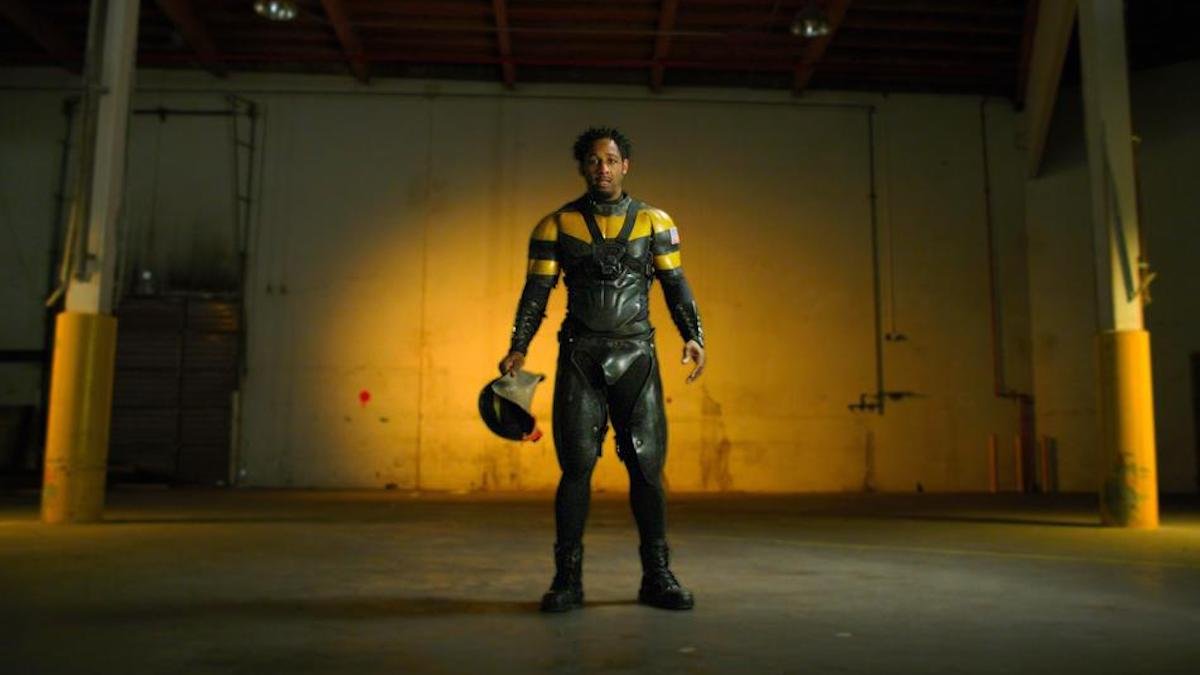
The title of Phoenix Jones: The Rise and Fall of a Real Life Superhero, says it all. Director Bayan Joonam’s fascinating new documentary, premiering at SXSW, charts the story of a man who dons a mask and costume to take to the streets of Seattle and try to do some good — alongside an eclectic team of fellow masked vigilantes.
They don’t really love the word “vigilante,” and would probably prefer “hero.” But the film leaves it up to viewers to decide whether they’re driven by heroism, altruism, ego, insecurity, or some combination of them all. Sometimes it looks like they’re having a lot of fun, and other times they seem as haunted as Batman.
Reports of Phoenix Jones’ late-night Seattle patrols started in 2010. The city is an intriguing backdrop for the doc, especially as it becomes a frequent focal point for demonstrations and protests, including against traditional law enforcement.
At times it seems like Phoenix Jones (our editorial policy is not to reveal secret identities) may be able to be a champion for the people in ways that police can’t. At other times, the people view him with skepticism, or as an agent of the powers that be. And at still other times, he himself has issues with the law.
Joonam went all in on understanding Phoenix Jones, spending years with the costumed crusader and witnessing acts of quiet heroism that never made the news. We asked him about what it’s like to get to know a real-life superhero — and the man behind the mask. We asked him about his research, Jones’ curious origin story, and how to be a hero today.
Director Bayan Joonam on the Quest to Make Phoenix Jones: The Rise and Fall of a Real Life Superhero
MovieMaker: You previously made QAnon — The Search for Q. Are you especially interested in secret identities?
Bayan Joonam: Ha, I never actually put that together before. I think great documentaries generally focus on a specific question.
With Phoenix Jones, his real identity was never the mystery. I already knew who was behind the mask. The question was: What kind of person decides to become a superhero in the real world? I am exploring the psychology of someone who chooses to live inside a self-created myth.
But the connection between the two projects really comes down to curiosity. I’m drawn to people who are shaping culture in unusual ways. Also, as someone who has loved the superhero genre as long as I can remember, I came to see this film as my contribution to it.
MovieMaker: How much time did you spend with Phoenix Jones, and over what time period?
Bayan Joonam: We spent about six years creating this project. Over that time I’d estimate we spent roughly six months together in total. For about a month of that, he actually lived with me in the Airbnb I was renting in Seattle, which gave me a much deeper window into who he is when the cameras aren’t rolling.
MovieMaker: How did you feel when parts of his backstory started to seem inconsistent? Was it more “this is bad for the doc” or “this is great for the doc”?
Bayan Joonam: His ability to spin a yarn is second to none, which is part of what makes him such a compelling subject. During interviews, I took mental notes on details that needed investigation, then built timelines to corroborate or challenge those accounts with other participants.
Like most good fabrications, there is usually a grain of truth somewhere inside the story. So separating fact from fiction became a central task in making the film.
To be fair, in many cases the stories actually turned out to be true, like the one he told about meeting Bill Clinton. That tension between myth and reality became one of the most interesting parts of the documentary.
MovieMaker: Watching this, I thought about how hard it is for anyone to be a public hero today, because any good deed will be seen as virtue signaling, or too good to be true. Do you have any thoughts on that?
Bayan Joonam: That’s a great takeaway, and I think you’re right. It’s incredibly difficult for anyone to maintain “hero” status in today’s environment because the internet eventually exposes every contradiction. And the reality is that none of us are perfect.
Superheroes work in movies because the narrative is clean. Real life isn’t. People are complicated, and the moment someone is elevated to hero status we immediately start looking for the flaws that bring them back down to earth.
At the same time, I think the best superheroes reflect our national identity. Phoenix Jones is not a superhero that could be engineered in a writers room, but he is undeniably the superhero that our society has shaped into existence.
MovieMaker: Do you think Phoenix Jones genuinely wanted to do good? Or to gratify his own ego? Or both?
Bayan Joonam: I think it’s both.
You have to ask yourself what conditions create a person who decides to dress up like a superhero and partol the streets looking for crime. Central to his story is the fact that he was given up for adoption at birth, which I think connects to his creation of a larger-than-life persona as a way of proving his value to himself and the world.
But in his daily life, when he’s not wearing the suit and sees someone with car trouble on the side of the road, he pulls over to help. He does a lot of things that never make the news or social media. I genuinely believe he wants to help when he sees someone in need.
Phoenix Jones: The Rise and Fall of a Real Life Superhero plays Friday and Monday at SXSW. The film is currently seeking distribution.
Main image: Phoenix Jones in Phoenix Jones: The Rise and Fall of a Real Life Superhero.



