
Mother Jones illustration; Unsplash
Who could have guessed they would be the ones on my mind? It was a personal appointment, perhaps the most intimate variety, and MAGA characters don’t normally seep into my private life. But there I was last month, at some point between a transvaginal ultrasound and substantial bloodwork, pondering the lives of Karoline Leavitt, Usha Vance, and Katie Miller.
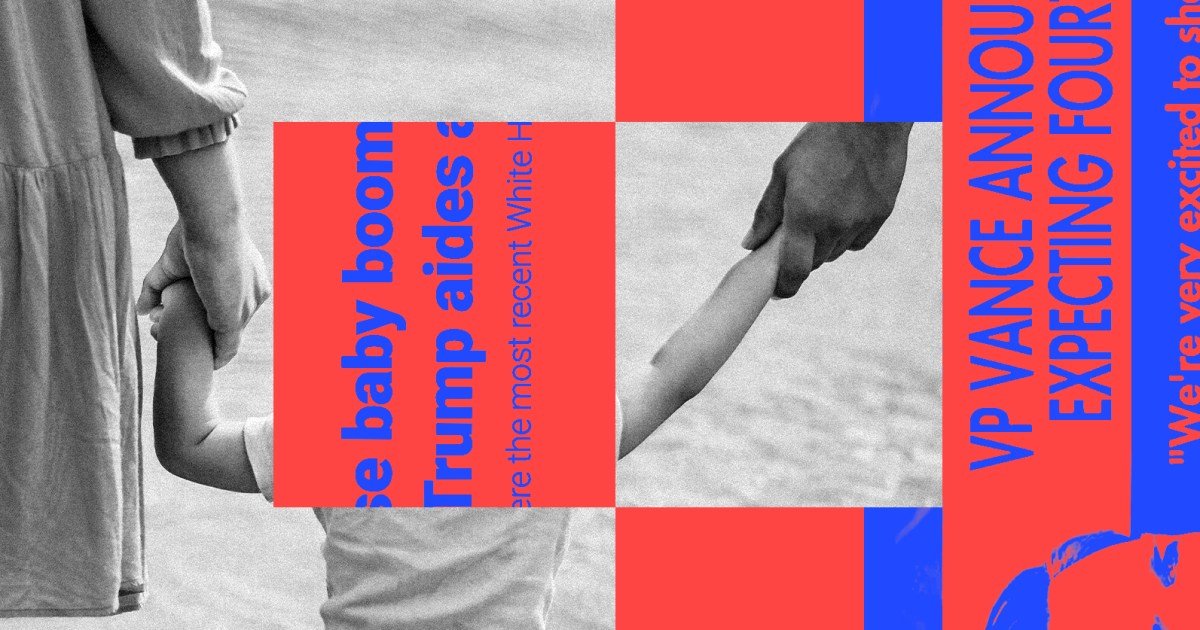
These three women are at the forefront of a trend: a so-called mini “baby boom” unfolding across the upper echelons of the Trump administration. In other words, Leavitt, Vance, and Miller are pregnant, each with due dates in late spring or summer. Their pregnancies have been accompanied by a bit of culture war, too: Fox News noted the “full boom” as evidence that the women are enthusiastic devotees of the administration’s pronatalist agenda. There was Vice President JD Vance, who at a March for Life rally shortly after his family’s announcement, declared: “Let the record show, you have a vice president who practices what he preaches.” In a December Instagram post announcing her pregnancy, Leavitt thanked Trump, a self-declared “fertilization president,” for “fostering a pro-family environment in the White House.” Miller regularly supplies her X account with expressions of pronatalist, anti-contraceptive concerns about the country’s declining birth rate.
I found myself in the unlikely position of envying the cheerfully un-ambivalent, un-conflicted, pregnant ladies of MAGA.
But back to me, in the doctor’s office. I am not pregnant, nor do my husband and I know if we ever want to be again after having a baby a little more than four years ago. Should we stick with one, this objectively awesome kid, we’d be a part of the fastest-growing family unit in the United States. “One and done,” as they say, would be normal and good, fine and familiar. Still, there isn’t much about our undetermined decision-making process that has felt stable. Instead, I face a steady source of neurotic turmoil, a topic I have now discussed across three therapists, one of whom, in January, suggested that I visit a reproductive endocrinologist to discuss the option of embryo freezing. Which is what brings me to a fertility clinic in New Jersey, where I found myself in the unlikely position of envying the cheerfully un-ambivalent, un-conflicted, pregnant ladies of MAGA.
It’s not easy for me to admit envy, considering that I find some aspects of this mini baby-boom a bit unsettling, from the implication that the vice president may be procreating to advance a political project to the overt eugenics that animate the administration’s push for more babies. But even so, in the midst of my private ambivalence, I have been spellbound by the easy certainty, or more accurately, the supreme public confidence with which Leavitt, Vance, and Miller appear to be growing their families. Their remarks convey the impression that, for some, choosing to become pregnant is as uncomplicated as waiting for the favored political winds to be at their backs and saying, “Let’s do this.” That certainty, even if performed, eludes me, and frankly, I desire it. Whether I decide to have another kid or not, I want to be secure in the choice, like these women seem to be.
When I reached out to Peggy Heffington, a historian at the University of Chicago and author of Without Children: The Long History of Not Being a Mother, to talk through all this, I was surprised, even comforted, to hear that some of what had informed her book was her own “personal place of being someone who has never felt sure about having kids.”
“For me, it was a grey area,” she said. “It always felt like there were other factors at play. That it’s never just about desire, it’s about context.”
It’s exactly this context that Leavitt, Vance, and Miller don’t appear to acknowledge. As Miller wrote in a February X post: “Women are biologically destined to have children. Biology equips women with unique tools and predispositions that make children more aligned with female physiology and psychology. You don’t need to wait for that perfect moment to have kids, you just need to have them.”
“You don’t need to wait for that perfect moment to have kids, you just need to have them,” Miller wrote.
It would take reams upon reams to unpack the arrogance of Miller’s assertions. But it’s her last claim, that women “just need to have” kids and forget the factors that go into the decision-making process, that elides the legitimate and troubling reasons why so many of us can’t decide. A short list: anxiety over the climate crisis, conflicts over career ambitions, the physical stresses, regret over the first one, and fears of identity loss. Then there are the brutal realities of having a child in a country lacking family-friendly policies: paid family leave, affordable child care, flexible working arrangements, and access to affordable fertility treatments.
“We’ve changed society in ways that have made it far more challenging” to have kids, Heffington said. “The way we work has come into conflict with the demands of a large family. We’ve made really deliberate decisions towards an individualized society that lacks support for families.”
And then there’s the sheer, mind-blowing expense. But you won’t hear about any of that from Leavitt, Vance, or Miller.
The contours of my own indecision bend toward freedom. That sweet ability to take the trip out of the group chat—Mallorca, Malibu, Granada, San Francisco!—that only grows the further you are from those grueling newborn days. The liberty to finish entire books without interruption, to ponder a surprising return of ambition, to take care of oneself in a way that feels uniquely dependent on the calculus of zero diapers, one daycare bill, and the 1,273 early illnesses that laid the groundwork, finally, for a more robust immune system. I can’t help but worry that another baby could be the destruction of that freedom. All of which, I imagine, smacks of selfishness among today’s pronatalists who see declining birthrates as threats to humanity.
It’s easy to brush off their messaging as weirdo creepiness, because, well, it is. But their dedication to portraying the illusion of a picture-perfect world of motherhood can trigger an ache not unlike the complex emotions some, including women experiencing infertility and miscarriage, feel when coming across Instagram pregnancy and birth announcements. Still, I never expected the trigger to come from prominent families of the federal government.
This has precedent. To understand how governments can stigmatize a woman’s ambivalence, we need only to go back 121 years to Theodore Roosevelt in 1905, speaking to the National Congress of Mothers:
There are many good people who are denied the supreme blessing of children, and for these we have the respect and sympathy always due to those who, from no fault of their own, are denied any of the other great blessings of life. But the man or woman who deliberately foregoes these blessings, whether from viciousness, coldness, shallow-heartedness, self-indulgence, or mere failure to appreciate aright the difference between the all-important and the unimportant—why, such a creature merits contempt as hearty as any visited upon the soldier who runs away in battle, or upon the man who refuses to work for the support of those dependent upon him, and who, though able-bodied, is yet content to eat in idleness the bread which others provide.
Roosevelt sets up a clear delineation between those who deserve empathy because they cannot conceive, and people who either choose not to or, like me, who struggle to decide, and should therefore be despised. For Roosevelt, his speech continued, we are the “creatures” who form “the most unpleasant and unwholesome feature of modern life.” Such harsh views are not dissimilar to Vance’s “childless cat ladies” dig or this administration’s countless efforts to inject “family values” and conservative gender norms across daily American life.
“The existence of women of this type,” Roosevelt continues, “forms one of the most unpleasant and unwholesome features of modern life.”
I don’t know how I’ll land on the decision to go for another. Shortly after the initial ultrasound, a financial counselor informed me that my mediocre insurance wouldn’t cover the treatment, which, should I eventually move forward with freezing and implantation, would cost just north of $37,000. (So much for Trump’s promise of free IVF, indeed.) But cost is far from the main factor making this decision feel, at times, impossible.
Was there ever a moment of uncertainty for the women of MAGA’s baby boom? Could they even empathize with a woman who can’t figure it out? It’s impossible to know. But portraying it as an easy decision, that just so happens to conveniently align with a political ideology, is to push a quieter cruelty. That they have entered my consciousness, in the most intimate of settings, must be some kind of proof of their propagandistic success.
“Don’t we all want that ease?” Heffington said. Looking at declining birth rates in the US, where the material and political contexts of daily life have changed so drastically over the last two centuries, she added, “There’s a feeling that this ease has been taken from us.” You just wouldn’t know it from the women of MAGA.



