
Right from the jump, two people all but guaranteed the 2026 Academy Awards were going to go well, and they both happened to portray the child-abducting witch known as Aunt Gladys.
One, of course, was Best Supporting Actress winner Amy Madigan. While accepting her Oscar for “Weapons” — the first award of the night — Madigan laughed long and hard. She thanked “all the dogs.” She talked about shaving her legs in the shower to get ready, and she talked about how she didn’t need to shave her legs after all because she ended up wearing pants.
But Madigan also mentioned how she was warned beforehand not to spend her precious seconds on stage “rattling off names” — to which, as she’s known to do, Madigan said no. She was going to spend her time on stage saying whatever the hell she wanted, but she was still kind enough to explain why all those thank you’s are important, actually.

“You’re not rattling them off,” she said. “They’re people who mean something to you, because you couldn’t be here without them.”
Rattling off names is an awards show staple, and while some may complain of its rote monotony, the Oscars wouldn’t be the same without all that gratitude. Saying thank you isn’t just a way to ingratiate yourself to Hollywood’s power players (the cynical interpretation), it’s a way to emphasize that making movies is a collaborative effort, even when you’re honoring individuals. It’s a way to look beyond yourself in a moment that’s ripe for narcissism. It’s also a way to, you know, say thank you. Which is important. And kind. And good.
Also good, kind, and important: Conan O’Brien, our second instrumental individual of the evening, who hosted his second excellent Academy Awards ceremony. He’s two for two, and like his first, O’Brien exuded a genuine love for movies from start to finish. What set this year apart was how readily an emboldened O’Brien — and the show around him — embraced Oscar traditions that past ceremonies have shied away from.
While celebrating an exciting group of winners, the 2026 Oscars were also for the fans — and so much better for it.
The telecast thrived by leaning into the aspects of awards shows that matter to people who love awards shows. Clips for many of the nominees? Check. Sincerity in the speeches and presentations? Check. Inside jokes aimed at film aficionados? Check. Sure, there were some sound issues, and there weren’t enough speakers like Javier Bardem (“No to war, and free Palastine”), but we did hear from those who were willing to speak up, and they weren’t as silent as in years past.
Also helpful: No one involved in the production acted like they were embarrassed to be putting on an awards show. The evening ran long, and it did so with gusto. There were long speeches (let the “K-Pop” people finish!), long tributes (the Fab Five format to present the first-ever Casting Oscar worked beautifully), and long performances. (The “Sinners” musical number managed to evoke Ryan Coogler’s direction with clever reveals of the new musicians, while the In Memoriam segment finally felt properly paced all the way through.) Heck, even Conan’s post-goodbye bit hit, where Jim Downey named him “host for life” (before killing him off, Lockjaw style). That’s so hard to do! Especially at the end of a long show, after the final award is handed out! (Just ask Kristen Bell, whose otherwise pleasant ping-pong tournament during the SAG Awards went one segment too far.)
Of course, plenty of Oscars telecasts get dinged for running long, and rightly so, but here’s the thing: When they’re good, no one cares. The people who look forward to the Oscars every year certainly don’t (like Roger). In fact, we love a long show, especially on a night when the winners are nothing short of golden.

There were a few surprises, big (a tie!) and small (Michael B. Jordan won a toss-up for Best Actor). History was made more than once, including landmark wins in Cinematography (Autumn Durald Arkapaw gave one of the night’s best speeches) and the first-ever Casting award (with a minor upset by “One Battle After Another’s” Cassandra Kulukundis). And aside from a few too many premature play-off attempts, the producers were as game for all of it as their host.
O’Brien’s opening sketch — in which he played Aunt Gladys running through various nominated films while being chased by angry children — paid homage to his favorite Oscars host, Billy Crystal, offered clever surprises (“K-Pop” Aunt Conan!), and set up an ideal framework for his monologue.
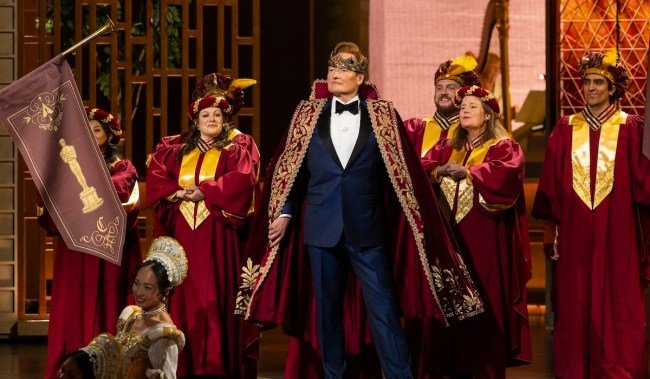
O’Brien opened with a silly bit highlighting a bunch of nominees and ended with a silly bit where he was crowned as a king and blessed by the Pope. In between, he landed great jokes about Amazon, Netflix (getting a chuckle out of Ted Sarandos by claiming it was his first time in a theater), and Timothée Chalamet (the night’s overused punching bag). From there, he just kept going:

He zinged Trump without ever saying his name. (“We’re coming to you live from the Has a Small Penis theater — let’s see him put his name in front of that.”) He lamented YouTube’s upcoming takeover of the Oscars telecast with back-to-back ad breaks featuring Jane Lynch (and an ill-advised flashlight). He poked at vertical dramas by highlighting Ventura Crossroads, a company that makes “Hollywood’s biggest movies smaller and taller.” He even took another shot across Netflix’s bow with a “Casablanca” bit (co-starring a hilarious Sterling K. Brown) about studios making movies where the characters repeat what’s going on to make it easier on audiences who aren’t paying attention. (“World War II — that’s the Hitler one, right?”)
None of these topics are exactly well-known to people who aren’t reading entertainment news on the daily. I’d be surprised if most of America knows what vertical dramas are, knew about the Oscars’ YouTube deal, or had heard about Netflix telling Matt Damon how to make dumber movies. But that didn’t stop O’Brien from nailing those jokes, and it didn’t stop the audience from roaring with laughter at each one. (Sarandos seemed genuinely tickled by the barb in O’Brien’s opening monologue.)
Combined with well-deserved and hard-earned wins for the likes of Paul Thomas Anderson and Ryan Coogler, two auteurs who are particularly beloved by cinephiles, and the 2026 Oscars felt like the first in a long time that were made with cinephiles top of mind. Usually, there’s too much emphasis placed on winning back viewers that have tuned out instead of respecting the viewers who’ve stuck around. It’s a strategy as irritating as it is misguided (those ’90s ratings aren’t coming back!), and it usually results in something disrespectful (like cutting categories from the broadcast) or downright disastrous (like just about everything in 2022).
The Oscars mean something to the people in the room, just as they mean something to many of the people watching at home. Leaning into that significance doesn’t require being serious from start to finish. You just have to why we’re here. O’Brien did that, Madigan did that, and everyone else followed their lead. What more could we ask for?
Grade: A
The 98th Academy Awards were held Sunday, March 15 at the Dolby Theater in Los Angeles, CA. ABC broadcast the ceremony, which was also available to stream on Hulu.



