
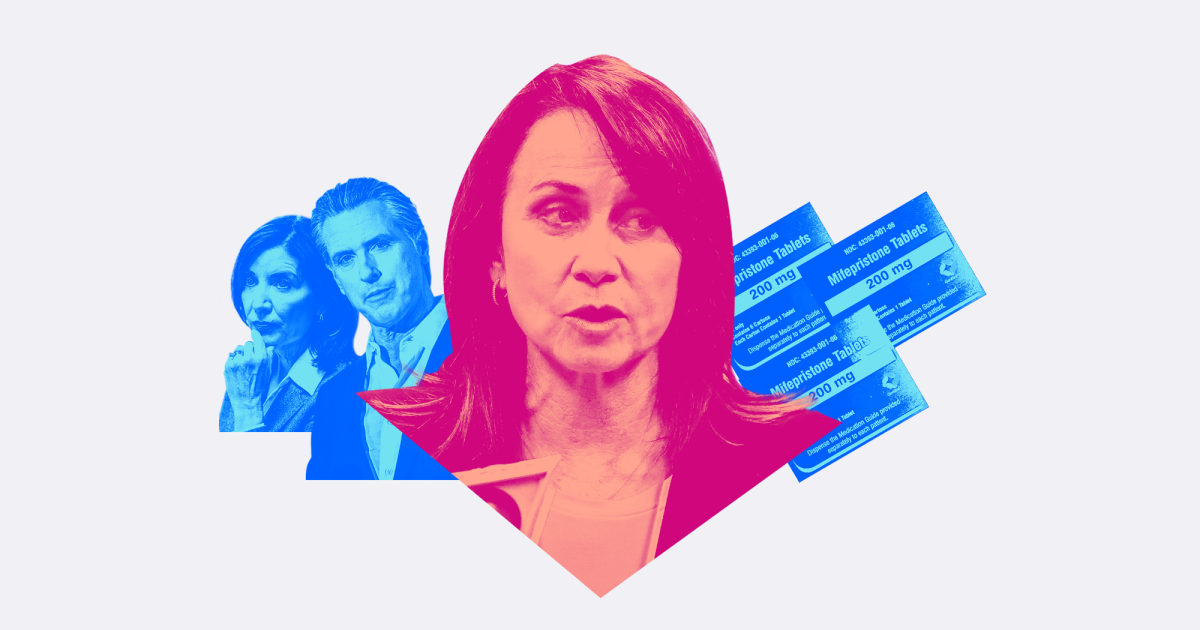
When Louisiana Attorney General Liz Murrill announced last month that she was planning to sue the governors of New York and California for refusing to extradite doctors accused of mailing abortion pills to her state, Gavin Newsom was unfazed. “@AGLizMurrill: Go fuck yourself,” he mocked on X. “California will never help you criminalize healthcare.”
New York Gov. Kathy Hochul didn’t bother responding. But she’d already made her position clear last year. “I will not be signing an extradition order that came from the governor of Louisiana,” Hochul said at a news conference. “Not now, not ever.”
This pushback—and the fact that, weeks later, Murrill still hasn’t followed through on her threat—says a great deal about the surprising reality of abortion access almost four years after the Supreme Court overturned Roe v. Wade, making abortion a states’ rights issue. Put simply, the abortion-access movement is winning. That’s thanks largely to “shield” laws—blue-state statutes that protect abortion providers and helpers from being investigated, prosecuted, sued, and harassed for providing care to patients living in places where abortion is illegal.
Shield laws are designed to thwart the near-total abortion bans and other restrictions that have proliferated in red states since the 2022 Dobbs decision. Broadly speaking, these measures prohibit law enforcement and state agencies from engaging in actions that could help abortion opponents bring criminal or civil cases against abortion doctors, helpers, or patients. In most shield-law states, police can’t serve arrest warrants; court clerks can’t issue subpoenas; IT staff can’t comply with records requests, and governors can’t sign extradition orders.
So far, 22 states and Washington, DC, have created some version of shield protections; eight of those states, including New York and California, have adopted laws that explicitly protect people who provide or facilitate abortion care via telemedicine. The laws have proven to be “one of the strongest tools that reproductive freedom advocates have to protect abortion access in a post-Roe reality,” says Ashley Kurzweil, a senior policy analyst at the National Partnership for Women & Families. “It’s painfully obvious that anti-abortion extremists are targeting shield laws because they are working.”
“It’s painfully obvious that anti-abortion extremists are targeting shield laws because they are working.”
The best evidence of the laws’ effectiveness comes from the Society of Family Planning’s #WeCount project, which has been tracking changes in the volume of abortions since just before Roe fell. In the most recent data, providers operating in shield states accounted for nearly 15,000 abortions per month—about 15 percent of the total number of abortions nationwide and an indication of the most unexpected development of the post-Roe era. Access to abortion hasn’t disappeared since Dobbs—it’s expanded. Instead of the steep declines that almost everyone was expecting, the number of abortions across the US has actually gone up.
This is true even in the most conservative parts of the country. Louisiana, for example, prohibits abortions in almost all cases, classifies the abortion medications mifepristone and misoprostol as “controlled substances,” and equates abortion providers with “drug dealers.” Yet according to #WeCount, more than 900 patients there are getting abortion pills from telemedicine providers every month.
The numbers are even more stunning in Texas. Abortions began plummeting in the state after lawmakers enacted SB 8, also known as the Heartbeat Act, which banned terminations after six weeks of pregnancy. Shortly after Dobbs, the state outlawed abortion almost entirely. But this past June, almost 4,200 women in Texas managed to access abortion care via telehealth, #WeCount found.
“Anti-abortion extremists thought, ‘we’re going to overturn Roe, we’re going to ban abortion, we’re going to trap people [where they live], and they’re not going to get care,’” says Lizzy Hinkley, legal director of the Abortion Coalition for Telemedicine, which advocates for shield protections across the country. “Because of shield laws and telehealth providers, that’s not the case—and they’re furious.”
Louisiana AG Murrill’s frustration has been increasingly evident in her public pronouncements. Blue states “don’t agree with the laws of our state, and so they have this whole system set up to nullify our laws,” she complained to NOLA.com last month. Last summer, she and other Republican attorneys general urged GOP Congressional leaders to pass federal legislation rendering shield laws invalid. “These laws are blatant attempts to interfere with states’ ability to enforce criminal laws within their borders and disrupt our constitutional structure,” their letter said.
Also signing the letter was Texas Attorney General—and GOP senatorial hopeful—Ken Paxton, who expanded on his grievances in a press release. Shield protections, he wrote, “embolden lawlessness, weaken our ability to enforce Texas laws, and trample on the rights of sovereign states to protect the unborn.”
Yet it was a 2021 Texas law—legislation that Paxton strongly supported—that prompted abortion advocates and blue-state policymakers to start looking for creative and expedient ways to protect abortion providers and patients. SB 8, the brainchild of far-right legal strategist Jonathan Mitchell, banned abortions early in pregnancy in flagrant violation of Roe (indeed, one of Mitchell’s goals was to use the law as a vehicle to reverse Roe). Even more ominous, it created a novel “bounty hunter” provision that gave any private citizen the power to sue anyone who “aided and abetted” an abortion for $10,000 per violation.
The law was a clear sign that if and when Roe was reversed, red states would try to enforce their anti-abortion policies across their borders. “The end game wasn’t just to stop abortions in Texas,” says Rachel Rebouché, a law professor at the University of Texas in Austin who previously was dean of Temple University’s law school. “It was to stop abortion everywhere.” SB 8 also showed that abortion foes intended to be audacious in their strategies; if abortion supporters wanted to stave off disaster, they needed to be innovative and fearless, too.
Texas SB 8, the “bounty hunter” law, made clear: If abortion supporters wanted to stave off disaster, they needed to be innovative and fearless, too.
Soon Rebouché and two fellow legal scholars, Drexel University’s David Cohen and the University of Pittsburgh’s Greer Donley, were brainstorming about some of the measures the Biden administration and Democratic-controlled states might take to safeguard patients and providers. What began as a conversation over lunch at a Mexican restaurant in Philadelphia in May 2021 morphed into a series of influential op-eds and journal articles. “We put every idea on the table,” Rebouché says.
At the time, there was no such thing as a shield law because there was no need. True, in America’s federalist system of government, states frequently pass laws that conflict with each other—on issues like gambling and recreational marijuana, for example. But to function, federalism also depends on interstate “comity”—the principle of mutual respect and deference to the laws and sovereignty of other states. “No local prosecutor is going to be that upset that someone from a state where casinos are illegal spends a weekend going to Las Vegas to gamble,” Cohen says. But abortion has never been this kind of an issue. “Because of its unique position in American politics and law,” Cohen says, “abortion highlights the complications of the [federalist] system in a different way.”
Perhaps the closest analogy to abortion shield laws is the “personal liberty laws” that Northern states enacted to resist the Fugitive Slave Act before the Civil War. Some laws required that fugitive slaves be given a jury trial before being returned to the state from which they had fled; others prohibited state officials from arresting or returning fugitive slaves and local jails from housing them.
“The liberty laws were something we were consciously emulating,” says Connecticut state Rep. Matt Blumenthal, who reached out to the law professors after reading an op-ed they published in the New York Times. Within weeks, he co-sponsored his state’s abortion shield law, which was signed in May 2022—the first in the country. Blumenthal brushes aside complaints by the likes of Paxton and Murrill that by passing shield laws, blue states somehow weren’t playing fair. His favorite response to the red-state critics: “Put down your sword, and we’ll lay down our shield.”
Blumenthal’s favorite response to the red-state critics: “Put down your sword, and we’ll lay down our shield.”
A month after the Dobbs decision, Massachusetts enacted the first shield law in the nation that included explicit protections for telehealth providers. Nearly four years later, almost every Democratic-controlled state has some form of shield laws—most by statute, four by executive order—and many states have already updated their 1.0 versions to make them stronger. (Eighteen states and Washington, DC, have also put in place shield laws for some aspects of gender-affirming care.)
While the exact wording differs, most states protect prospective witnesses from having to cooperate with anti-abortion prosecutions and lawsuits, as well as “nonfugitive” abortion providers from being extradited to face prosecution in states where abortion is illegal. Most bar the expenditure of state resources on anti-abortion legal cases and protect providers from having their medical licenses suspended or their malpractice insurance cut off for providing abortion care that’s legal in their own state. Some laws protect confidential patient information or allow people sued under an anti-abortion statute in another state to file their own “clawback” lawsuit in retaliation. But only eight states go so far as to specifically protect teleheath abortions, and several strongly pro-choice ones—including Illinois and Maryland—are not on that list.
Among the most expansive are California’s laws, which also protect lawyers who defend abortion providers and researchers who study abortion care. Last year, lawmakers exempted pharmacies in the state—which supply the vast majority of abortion pills to telemedicine patients around the country—from having to include the names of patients or doctors on abortion-medication labels. “This is how some lawsuits have been brought,” says Diana Kasdan, of UCLA’s Center on Reproductive Health, Law, and Policy, “with disgruntled exes and partners literally rifling through [a patient’s] personal belongings to find their medication.” But one of California’s most important protections—barring the extradition of abortion providers—is by executive order, and not yet enshrined into statutory law.
When first discussed, shield laws seemed so far-fetched that some of the biggest mainstream abortion rights groups—including Planned Parenthood—wanted nothing to do with them. Now, Hinkley says, they are key to protecting abortion access for vast swaths of the country. “They are a perfect example of how the abortion rights movement has thought creatively and strategically and boldly” in the post-Roe era, she says. “And thankfully, state legislators and governors have moved along with us and been willing to take those big swings.”
Another surprise of the post-Roe era? The expected tsunami of anti-abortion lawsuits and prosecutions across state lines has been more like a slow drip. While shield laws might be a deterrent, Cohen notes that there seems to be little public appetite to punish people harshly over abortion care. “Abortion is politically popular, so prosecutors going after providers or patients are probably running the risk of suffering political blowback.” It’s one thing for conservatives to declare their anti-abortion bona fides on the campaign trail, Cohen says, “but another thing to actually bring a lawsuit or prosecution that’s going to take a lot of resources and time. Maybe you don’t really want to do that to an individual, even if you don’t think abortion is right.”
Finding cases that can stand up in court has been another challenge. “The reality is, most people who get abortions do so in the privacy of a medical office or their own home,” Cohen says. “They come away from [the experience] perfectly healthy and unpregnant, go about their lives, and not many people know about it, or if they do, they’re supportive. It’s the rare case where someone finds out and tells Ken Paxton.”
“The reality is, most people who get abortions do so in the privacy of a medical office or their own home. . . It’s the rare case where someone finds out and tells Ken Paxton.”
In fact, it took 18 months from the signing of Connecticut’s law for red-state AGs to counterattack. In December 2024, Paxton filed a civil suit against Dr. Margaret Carpenter, a New York-based provider and cofounder of the Abortion Coalition for Telemedicine, accusing her of supplying abortion pills to a Texas woman who ended up in the emergency room with complications. A month later, Murrill indicted Carpenter for allegedly supplying the abortion pills used to end the pregnancy of a Louisiana teenager; Murrill also indicted the girl’s mother.
In both cases, New York’s shield law held. Paxton sued Carpenter for $100,000 under a variety of Texas laws, but Carpenter and her lawyers—citing the shield law—didn’t respond, resulting in a default judgment in Paxton’s favor. When a county clerk, again citing the shield law, refused to enforce the judgment, Paxton sued him—so far, unsuccessfully. “Texas has no authority in New York,” the state’s AG, Letitia James, declared, “and no power to impose its cruel abortion ban here.” Gov. Hochul similarly refused to extradite Carpenter to face the Louisiana charges.
More recently, abortion foes have trained their sights on a California doctor, Rémy Coeytaux, and the European-based organization he’s affiliated with, Aid Access, which prescribes and mails abortion pills throughout the US. Murrill has accused Coeytaux of sending pills to a man who allegedly forced his ex-girlfriend to take them; she’s also tried to extradite the same doctor for a 2023 case. Gov. Newsom’s response was quick and concise: “Louisiana’s request is denied.”
Paxton, meanwhile, has filed suit against Aid Access and Coeytaux as well as against a Delaware provider, Her Safe Harbor, and the nurse-practitioner who runs it. And Mitchell, the former Texas solicitor general who helped write SB 8, has sued Coeytaux and Aid Access separately in federal court over lurid allegations that two women were coerced or tricked into having medication abortions by their exes. All those cases are pending.
In court documents and public statements, Paxton and Murrill are arguing that the shield laws violate two provisions of the Constitution that are bulwarks of the American legal system: the Full Faith and Credit Clause, which holds that states must respect “the public acts, records, and judicial proceedings” of other states, and the Extradition Clause, which requires the extradition of anyone “who shall flee from justice, and be found in another state.”
Unsurprisingly, conservative groups agree. Cooperation between states “is required by the Constitution, and by multiple agreements that most states have signed,” Thomas Jipping, a former senior fellow at the Heritage Foundation, opined at The Daily Wire last year. “Abortion shield laws break from that tradition, potentially causing irreparable damage to the interstate comity that has characterized the United States for so long.”
But there are important exceptions to the Full Faith and Credit Clause, legal scholars who support abortion rights say. For example, the Supreme Court has long held that states aren’t obligated to uphold civil judgments from other states that are “penal” in nature—that is, when the goal of the judgment is to punish someone for behavior the state disagrees with. “Every action that we’ve seen these states try to enforce against abortion providers in the shield context is penal in nature,” Hinkley says. Another exception is when a court judgment issued in one state (say, Texas) violates the “public policy” of another (say, New York’s support for abortion rights).
The Extradition Clause, meanwhile, typically applies to individuals who have committed a crime in one state and fled to another. But providers in shield-law states are operating out of their own states, where abortion is legal; they are not fleeing. “The claim that the US Constitution requires extradition,” Rebouché says, “is a tough one for them to win.”
But these theories remain to be tested. Legal scholars see the looming showdown as the most consequential fight over states’ rights and abortion since the Dobbs decision—one that is almost guaranteed to end up before the Supreme Court. “I frankly think the [justices] will be annoyed with those blue states . . . trying to undermine the promise of Dobbs,” Erik Baptist, senior counsel of the influential conservative legal group Alliance Defending Freedom, told attendees at the National Pro-Life Summit last year. “I’m looking forward to the future of that litigation.” (ADF did not respond to a request for comment.)
“I frankly think the [justices] will be annoyed with those blue states, such as California and New York, trying to undermine the promise of Dobbs.”
Texas and Louisiana aren’t waiting around to see what happens. Both states have passed harsh new laws targeting abortion pill providers, and Murrill and Paxton have filed lawsuits challenging the Food and Drug Administration’s regulation of mifepristone, including Biden administration rules that allowed telemedicine abortions. In his various lawsuits, Mitchell has argued that the mailing of abortion pills violates the federal Comstock Act, a long-defunct Victorian-era obscenity law that, if enforced, would amount to a national abortion ban. At the federal level, abortion opponents have been pressing the Trump administration to stop the flow of pills (with little luck so far); Sen. Josh Hawley of Missouri just introduced a bill that would direct the FDA to revoke its approval of mifepristone.
Abortion supporters aren’t waiting around, either. Connecticut is among the states with legislation this year to extend shield protections to telehealth providers operating from within their borders, and Vermont has updated its laws to cover telemedicine providers visiting from other states. Various states have upgraded their shield laws to exclude providers’ names from abortion pill labels, and New York is considering a bill to leave off patients’ names as well. In California, repro rights groups are pushing to codify the ban on extraditing abortion providers like Coeytaux before Newsom leaves office at the end of the year.
Meanwhile, thanks to these laws, telemedicine abortions are becoming mainstream in a way that few people imagined four years ago—and that could be very difficult to reverse. “Every day, more and more people are getting comfortable using abortion pills they get online,” Rebouché says. “It’s very hard to claim … that this is a radically dangerous drug, when thousands and thousands of people use it successfully every day.”
Top image: Mother Jones illustration; Lev Radin/ZUMA; Jill Connelly/ZUMA Press; Chris Graythen/Getty; Allen G. Breed, File/AP



