
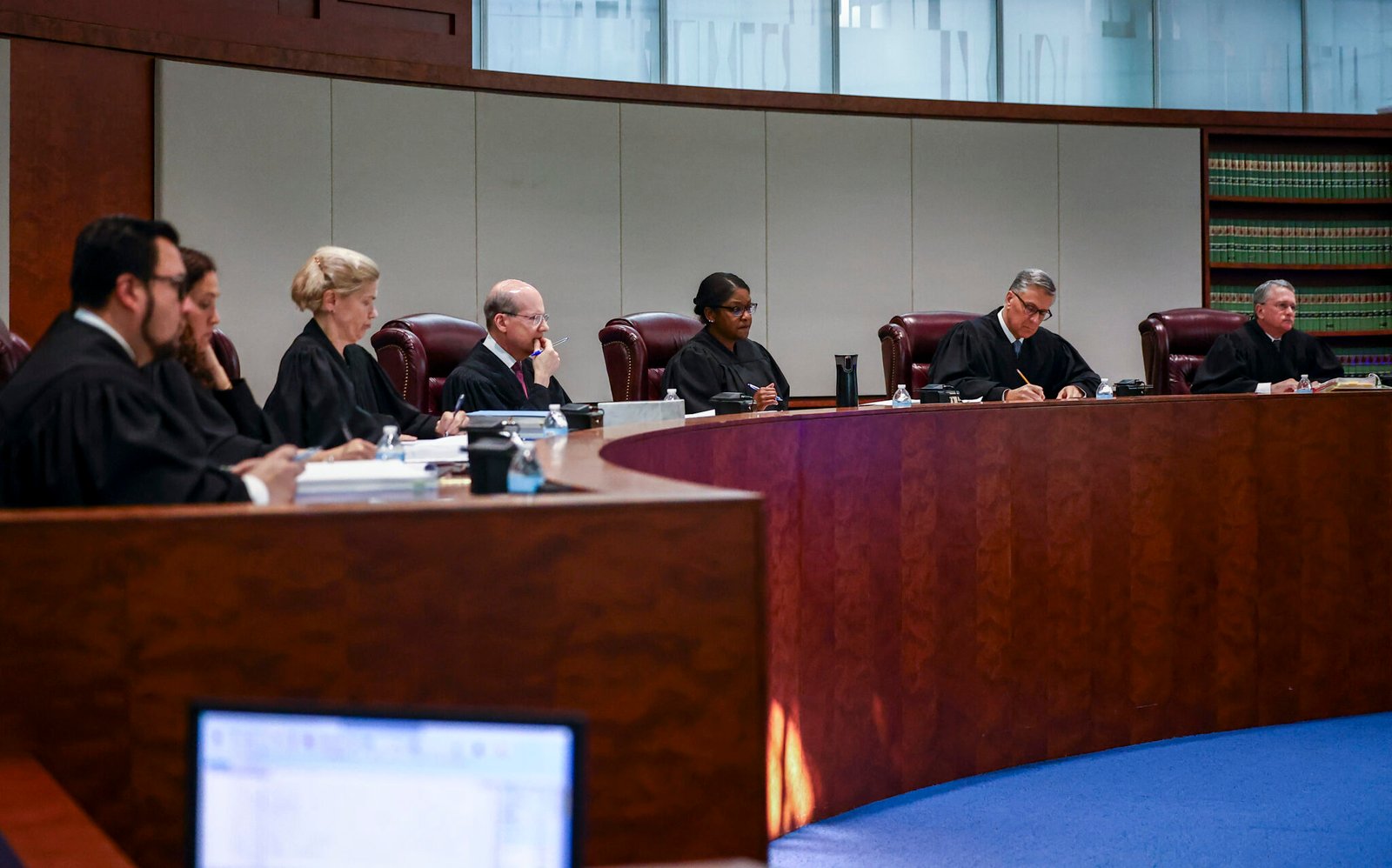
New Jersey’s Supreme Court on Tuesday heard arguments over the mental state required by a law that creates civil and criminal penalties for individuals who disclose the personal information of judges, law enforcement officials, and some other public officials.
The case before New Jersey’s high court asks whether the statute, known as Daniel’s Law, carries strict liability — that is, liability that does not weigh a person’s intent — for individuals who keep protected information up after receiving a request to take it down.
Critics of the law who are challenging it argue that it does, a point key to claims in a related federal case that could invalidate the law’s enforcement mechanism. The law’s defenders argue it uses a looser standard that does consider a person’s ill intent or guilty mind, known legally by the Latin phrase mens rea.
Judge disqualifies leadership at US Attorney’s Office in NJ
“A legislative fix is needed. The answer here is clear: The statute requires no mens rea,” said Michael Berry, an attorney for Thomson Reuters who argued on behalf of data firms sued over compliance with the law.
Daniel’s Law was enacted in 2020, months after a gunman shot and killed the son of a federal judge in her New Jersey home. It was intended to allow judges and law enforcement officials to shield their home addresses and other personal information from public view.
The case before the court centers around a dispute between Atlas Data Privacy, a firm that enforces Daniel’s Law on behalf of the people it covers, and a bevy of data brokers Atlas sued in 2024 for failing to respond to tens of thousands of requests to remove personal information.
Though initial versions of Daniel’s Law contained language that required data brokers and others disclosing protected information to weigh whether a reasonable person believed the disclosure could cause harm to a protected person, that language was eliminated by amendments in 2023.
Current law does not enumerate any standards for most violators, saying only that those who violate its provisions “shall be liable” and may face civil action in state Superior Court, which “shall award” actual damages of $1,000 per violation, plus attorney’s fees and other costs.
The law does require willful or reckless disregard in order to award punitive damages, and amendments made in 2024 gave government records custodians some protections from consequences for disclosures that violate Daniel’s Law.
The lack of other standards in the bill, plus its own language, made clear legislators intended Daniel’s Law to carry strict liability, including in situations where it was impossible to comply with takedown requests, Berry argued.
“They took the reasonable person standard out. The Legislature put a reasonable effort standard in for government custodians. For civil liability, there is nothing,” Berry said.
Historically, courts have struck down laws that impose strict liability on speech as unconstitutional over the chilling effects they have on activities protected by the First Amendment.
The state Supreme Court is hearing the case due to a request from the U.S. 3rd Circuit Court of Appeals, which is weighing a case on the constitutionality of Daniel’s Law.
Lawyers for Atlas and the Office of the Attorney General argued that the text of the law, rather than requiring strict liability for violators, merely requires proof that people who violate it acted with negligence.
Under Daniel’s Law’s current construction, covered individuals or their agents send letters to individuals or companies that have disclosed protected information. Liability attaches if the information remains available 10 days after the notice is received.
Noncompliance with that notice requirement makes one negligent, and that means negligence is still the standard under the law, argued Eric Palmer, an attorney for Atlas.
“I think the Legislature did not explicitly use the words negligence or negligent disregard of the law — that makes sense in context because it’s presupposed, generally, when you have a tort statute, you’re not creating strict liability except in contexts like abnormally dangerous activities, certain things involving wild animals or animals that cannot be controlled in various ways,” Palmer said.
Palmer and New Jersey Deputy Solicitor General Michael Zuckerman pointed to the negligence standard in prior versions of Daniel’s Law, which required people who disclose data to weigh whether a reasonable person would believe the disclosure creates a risk of harm. Legislators would not have removed that and intended for the law to carry strict liability, the attorneys said.
Daniel’s Law is severable, which means a decision that strikes down part of the law will leave other parts intact and operative.
GET THE MORNING HEADLINES.



