
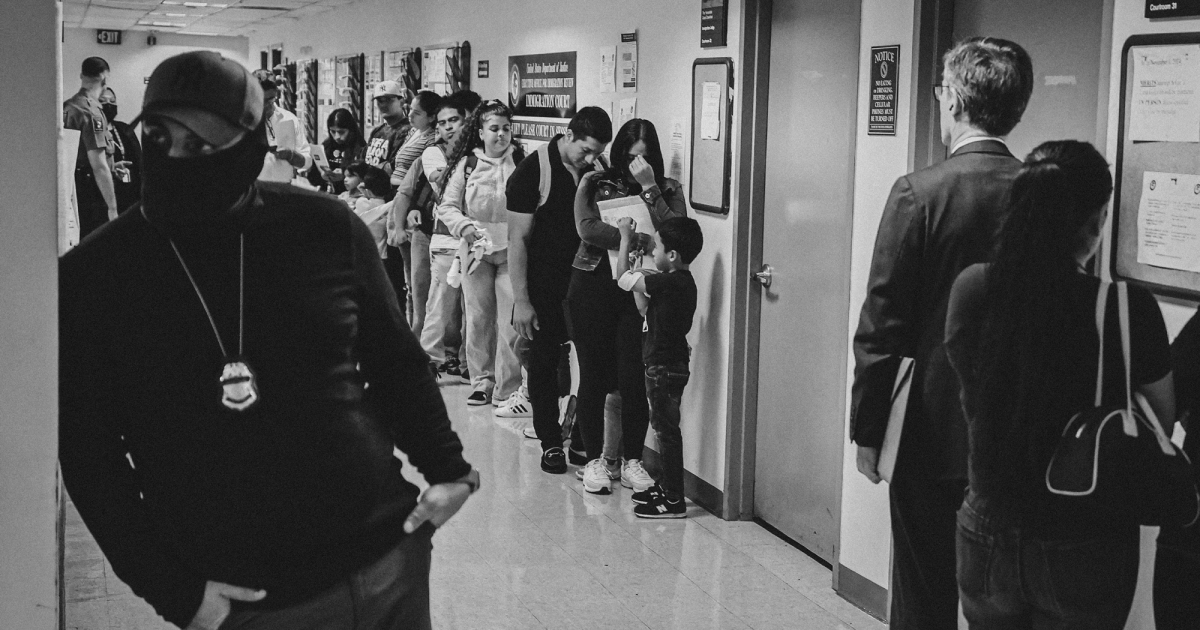
People line up before their hearings at the New York Federal Plaza Immigration Court inside the Jacob K. Javitz Federal Building in New York in October.Charly Triballeau/AFP/Getty
In November, a 22-year-old woman disembarked from her deportation flight in Honduras, five months pregnant and distraught. Immigration officers in the United States had flown her out of the country without asking her an important question: Did she have any kids? Her 2-year-old daughter was left behind.
“They didn’t ask me anything,” she said in Spanish, according to a new report from the Women’s Refugee Commission and Physicians for Human Rights.
The two nonprofits recently visited Honduras to speak with newly deported parents there. Over five days in November, researchers interviewed 29 people, as well as staffers from a Honduran reception center who had interacted with hundreds of other deportees.
Researchers in Honduras interviewing mothers ICE had deported “witnessed many women arriving in acute emotional distress.”
The vast majority of parents said ICE had not asked them if they had kids, contrary to the agency’s own rules. “We’ve been tracking significant levels of family separation, in violation of the policies that the US government has to protect family unity,” says WRC’s Zain Lakhani.
ICE has long had guidelines for detained immigrant parents. Under the Biden administration, the rules required officers to record whether detainees had minor children at home, and to ensure the kids had someone to care for them. This is still true under the Trump administration, even though ICE weakened the guidelines significantly last July.
While the majority of interviewed parents told WRC and Physicians for Human Rights that ICE had never asked if they had children, some tried to volunteer that information to the agency—but it didn’t make much difference. According to the report, a mother of four whose husband had previously been deported told officers that her children would be alone if she was detained. They took her anyway, and the kids had to fend for themselves until their grandmother, who lived in another state, could travel to meet them.
A father, meanwhile, said he begged officers to let him notify the babysitter that he was being arrested; they declined to give him the opportunity, though thankfully the sitter stayed with his daughter for 11 days anyway.
When the Trump administration revised the guidelines for detained parents in July, it made a crucial change: Previously, deported parents could decide whether they wanted their children to join them abroad, and ICE was supposed to facilitate that choice. Now, ICE will only facilitate it if doing so is “operationally feasible.”
The result is more separations. Four of the women interviewed in Honduras had recently given birth, and all were separated from their infants. Researchers “witnessed many women arriving in acute emotional distress, including uncontrollable crying and visible panic,” according to the report. “Many had had no contact with their children or their caregivers for days or weeks.”



