
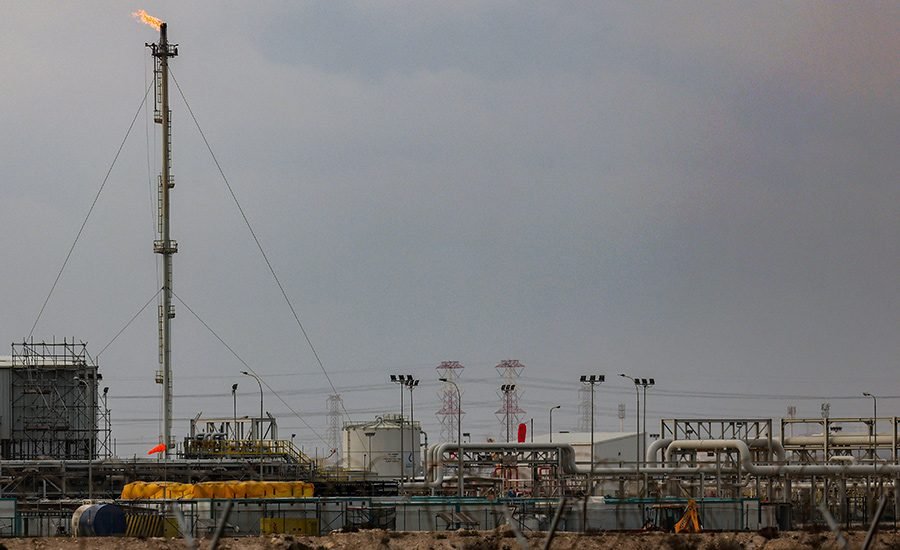
Missile strikes on Qatar’s Ras Laffan industrial complex have taken roughly 17% of the country’s LNG capacity offline and could take three to five years to repair, according to QatarEnergy Chief Executive Saad al-Kaabi, raising immediate concerns about global gas supply and project timelines.
The March 19 attack is the most severe in a series targeting the country’s LNG infrastructure this month, disrupting a facility that analysts and industry reporting, including the Financial Times, say normally supplies roughly one-fifth of global LNG.
The strikes are testing a core assumption underpinning modern LNG infrastructure—that scale and efficiency can be maintained without sacrificing resilience. The concentration of global LNG supply at Ras Laffan is not just geographic—it is engineered.
Columbia University energy analyst Anne-Sophie Corbeau has described a direct strike on the complex as her “Armageddon scenario” for global gas markets.
The war’s disruption is already affecting that supposition. Reuters reported that no work is currently taking place on Qatar’s North Field expansion and project timelines could now be delayed by more than a year.
RELATED
Hormuz Bypass Infrastructure Was Sized for a Short Disruption. This Is Not That.
A System Without a Bypass
In LNG, the liquefaction train is the system. Natural gas moves from offshore wells through processing and into trains where it is cooled to roughly -162°C for storage and export. QatarEnergy LNG says the system includes 14 onshore LNG trains, including six mega-trains, each with capacity of about 7.8 million tonnes per year.
Looking for quick answers on construction and engineering topics?
Try Ask ENR, our new smart AI search tool.
Ask ENR →
Offshore, approximately 208 wells supply about 18.5 billion cu ft per day of gas to those trains, according to the company, feeding a centralized liquefaction complex rather than a distributed network.
Restarting LNG infrastructure is a staged process that can take weeks even without damage, making unplanned outages significantly more disruptive, according to Wood Mackenzie and The Economist.
Diagram illustrates the optimized cascade liquefaction process used in LNG trains, where natural gas is progressively cooled through propane, ethylene and methane refrigeration cycles before storage and export.
Graphic courtesy of RBN Energy
Since these systems function as tightly integrated infrastructure, damage to one component can cause a delay in restarting the entire train, limiting the ability to restore partial capacity.
Unlike scheduled maintenance outages, which are organized for controlled shutdown and restart, damage to critical liquefaction equipment can significantly extend timelines and complicate system-wide recovery.
That engineering reality carries through to the system’s design and construction.
The core of Ras Laffan’s liquefaction capacity was delivered through international engineering, procurement and construction joint ventures led by firms including Technip and Chiyoda, which built multiple 7.8-million-tonne-per-year LNG mega-trains under multibillion-dollar contracts.
Technip said its joint venture with Chiyoda executed EPC work for RasGas expansion Trains 6 and 7, while Consolidated Contractors Co. has documented its role in earlier Qatargas Train 4 and 5 developments.
Those trains share upstream infrastructure, including offshore platforms and roughly 100-km export pipelines feeding onshore facilities, reinforcing both scale and interdependence across the system.
RELATED
Qatar Awards $4B Gas Development Contract to Saipem, China Offshore Oil Engineering
Megaproject Scale, Single-Node Exposure
Ras Laffan operates as a centralized liquefaction complex where production, processing, storage and export functions are co-located. QatarEnergy LNG says terminal operations coordinate shared storage and marine loading infrastructure across multiple operators and products.
Prior ENR reporting noted that QatarEnergy is expanding the North Field—the world’s largest non-associated gas reservoir—to raise LNG capacity from 77 million tonnes per year to 142 million tonnes annually by 2030.
That expansion is already under construction. The company has awarded major EPC contracts to international consortia, including a joint venture of Technip Energies, Consolidated Contractors Co. and Gulf Asia Contractor for North Field West onshore facilities, as well as a more than $4-billion offshore contract to Saipem and China Offshore Oil Engineering Co. for large compression complexes.
ING commodities strategists Warren Patterson and Ewa Manthey said even limited damage at Ras Laffan would force markets to price in a higher risk premium, citing the region’s concentration of energy infrastructure.
RELATED
UPDATED: Mideast Construction Projects Halted as Owners, Industry Firms Steel for Impacts of War
Expansion at Risk as Global Supply Tightens
The disruption is reverberating beyond Qatar’s borders because LNG supply cannot be quickly replaced or rerouted at scale. Unlike oil markets, where alternative supply can sometimes be redirected, LNG depends on fixed liquefaction capacity and dedicated export infrastructure.
Wood Mackenzie said initial expectations of a short disruption now appear “increasingly unlikely,” warning that prolonged outages would tighten global LNG supply further.
Even if other exporters in the U.S., Africa or Australia increase output, replacement volumes cannot be brought online quickly enough to offset a prolonged outage. Higher prices may incentivize additional supply over time, but not at the speed required to stabilize markets in the near term.
For contractors, owners and policymakers, the disruption underscores a central tension in modern LNG infrastructure: systems engineered for maximum efficiency and scale are inherently difficult to replicate, repair or replace when they fail.
Source: www.enr.com



