
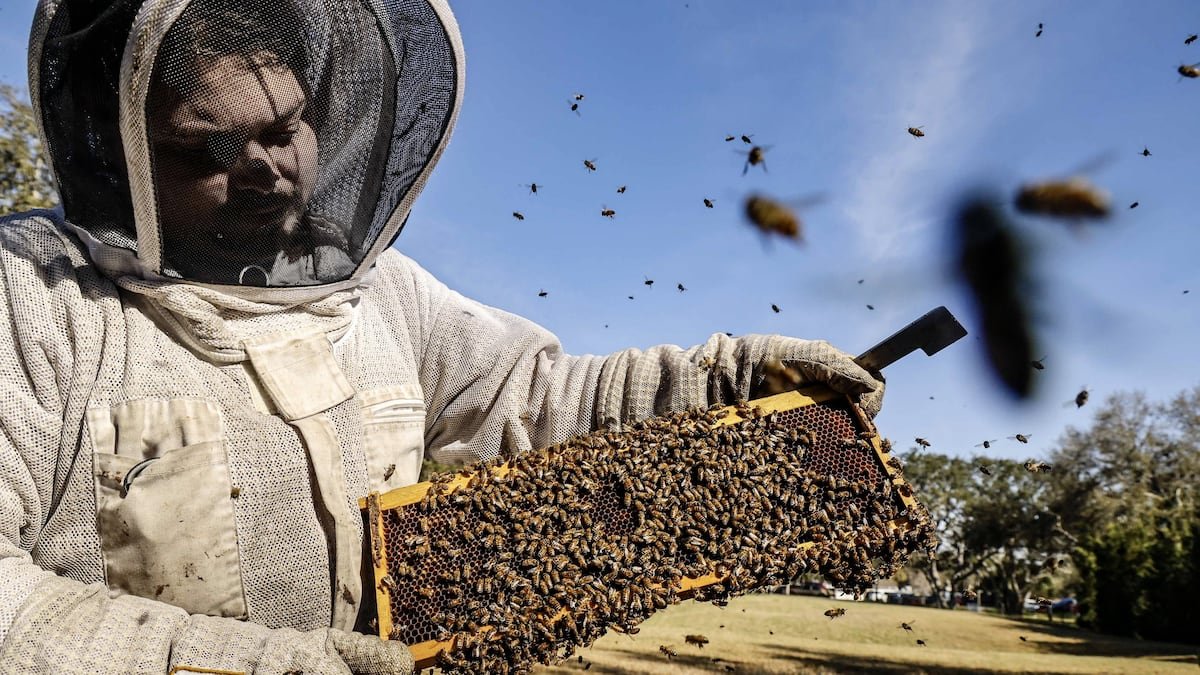
Smoke pours over the colony of bees, dousing the air in a sweet, earthy smell of burning wood.
Drake Elting holds the smoker while Stephanie Ramthun pulls out a wooden slat covered in buzzing honeybees.
The pair, dressed in thick white suits, look like astronauts exploring another planet.
In a way, they are.
They’re examining the health of Ramthun’s honeybees. Inside the hive is an entire world of worker bees, babies and, of course, the queen.
Ramthun is among the more than 5,500 registered beekeepers in Florida. The state is a bee paradise — so much so that out-of-state beekeepers and their pollinators often winter here.
Honeybees, while a major boost to the state’s agriculture, are not native to Florida. The state is home to more than 300 local bee species that vary in size, looks and food preferences.
And they largely have one thing in common: They pollinate, boosting our environment and propping up Florida’s agriculture industry.
But in recent years, Florida has become less friendly to managed honeybees and native bees. The insects face a laundry list of threats: overdevelopment, damaging weather and pests, to name a few.
Beyond the grief of losing these tiny, bumbling insects, there’s the painful hit to the state’s wallet. Fewer bees, managed or native, means less juicy fruit and vegetables, and less money for Florida’s already struggling farming industry.
“We rely on these organisms for our economy, for our jobs, for nature-based tourism, for the productivity of our natural systems,” said Jaret Daniels, an entomologist and curator at the Florida Museum of Natural History.
“These are essential for why people live in Florida, come to Florida.”
Bees, according to Daniels, are Florida’s lifeblood. And they’re in trouble.
Florida’s buzzing with bees
When you picture a bee, you’ll probably imagine something fluffy, plump, striped black and yellow. Cartoonish, even.
“Traditionally, most people think of the honeybee when they think of any bee,” Daniels said.
Honeybees were imported from Europe in the 17th century, according to the U.S. Geological Survey.
And while these bees are important for honeymaking and the agricultural world, they aren’t the only pollinators around.
Of Florida’s roughly 320 native bee species, about 30 are found only here. They can be iridescent green or blue. They can have antennae that curl over their heads like horns. Or they can dig deep underground, creating cozy nests.
Among other species, like butterflies, moths and wasps, bees are considered the most efficient pollinators. When collecting food, they distribute pollen (typically stuck to their bodies) to other plants.

Florida bees are easily mistaken for wasps or other insects, but the evidence of them is everywhere. Their hard work is behind a blooming backyard garden or in the tiny chunks taken from leaves (hi, leafcutter bees).
Roughly 90% of all flowering plants use insects for pollination. Without pollinators, food chains would crumble.
The reality is sobering when you take into account that a fifth of pollinators in North America are at risk of extinction, according to a 2025 study that examined nearly 1,600 species.
And bees face the largest threat, with over 30% of the species at high risk of extinction.
The study, of which Daniels was a part, identified development as their largest threat in Florida.
“A lot of the natural land in Florida is disappearing due to development, due to agricultural conversion,” Daniels said.
Some native bees are specialist bees, meaning they are dependent on certain plants, said Rachel Mallinger, an associate professor of pollinator ecology and conservation at the University of Florida.
Mallinger cited the silver-leaved aster, a dainty wildflower, visited by a few specialist bees. Or the Ashe’s calamint, a threatened species that serves as a host plant for a rare blue bee found only in Lake Wales Ridge.
These aren’t typical backyard plants. Instead, they tend to grow only in native Florida ecosystems, Mallinger said.
“These bees, they’re very susceptible, vulnerable, to land use change, because they can’t just feed on a different plant,” Mallinger said.
An industry built on bees
There may not have been tons of bees on Colby Sadler’s Ruskin property in late February, but their influence was everywhere.
A trailer sitting outside his warehouse has a specialty license plate declaring “save the bees.” It’s a new Florida plate, pushed by the Florida State Beekeepers Association, where Sadler serves as president.
“It’s pretty cool,” he says. The pride is clear in his voice.
There’s also a boat on his property. It’s named “Honeybelle” for his daughter, and honey, of course.
Inside the warehouse is everything he needs to keep his honeybees going — from giant metal equipment used to make sugary syrup for honeybee food, to a machine used to extract honey.
It’s a lot of “redneck engineering,” he said. He and his employee, Dougray Hilt, built much of the equipment and maintain it themselves.
Sadler is the owner of Sadler Honey Farm. He’s a third-generation honey beekeeper. His earliest memory, from when he was around 3, is of being in a beeyard.
“It’s a part of me,” Sadler said. “It’s my whole entire life.”
In the past decade, his business has changed.
Originally, around 90% of Sadler’s income came from honey production. But development, hurricanes and a crippled citrus industry have made maintaining that side of the business more difficult.
“It’s been a lot harder to make honey,” Sadler said.
He started offering pollination services to supplement his business. A farmer pays Sadler for the use of his bees, placing them near crops. Then the bees do what native species would typically do for free: move from crop to crop, pollinating plants and helping them grow into the food we see at grocery stores.
In February, Sadler was on a blueberry farm in Brooksville, where his bees were hard at work.
Blueberries depend heavily on pollination. The crop may grow a few berries on its own, but it does far better with help from insects.
Other crops, like watermelons and pumpkins, depend entirely on pollinators to grow.
If you bite into a blueberry and see tiny seeds, those are all examples of pollination. The more times bees visit the flowers, the more seeds they produce and the larger the berry grows, making it more attractive and valuable.
Insect pollination is necessary or beneficial for about 43% of Florida-grown crops, according to a study by University of Florida researchers. They estimate pollinators contribute at least $50 million per year to seven of Florida’s most valuable crops.
Mallinger, an author on the study, said that value is likely an underestimate.
“This is what we would lose for our major crops,” Mallinger said. “It’s not even including what we would lose for our minor crops, and it’s also not including any effects on both the flavor and nutritional value of the crop.”
Of the state’s top 10 animal pollinator-dependent crops, four (blueberries, watermelons, cucumber and squash) are consistently stocked with managed bees, the 2021 study said. Native species, along with other pollinators like flies or butterflies, largely pollinate the others.
Florida bees face an uphill battle
Florida is the place to be if you are, well, a bee.
The mild climate means something is almost always in bloom.
Beekeepers typically truck their bees down to Southern states, largely Florida or Texas, so the insects can survive away from harsh winter conditions, said Amy Vu, a state specialized extension agent in apiculture at UF.
Florida beekeepers will also migrate around the United States, Vu said. In the summer, it’s common to take bees to North or South Dakota. Sadler, who largely stays within Florida, had bees in California in February to pollinate almond crops.
“It’s easier for beekeepers, and it’s more cost-effective to take their bees around to different blooms,” she said.
But Florida isn’t quite the bee paradise it once was.
Beyond development challenges, Florida’s weather has become more finicky as climate change has caused extra bouts of extreme weather.
The livelihoods of beekeepers and farmers depend on how the weather cooperates, Vu said.
Just this year, several hard freezes and an ongoing drought have led to brown, crispy plants across the state.
“We really thought we got lucky not having a hurricane this past year, but then, of course, the freeze came in,” Vu said.
Hurricane Ian, which became a supercharged storm in 2022 before blasting into west-central Florida, was one of the worst hurricanes Vu had seen on the state’s bee industry.
“We got frickin’ wrecked,” Sadler said.
He estimates he lost about a half-million dollars overnight. In the past five years, storm surge and flooding have put his losses over $1 million, he said.
Bees in need
In late February, Ramthun drove to the St. Petersburg retirement community where she keeps two of her honeybee hives.
She pulled open the flatbed of her truck, where she had stowed piles of wooden slats and boxes.
She spends much of her week crisscrossing Tampa Bay, checking on hives — from rural fields to backyards — making sure they’re healthy, well-fed and pest-free.
“The bees are spread out more, so that’s more opportunity for flowers,” Ramthun said. “We found it’s like cows in a pasture; if you have too many, they’re going to be hungry.”
Ramthun and Elting, an assistant beekeeper, removed frames from a hive at the retirement home, as if rifling through a filing cabinet. All around, bees sang an angry tune of buzzing, upset that their home was being disturbed.
As the owner of Tampa Bees, Ramthun sells honey and offers “bee experiences.”
Years ago, she used to rent her bees to farmers for pollination services. She stopped because she was worried about their health. Farms typically lack wildflowers and natural vegetation, and farmers also use too many pesticides, she said.
When performing pollinating services, she often had to supplement her bees’ diet with sugar water. But it’s not a replacement for the nutrition they need, she said.
Now her bees are placed strategically across Tampa Bay. At the St. Petersburg retirement community, the hive is situated next to a parade of greenery.
It’s one solution to the challenges facing native and nonnative bees: More green spaces, and protecting those already there. But that’s complex in a state with a deluge of new residents.
Sadler has struggled to find open areas that check all the boxes for a healthy habitat for bees. He pores over hunting maps, and when he finds a spot that could work, he’ll knock on residents’ doors, asking to put bees on their property.
He offers them lots of honey. It typically works.
For specialist bees, Mallinger said habitat protection is vital. Most already live in wildlife refuges or in state and national forests, so the key is to protect them.
The areas don’t have to be free of humans, Mallinger said; the bees can coexist with campgrounds and recreation as long as they have plants and areas for nesting.
Daniels suggested adding native plants to personal gardens, enticing native pollinators to stop by. Farmers can add more diverse vegetation. And greenery can be added even in the slimmest of areas, like the sides of roads.
It’s in everyone’s best interest, Daniels said, to care about the little pollinators.
• • •
The Tampa Bay Times launched the Environment Hub in 2025 to focus on some of Florida‘s most urgent and enduring challenges. You can contribute through our journalism fund by clicking here.



