
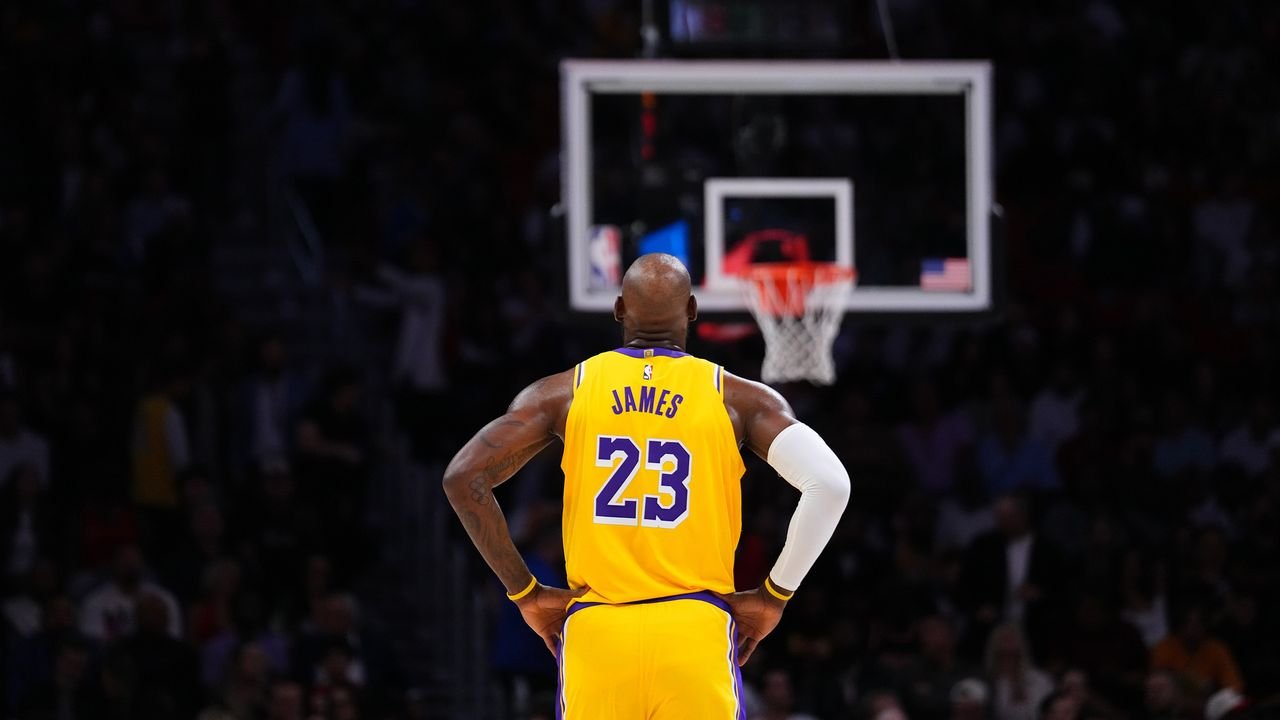
This past Wednesday, against the Houston Rockets, James played in his one-thousand-six-hundred-and-tenth N.B.A. game. When he played his first, in 2003, not all of his Laker teammates had been born. (One of them, after all, is James’s son.) The previous evening, I spoke to Sean Bryan, a primary sports-medicine doctor at the Hospital for Special Surgery, about what happens to the body as it grows older: osteoarthritis, slowing reflexes, decreased flexibility, inflammation. Much of it, Bryan said, is chronic and impossible to reverse.
There was, I thought, something oddly reassuring about the idea that James was not immune to the physical effects of aging. It put me in mind of our common mortality, etc. Then, the next night, I turned on the Rockets-Lakers. James scored the game’s first points, a three, and proceeded to put on a show: thirty points on thirteen of fourteen shooting. Six of his shots were dunks. One of them, in the second quarter, was so acrobatic that even a young James might not have pulled it off. James’s teammate Marcus Smart flung an errant lob, and James, who’d lost his defender with a vicious backdoor cut, leaped to the level of the backboard, leaned back to catch the ball as it sailed out, and then, still soaring, reversed his arm’s momentum to finish the slam. My awe had barely subsided when, two minutes later, James got the ball, raced just past the free-throw line, and took flight. The closest Rockets defender, Reed Sheppard, could do nothing as James hammered another dunk. Being old myself, I went to bed before the game was over, while the Lakers went on to beat the Rockets, for their seventh straight win.
The Lakers left Houston that night and landed in Miami, checking into the team hotel around 5 A.M. James was listed as questionable for that night’s game, with left foot arthritis. (“Every back-to-back for the rest of the season is T.B.D.,” he’d said in January. “I’m forty-one.”) But, after receiving treatment on the foot, he decided that he was ready to play in his one thousand-six hundred-and-eleventh N.B.A. game, tying the record for the most ever, held by Robert Parish. James scored nineteen points, on eight of twelve shooting, and had fifteen rebounds and ten assists. The Lakers won again.
James wasn’t the star of the night: that was Luka Dončić, who scored sixty. But what James has begun doing is just as impressive, and not only because he is doing it on arthritic joints. When Dončić arrived in Los Angeles, via a shocking trade with the Dallas Mavericks last season, James, no matter what he said publicly, struggled, on the court, to cede the team to the younger star. This was understandable: he had always been better than everyone else he played with. He had tremendous physical and mental gifts, but he was also a master at exercising control. With the Dončić trade, the Lakers had communicated to him, without warning, that his time in charge was over.
He didn’t entirely hide his displeasure. “We understand the difficulty in winning now while preparing for the future,” Rich Paul, James’s agent, said in a statement last summer, when the N.B.A. star opted into a one-year contract. “We do want to evaluate what’s best for LeBron at this stage in his life and career.” But just a couple of weeks ago, when James returned from another stretch on the sidelines, and played against the Chicago Bulls, he did something unexpected: he spent the first quarter setting screens and moving without the ball, and he didn’t take a single shot. Then, in the third, he helped the Lakers take over the game. “It is a sacrifice,” he acknowledged, of adapting his style to orbit other stars. But he was focussed on what benefitted the team. “The team is most important,” he said. “Everybody’s successful when we win.” He’s still getting big individual numbers sometimes—though not in the way he used to, by bending the game to his will. Now he’s scoring in transition and waiting for the ball to reach him in an advantageous situation, after he’s made a hard cut or found himself in a prime spot on the floor. It helps that he can still see the advantage quicker than anyone else on the court.



