
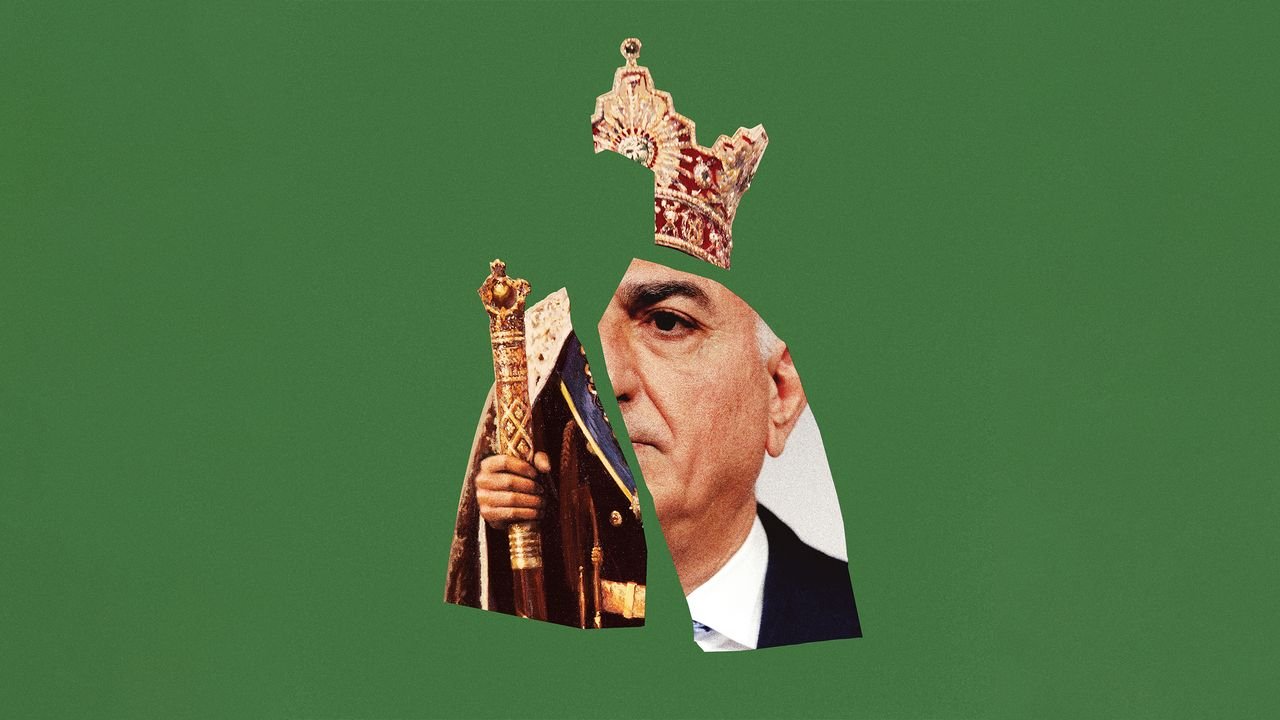
Reza was eighteen when the Islamic Revolution overthrew his family’s reign, in 1979. At the time, he was at fighter-pilot training in Lubbock, Texas, part of his preparations for becoming a modern king. The Pahlavis, in exile, were vilified, but the family still appeared duty-bound to project the image of Reza as the dynastic heir of Iranian monarchy. The Empress, based between Greenwich, Connecticut, and Paris, remained socially enmeshed in Europe’s royal circles, but Reza stayed in the United States, completing a degree at the University of Southern California, and then living a suburban existence in Potomac, Maryland. On a podcast in 2023, he admitted that, despite having always insisted that he was fighting to unseat the regime, he never envisioned returning to Iran permanently. “My children live here,” he said. “My friends live here. Everybody that I know is here. If I was to go back, what do I go back to?”
In the early eighties, when Pahlavi was in his twenties, Ardeshir Zahedi, the Shah’s last Ambassador to the U.S., brokered meetings between Pahlavi and American officials. “The Americans at the time were quite hopeful they could get some results with Reza, but they soon lost confidence in him,” Tino Zahedi, one of Ardeshir’s cousins, told me. “They didn’t believe he could reign.” In the following years, reports emerged of Pahlavi accepting funds and support from the C.I.A. and from various Arab monarchies to run his small-scale political operations. (Pahlavi has always denied this.) Ardeshir Zahedi eventually parted with him, saying in later years that accepting financial backing from foreigners and essentially asking them to drop bombs on their own country was un-Iranian.
For years, Pahlavi kept up appearances, insisting that he was the rightful Crown Prince of Iran, refusing to acknowledge the abolition of the Pahlavi monarchy, and releasing messages to the nation at the Persian New Year. But he was not a decisive political figure. To those who knew his father, he cut a strange figure, neither common nor majestic but a suburban man of Maryland who shopped at the mall and attended a weekly poker game in Bethesda. He seemed resigned to exile and uncertain about the prospect of changing Iranians’ minds from afar. “He’s a good person, but he’s indolent, and he knows it himself,” an Iranian insider in Washington who knew Pahlavi in the eighties said.
In 2001, I interviewed Pahlavi for Time, and found him impressive. I was based in Tehran at the time, as an American-born foreign correspondent, and most of the Islamic Republic officials I met were slovenly, undereducated, and lecherous. Some were downright sinister; others piously refused to look women in the eye. Next to them, Pahlavi seemed dignified, well informed, and worldly. My abiding memories of the encounter were just how normal and decent he seemed, qualities that seemed precious inside Iran, where nothing was remotely decent or normal.
The country, meanwhile, was experiencing a series of convulsions. Various reform and feminist movements were pushing the regime to soften its militant foreign policy, its oppressive dress codes, and its censorship of civil society. In 2009, when an election was stolen from a reformist candidate and handed to a hard-liner, millions of people marched peacefully in the streets. In response, the regime killed dozens, and arrested and tortured many more. A young generation born after the Revolution learned that modest, internal change would never come.
The following year, a London-based television network called Manoto began broadcasting directly to Iran in Persian. The network had secured access to the vast pre-revolutionary archive of Iranian state radio and television, allowing it to produce a sophisticated stream of content—documentaries, bio-pics, concerts—that elided the authoritarian grip of the Shah’s rule and highlighted the wealth and promise of pre-revolutionary Iran. It quickly became one of the most watched channels in the country. Seven years later, Iran International, a well-funded, pro-Pahlavi news network, emerged in London. Today, it covers Pahlavi’s every move with near-reverence. “Big money went into weaponizing the Iranian population through these networks,” Nasr said. “And Reza Pahlavi was the beneficiary. They created mass nostalgia for that era and positioned him as the person who could take Iranians back there.”
One of the great challenges of the Islamic Republic was how to reconcile its Islamist project with Iran’s history. For nearly twenty-five centuries, the Persian Empire and the modern nation-state of Iran had been ruled through monarchy. The ancient idea of Iran was that of a distinct people bound together within a distinct empire, protected and led by shahs conferred with farr, a subtle concept that the Yale historian Abbas Amanat has described as “kingly charisma divinely bestowed upon a ruler of the right quality.” The king was “the shadow of God on earth,” but he could also lose his farr, if he failed to defend the kingdom or if he ruled as a tyrant.



