
 State government would slightly reduce its longstanding reliance on one-time revenue sources under Gov. Mikie Sherrill’s $60.7 billion budget, even as overall spending would increase to a record high.
Sherrill’s budget calls for the share of annual spending backed by what are commonly referred to as one-shot revenues to decline to just over 3% of planned annual spending, according to new fiscal estimates obtained by NJ Spotlight News via a public-records request.
State fiscal policy experts generally caution against states’ relying too heavily on nonrecurring revenues to back annual spending because doing so can create structural imbalances that can make a budget unsustainable

In recent years, former Gov. Phil Murphy and lawmakers relied on billions of dollars from one-shot revenue sources to support annual spending that has outpaced annual revenue growth.
That practice has left a sizable structural budget gap, and this year, Sherrill, a first-term Democrat, has made reducing the remaining imbalance a top fiscal-policy goal.
In turn, her proposed budget would trim the share of planned one-shot revenues to less than $2 billion, according to the new fiscal estimates.
In all, Sherrill’s budget for the fiscal year that begins July 1 calls for annual spending growth of about 3% compared with the $58.8 billion budget that Murphy, a fellow Democrat, enacted for the current fiscal year, which ends June 30.
Unlike recurring revenues, which are sourced from taxes including income and sales, nonrecurring revenues are generally produced by one-offs, like asset sales or fund diversions. That budgeting practice can be a negative when Wall Street analysts set credit ratings, which influence the cost of borrowing for major infrastructure projects and other needs.
To help reduce the state’s reliance on one-shots, the budget Sherrill proposed to lawmakers this month calls for spending reductions in several key areas. Among them is the planned allocation for the Stay NJ property tax relief program, which currently benefits senior homeowners earning up to $500,000 annually.
Her spending plan also calls for raising about $750 million in new revenue by tweaking corporate tax deductions and enacting other tax policies on New Jersey businesses and business owners.
However, Sherrill’s budget also calls for spending nearly $2 billion in surplus to support annual appropriations. That’s the largest single source of non-recurring revenue booked in her proposed budget, according to the new fiscal estimates.
The annual spending plan enacted by Murphy and lawmakers for the current fiscal year, which ends June 30, also called for spending down surplus, but at a slightly lower amount.
The same spending plan also diverted more than $550 million from the off-budget debt defeasance and prevention fund, helping to drive the grand total for one-shot revenues above $2.5 billion – roughly 4.4% of planned annual spending.
“One-shots may help balance the books for one year, but always — always — lead to a mad scramble to close an even bigger hole the next.” — Ex-Gov. Phil Murphy
The total dollar amount for non-recurring revenue would drop to $1.98 billion starting July 1, according to the new estimates.
A report published roughly a decade ago by the nonpartisan Volcker Alliance flagged New Jersey’s use of large fund transfers, diversions and asset sales as one-time revenue sources as a key concern.
And during his own tenure, Murphy, a former Goldman Sachs Group Inc. senior partner, had also highlighted the fiscal dilemma that can arise when revenues he referred to as “one-shots” are used to balance annual state spending.
It was during the fiscal year 2021 budget message to lawmakers in Trenton that Murphy said: “One-shots may help balance the books for one year, but always — always — lead to a mad scramble to close an even bigger hole the next.”
However, Murphy also outlined a “conscious decision to increase spending and investments in order to jump-start our economy” coming out of the COVID-19 pandemic.
At the same time, majority Democrats in the Legislature in recent years have followed a practice of adding hundreds of millions of dollars in new spending to the governor’s proposed budget in the final days before its adoption in late June.
These 11th-hour additions – often funding legislative pet projects, among other line items — have generally not been offset with coinciding cuts or increases in revenue, helping to widen the structural gap Sherrill has now identified as a key fiscal concern.
This year, Sherrill has indicated she may not entertain last-minute additions, which critics call pork or Christmas tree items.
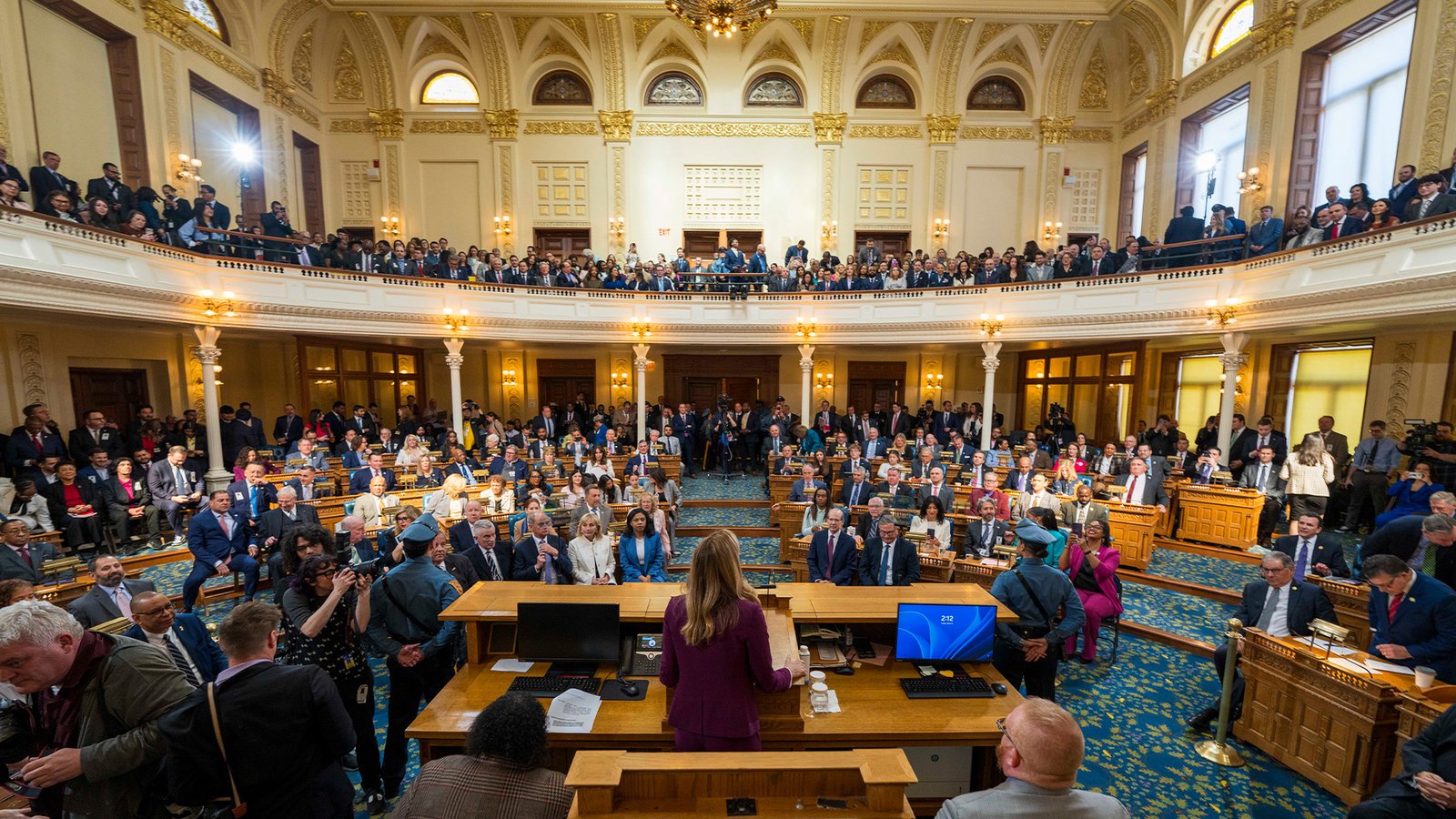
“It’s time to close the deficit the right way, structurally, so we’re not just plugging new holes every year,” Sherrill said during her March 10 budget address.
This story is made possible in part by the Corporation for Public Broadcasting, a private corporation funded by the American people.



