
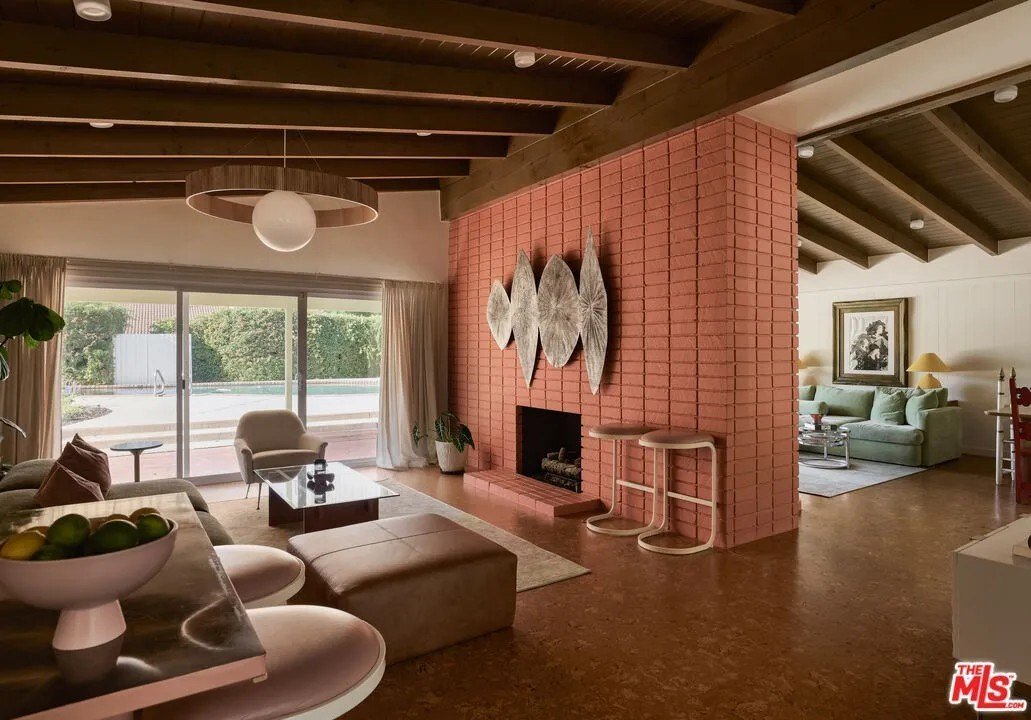
On the western edge of Los Angeles, in a quiet corner of Woodland Hills, sits an elegant midcentury modern home that exemplifies everything its architect, Charles Du Bois, stood for: clean, livable design with seamless indoor-outdoor flow and a storybook charm not always found in homes from that era.
Completed in 1960, the four-bedroom abode has changed hands on just two occasions in its 66-year history, most recently in October 2024, when it was sold for $1.45 million to interior designer Olivia Lundy and her husband.
The couple carried out a meticulous reimagining of the home, which they are now ready to pass on to its next steward. They put the property on the market for $1.69 million—having initially listed it for just a few weeks in October 2025, for $1.79 million.
Set on a generous corner lot, the 2,115-square-foot home captures attention with its iconic architecture, framed by greenery and shaded by mature palm trees. Inside, vaulted ceilings and walls of glass draw the outdoors in, an aesthetic that is the essence of California living.
But the design inspiration can also be credited to another unlikely source, according to listing agent Shelton Wilder with Christie’s AKG. Wilder points out that Du Bois was believed to have based his aesthetics on iconic Disney movies.

“Charles Du Bois is one of the fathers of midcentury modern architecture,” Wilder notes. “Supposedly, he shared a drafting table with Walt Disney during World War II, something that’s often credited for the almost ‘movie set’ feel his homes have.”
That cinematic magic combines with cozy, updated interiors to create a home where slow mornings over coffee or 5 o’clock poolside cocktails are just part of everyday life.
“It embodies that effortless California lifestyle,” co-listing agent Emily Neri adds, pointing to “light-filled interiors that open directly to the expansive backyard and pool and inviting spaces that make entertaining or everyday living feel easy and elevated.”
What makes this particular home especially compelling is that, despite its 66-year history, it has had only two owners, the first of whom lived there for more than 60 years.
“The first buyers were there from 1962 to 2024, which speaks to how special it is,” Wilder explains.
The home’s recent transformation was meticulous and thoughtful, with Lundy’s influence evident in every detail—from richly layered textures to color-drenched rooms that are at once timeless and modern.
“The original architectural elements have really been preserved and thoughtfully enhanced with designer-driven updates,” says Neri.
The home reflects a modernized 1960s aesthetic, with its pink dry bar, bespoke pendant lighting, and stylish bedrooms with modernist color-block artwork on pastel walls.
The property also benefits from its prime Woodland Hills location, with proximity to top San Fernando Valley destinations, as well as easy access to the 101 freeway, Malibu, and the greater Westside.
Still, when it comes to a home like this one, it’s the intangible qualities that resonate deeply with prospective buyers. Over the years, it has served not just as a residence, but also as a gathering place—most notably hosting two family weddings, a detail that underscores its warmth and livability.
“Homes like this don’t come around often,” Wilder says. “Between the iconic architecture and the incredibly intentional design, it feels less like something you buy and more like something you’re lucky enough to own.”
Hailed as an architectural “visionary,” Du Bois was renowned for his residential properties in Los Angeles and Palm Springs.
He is perhaps best known for his work on a collection of “Swiss Miss” homes in the Palm Springs area, all of which feature a bold A-frame roof.
Du Bois came up with the style in the 1950s, when midcentury modern design was all the rage, and the Alexander Construction Company sought a residence that would stand out in the Vista Las Palmas neighborhood.
The Swiss Miss moniker evolved thanks to a real estate agent who was more familiar with the pitched roof of a Swiss chalet rather than Polynesian architecture. Decades later, the Swiss sobriquet has stuck.



